Dubai Telegraph - Webb telescope finds CO2 for first time in exoplanet atmosphere

EUR -
AED 4.183702
AFN 72.898305
ALL 91.759381
AMD 414.060448
ANG 2.039279
AOA 1045.629463
ARS 1736.757043
AUD 1.621037
AWG 2.051107
AZN 1.940872
BAM 1.952824
BBD 2.292198
BDT 140.04215
BGN 1.917489
BHD 0.429014
BIF 3427.812462
BMD 1.139029
BND 1.454042
BOB 13.9473
BRL 5.920908
BSD 1.138011
BTN 108.981251
BWP 15.496252
BYN 3.438497
BYR 22324.977409
BZD 2.288903
CAD 1.612114
CDF 2631.158464
CHF 0.944374
CLF 0.027756
CLP 1095.978602
CNY 7.644426
CNH 7.659074
COP 3778.707452
CRC 517.432031
CUC 1.139029
CUP 27.312384
CVE 110.101588
CZK 24.362759
DJF 202.428764
DKK 7.475821
DOP 67.67955
DZD 152.381212
EGP 58.972913
ERN 17.085442
ETB 184.621985
FJD 2.559684
FKP 0.861964
GBP 0.860121
GEL 2.978608
GGP 0.861964
GHS 13.218381
GIP 0.861964
GMD 83.723052
GNF 10009.144491
GTQ 8.691101
GYD 238.116589
HKD 8.934826
HNL 30.545664
HRK 7.53252
HTG 148.938946
HUF 365.054431
IDR 20459.247154
ILS 3.471831
IMP 0.861964
INR 109.128875
IQD 1490.887235
IRR 1565681.419908
ISK 137.002903
JEP 0.861964
JMD 180.045664
JOD 0.807617
JPY 179.169908
KES 147.538924
KGS 99.606081
KHR 4628.130957
KMF 493.200155
KPW 1025.126876
KRW 1545.325584
KWD 0.351562
KYD 0.948347
KZT 504.104277
LAK 25527.11282
LBP 101913.340862
LKR 375.750767
LRD 195.74947
LSL 18.567842
LTL 3.363258
LVL 0.688988
LYD 7.275914
MAD 10.921091
MDL 20.200044
MGA 5024.542606
MKD 61.481732
MMK 2391.390859
MNT 4099.17619
MOP 9.19431
MRU 45.782643
MUR 54.138501
MVR 17.598436
MWK 1973.371135
MXN 20.182304
MYR 4.640638
MZN 72.795802
NAD 18.567842
NGN 1510.159858
NIO 41.877845
NOK 10.828212
NPR 174.370201
NZD 2.011372
OMR 0.437947
PAB 1.138011
PEN 3.863466
PGK 5.070474
PHP 71.013366
PKR 315.346974
PLN 4.372511
PYG 6708.043963
QAR 4.148343
RON 5.273141
RSD 117.531937
RUB 95.850179
RWF 1681.922487
SAR 4.271141
SBD 9.112819
SCR 15.891458
SDG 685.130407
SEK 11.295727
SGD 1.455241
SHP 0.859969
SLE 28.077499
SLL 23884.869006
SOS 650.434629
SRD 42.904397
STD 23575.610124
STN 24.463691
SVC 9.95822
SYP 14809.661324
SZL 18.563448
THB 38.023125
TJS 10.498618
TMT 3.997993
TND 3.368967
TOP 2.742509
TRY 55.770873
TTD 7.740512
TWD 36.150749
TZS 3012.730686
UAH 50.961264
UGX 4457.384378
USD 1.139029
UYU 45.590933
UZS 13468.596133
VES 970.944534
VND 29587.429244
VUV 134.982293
WST 3.149966
XAF 655.957
XAG 0.017719
XAU 0.000265905031
XCD 3.078285
XCG 2.050822
XDR 0.805353
XOF 655.957
XPF 119.331742
YER 269.551735
ZAR 18.590875
ZMK 10252.636055
ZMW 22.200051
ZWL 366.767021
SSP 6506.810465
MXV 2.287096
  • CMSC

    -0.1000

    20.41

    -0.49%

  • BCC

    1.2600

    77.36

    +1.63%

  • NGG

    0.1550

    75.385

    +0.21%

  • RBGPF

    -1.0100

    65.99

    -1.53%

  • RIO

    0.0800

    94.55

    +0.08%

  • CMSD

    -0.0750

    20.295

    -0.37%

  • BCE

    -0.3900

    20.91

    -1.87%

  • RELX

    -0.0150

    33.495

    -0.04%

  • GSK

    -0.3490

    49.301

    -0.71%

  • RYCEF

    -0.3000

    19.6

    -1.53%

  • AZN

    2.0900

    166.65

    +1.25%

  • JRI

    -0.1500

    11.02

    -1.36%

  • BTI

    -0.4200

    55.6

    -0.76%

  • BP

    -0.1750

    44.235

    -0.4%

  • VOD

    0.1200

    16.61

    +0.72%

Webb telescope finds CO2 for first time in exoplanet atmosphere
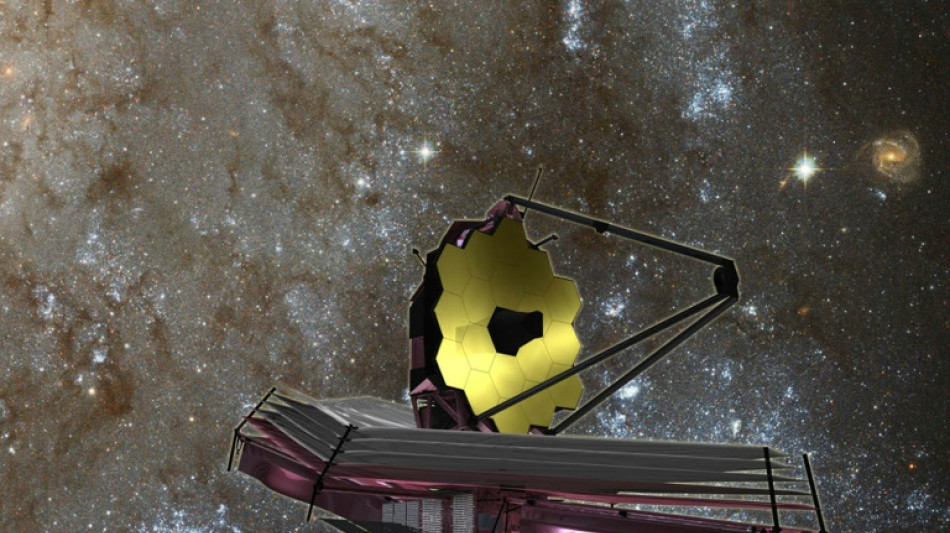
Webb telescope finds CO2 for first time in exoplanet atmosphere / Photo: Handout - NASA/AFP/File

Webb telescope finds CO2 for first time in exoplanet atmosphere

The months-old James Webb Space Telescope has added another major scientific discovery to its growing list: detecting for the first time signs of carbon dioxide in the atmosphere of a planet outside our solar system.

Text size:

Although the exoplanet would never be able to support life as we know it, the successful discovery of CO2 gives researchers hope that similar observations could be carried out on rocky objects more hospitable to life.

"My first thought: wow, we really do have a chance to detect the atmospheres of terrestrial-size planets," tweeted Natalie Batalha, a professor at the University of California at Santa Cruz and one of hundreds who worked on the Webb project.

Their study of exoplanet WASP-39, a hot gas giant closely orbiting a star 700 light years away, will soon be published in the journal Nature.

"For me, it opens a door for future research on super-Earths (planets larger than Earth but smaller than Neptune), or even Earth-sized planets," Pierre-Olivier Lagage, an astrophysicist with France's Atomic Energy Commission (CEA), told AFP.

The detection of CO2 will also help scientists learn more about how WASP-39 formed, NASA said in a press release. The exoplanet, which orbits its star once every four Earth days, has a mass one-quarter that of Jupiter but a diameter 1.3 times bigger.

The frequency of its orbit and large atmosphere made WASP-39 an ideal candidate for an early test of Webb's state-of-the-art infrared sensor, known as NIRSpec.

Each time the exoplanet crosses in front of its star, it blocks out an almost imperceptible amount of light.

But around the edges of the planet, a tiny amount of light passes through the atmosphere.

Webb's highly sensitive NIRSpec can detect the small changes that the atmosphere has on the light, allowing scientists to determine its gas composition.

The Hubble and Spitzer telescopes had already detected water vapor, sodium and potassium in WASP-39's atmosphere, but carbon dioxide can now be added to that list thanks to Webb and its NIRSpec instrument.

"It was a special moment, crossing an important threshold in exoplanet sciences," said Zafar Rustamkulov, a Johns Hopkins University researcher, in the NASA press release.

H.El-Qemzy--DT