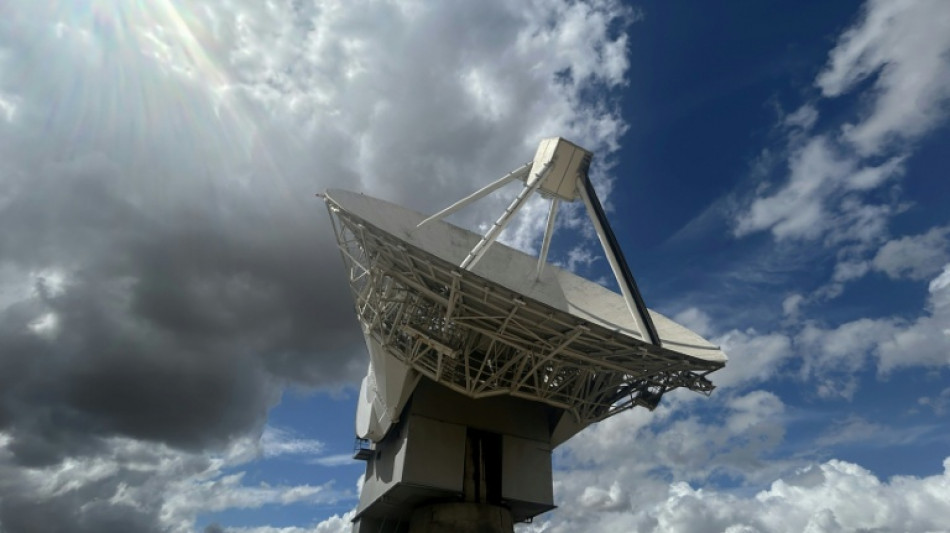
UK observatory nervously watches growing space junk threat / Photo: Daniel MATTHEWS - AFP
In the sweeping shadow of a satellite dish, staff at the Chilbolton Observatory in southern England track a growing number of objects in Earth's orbit, providing data that underpins Britain's space monitoring efforts.
As the hulking antenna swivels into action, screens inside the control room light up with the names of objects the radar system detects: stars, satellites and abandoned rocket bodies.
Experts at Chilbolton Observatory, operated by the UK's national space laboratory RAL Space, monitor UK-licenced satellites and fast-multiplying fragments of space debris swirling around them.
The space junk includes defunct man-made objects like rocket bodies, dead satellites and fragments from launches, explosions and collisions that threaten to re-enter Earth's atmosphere or crash into functioning satellites.
According to the European Space Agency, there are more than 46,000 pieces of debris weighing a total of 17,000 tonnes currently in orbit.
"Most of those don't collide with anything, most of the time," Matthew Archer, deputy director for launch and space domain awareness at the UK Space Agency told AFP on a visit to the observatory.
"But any of them can cause significant damage or even destroy potential satellites."
On Wednesday, part of a SpaceX rocket about the size of a bus slammed into the Moon, unleashing a stream of debris. Researchers warn the growing density of space junk could trigger the so-called "Kessler syndrome" cascade of collisions.
- 'Look at everything' -
Chilbolton Observatory feeds data to the National Space Operations Centre (NSpOC) -- led by the UK Space Agency and UK Space Command -- that works around the clock to prevent orbital collisions and track debris re-entering Earth's atmosphere.
"Our role is to look at everything that happens and is in space," said Archer.
Space infrastructure underpins some 20 percent of the UK economy, said Archer. The growing "number of objects is making space far more congested, so the need for this capability is growing all the time."
As he speaks, multiple Starlink devices -- part of the constellation of thousands of internet satellites launched by US tycoon Elon Musk's SpaceX -- float by on the control room screens.
There are currently 14,000 satellites orbiting Earth, with some 1.7 million satellites planned in coming years. SpaceX alone has unveiled plans to begin launching more than one million satellites in 2028.
The UK has pledged to invest £85 million ($114 million) in the NSpOC, which issues around 3,000 monthly collision warnings to satellite operators.
The researchers also monitor to ensure satellite operators are complying with their licences and track foreign "adversaries".
"We see examples of countries that have demonstrated the ability to get close or to fly by certain objects," said Archer. "We do have to track ... threats regularly from a military perspective."
And when space debris re-enters the atmosphere, scientists are on stand-by to issue alerts for objects which may not burn up before landfall.
In January, Britain and European countries closely watched the re-entry of a Chinese rocket, amid fears fragments could land in Britain. The rocket eventually splashed down in the Pacific Ocean.
- Asteroids -
"The whole environment is changing," said Chilbolton Observatory's facility leader Sarah Nash. "It really is a multinational environment and there are so many objects that are not controllable."
"The only way that all of this can continue to operate safely is by keeping track of where everything is," Nash told AFP.
Another branch of their work is planetary defence, which involves identifying threats like comets and asteroids.
Last year, the UK Space Agency became a member of the International Asteroid Warning Network (IAWN), which monitors the movement of asteroids including those that could hit Earth.
"We work in partnership with NASA and others in the US to effectively give a percentage chance that (it) might hit the Earth and when that might happen," said Archer.
While smaller space rocks frequently burn up in Earth's atmosphere, large orbiting rocks like asteroids are rarer.
The UK to support the European Space Agency's 2029 mission to study a 375-metre (1,230 feet) wide asteroid called Apophis as it flies by Earth.
"Asteroids are a really interesting challenge in many ways. It's unusual for an asteroid to come out of nowhere," explained Nash.
The giant space rocks are generally monitored by optical sensors, as they are too far away for Chilbolton's radar dish to detect.
"If they're close enough for the (radar) antenna to see them, then we have bigger problems," laughed station manager Graham Marshall.
D.Farook--DT