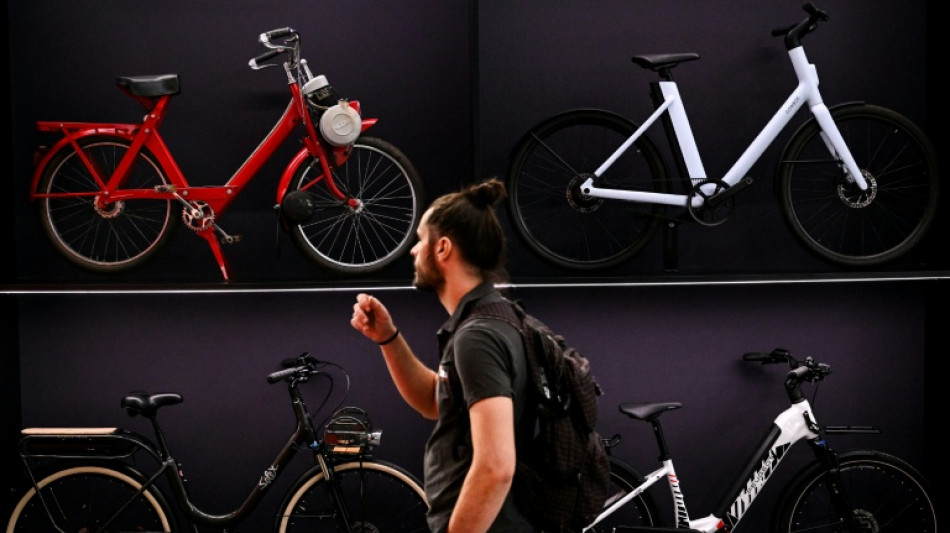
Cycling industry bets on smart bikes to boost sales / Photo: Kirill KUDRYAVTSEV - AFP
At the Eurobike trade fair, hopes are high that smart and AI-enabled bicycles can revive an industry that has been dealing with years of flagging sales.
Artificial intelligence, long used in cars and smartphones, is now entering the cycling world in areas ranging from electric motors to safety and services.
At the stand of Avinox, a manufacturer of motors for electric bicycles, the DNA of parent company and Chinese drone specialist DJI has been transposed to cycling.
The motor on display features sensors that continuously monitor the cyclist's movements and terrain conditions, allowing AI to automatically adjust the motor's assistance to the pedal drive.
This makes the ride "easier and safer without having to think about it," Avinox developer Ferdinand Wolf said.
The system even allows a rider to transmit their real-time heart rate so that the e-bike motor modifies the level of assistance as needed.
- Safety alerts -
Elsewhere at the show, there is technology that aims to keep cyclists alive and injury-free.
At Germany's Canyon, a racing bike equipped with cameras and radars promises to alert cyclists "to the presence of elements they do not necessarily perceive", company spokesman Ben Hilldson said.
"If a car is parking, the system can anticipate the opening of a door and warn the cyclist," he said.
The rider would then be alerted via either visual signals on the frame, vibrations in the handlebars or through technology inside their helmet.
Canyon is presenting a helmet fitted with a large visor capable of displaying real-time alerts or receiving an audio signal, depending on the user's preference.
The products are for now in the prototype stage, Hilldson said.
Canyon is also working with carmaker Volkswagen on a communication system that would allow the bicycle to interact with surrounding cars and other infrastructure, with the launch expected in about three years.
The main obstacle: almost all vehicles currently on the road are not yet equipped to exchange such data.
- Smart networks -
Artificial intelligence is also shaking up services in the cycling industry.
At insurer Linexo "around 90 percent of claims will be handled entirely automatically by the end of the year", head of the bicycle division Soeren Hirsch said.
Automation handles standard cases, while experts review complex claims and detect fraud, "the only way to keep insurance premiums stable", he added.
Start-up Wunderfix meanwhile offers repair services linking retailers, customers and shops via an application that allows cyclists to diagnose and, where possible, repair their bicycles themselves.
Some 3,000 service requests have already been recorded this year, the company says.
The rise of AI-enabled and smart bikes has fuelled hopes of a rebound for the business.
The European bicycle market shrunk in 2025 for the third year in a row, with sales dropping four percent to 15.2 million units, according to consultants EY-Parthenon.
"After the boom during the Covid-19 pandemic, the sector has been going through a painful consolidation since 2023: lower sales, high inventories and strong pricing pressure have weighed heavily on many players," EY-Parthenon analyst Constantin Gall said.
The market is nevertheless expected to stabilise this year before slowly recovering, with revenue forecast at 21.2 billion euros for 2031 -- on a par with the record-breaking sales of 2022.
Alongside infrastructure investment, "digital and data-driven offerings" will be a growth-driver, the consultancy said.
A.Krishnakumar--DT