Dubai Telegraph - NASA's new rocket on launchpad for trip to Moon

EUR -
AED 4.184217
AFN 71.778596
ALL 94.26058
AMD 418.558169
ANG 2.039871
AOA 1044.771654
ARS 1684.037898
AUD 1.652409
AWG 2.052229
AZN 1.941395
BAM 1.955605
BBD 2.29677
BDT 140.265982
BGN 1.926481
BHD 0.429957
BIF 3386.861518
BMD 1.139336
BND 1.475553
BOB 7.880212
BRL 5.89839
BSD 1.140386
BTN 107.036303
BWP 15.497451
BYN 3.307369
BYR 22330.988246
BZD 2.293471
CAD 1.616661
CDF 2583.449152
CHF 0.922361
CLF 0.026741
CLP 1051.03496
CNY 7.745378
CNH 7.752824
COP 3917.408495
CRC 517.748256
CUC 1.139336
CUP 30.192408
CVE 110.253981
CZK 24.27816
DJF 203.069705
DKK 7.480658
DOP 67.003304
DZD 152.015808
EGP 56.43136
ERN 17.090042
ETB 183.850126
FJD 2.581854
FKP 0.861788
GBP 0.863068
GEL 3.01359
GGP 0.861788
GHS 12.857715
GIP 0.861788
GMD 83.171943
GNF 9992.001402
GTQ 8.700131
GYD 238.656149
HKD 8.935301
HNL 30.511951
HRK 7.539903
HTG 149.045104
HUF 354.163079
IDR 20349.226973
ILS 3.420345
IMP 0.861788
INR 107.508332
IQD 1493.850705
IRR 1566872.020062
ISK 144.115067
JEP 0.861788
JMD 179.602051
JOD 0.807834
JPY 184.293362
KES 147.565252
KGS 99.635383
KHR 4577.542521
KMF 494.472282
KPW 1025.40292
KRW 1749.211811
KWD 0.35275
KYD 0.950305
KZT 553.304703
LAK 25030.498458
LBP 102119.294221
LKR 383.321691
LRD 207.719241
LSL 18.745127
LTL 3.364164
LVL 0.689173
LYD 7.320268
MAD 10.693231
MDL 20.218979
MGA 4823.517939
MKD 61.628841
MMK 2391.906346
MNT 4077.580531
MOP 9.211779
MRU 45.511452
MUR 53.834064
MVR 17.603174
MWK 1977.402379
MXN 19.943172
MYR 4.65765
MZN 72.807828
NAD 18.745127
NGN 1567.875065
NIO 41.965806
NOK 11.31707
NPR 171.257885
NZD 2.017953
OMR 0.438079
PAB 1.140386
PEN 3.888611
PGK 5.0045
PHP 69.855021
PKR 317.362483
PLN 4.291823
PYG 6960.304389
QAR 4.156785
RON 5.244483
RSD 117.36827
RUB 89.906115
RWF 1670.033097
SAR 4.282472
SBD 9.173881
SCR 16.016599
SDG 683.602068
SEK 11.094411
SGD 1.474533
SHP 0.850629
SLE 28.259714
SLL 23891.313258
SOS 651.734866
SRD 42.70578
STD 23581.957684
STN 24.497552
SVC 9.978003
SYP 125.933213
SZL 18.734128
THB 38.028805
TJS 10.554045
TMT 3.987676
TND 3.379962
TOP 2.743248
TRY 53.039861
TTD 7.750225
TWD 36.299026
TZS 2999.100271
UAH 51.186584
UGX 4185.581694
USD 1.139336
UYU 45.775425
UZS 13697.631062
VES 707.246307
VND 29964.540351
VUV 136.297015
WST 3.167398
XAF 655.89145
XAG 0.019435
XAU 0.00028
XCD 3.079113
XCG 2.055195
XDR 0.815718
XOF 655.89145
XPF 119.331742
YER 271.874128
ZAR 19.354809
ZMK 10255.396502
ZMW 20.541947
ZWL 366.865771
  • CMSC

    -0.1160

    21.93

    -0.53%

  • VOD

    0.0300

    13.89

    +0.22%

  • BCE

    -0.2800

    22.92

    -1.22%

  • NGG

    -0.4100

    83.01

    -0.49%

  • GSK

    0.6100

    52.5

    +1.16%

  • RYCEF

    0.3900

    18.39

    +2.12%

  • RBGPF

    3.7000

    65

    +5.69%

  • CMSD

    -0.1600

    21.77

    -0.73%

  • RIO

    -1.3700

    93.74

    -1.46%

  • RELX

    0.4200

    31.34

    +1.34%

  • JRI

    0.2100

    12.79

    +1.64%

  • BCC

    1.2600

    81.02

    +1.56%

  • BP

    -0.5900

    37.13

    -1.59%

  • AZN

    2.7300

    188.41

    +1.45%

  • BTI

    0.2800

    62.76

    +0.45%

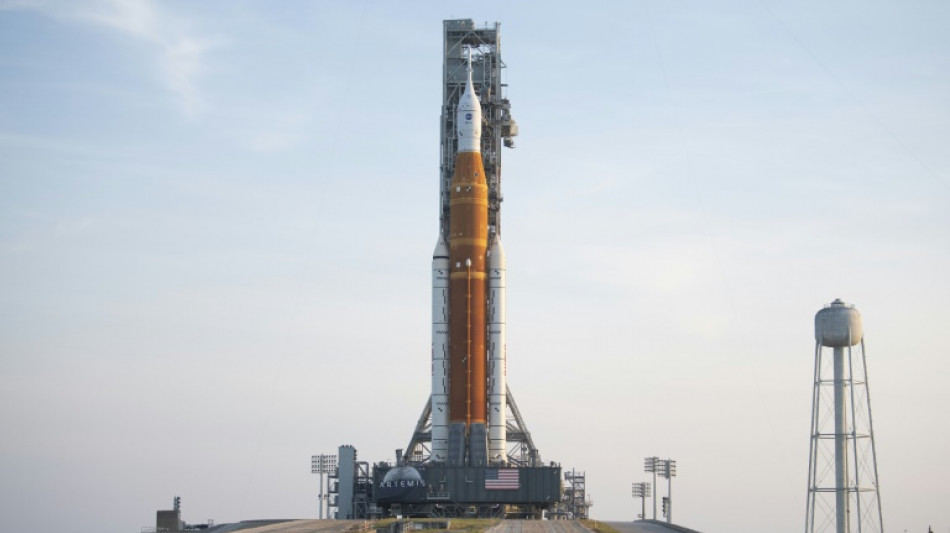
NASA's new rocket on launchpad for trip to Moon
NASA's new rocket on launchpad for trip to Moon / Photo: Joel KOWSKY - NASA/AFP

NASA's new rocket on launchpad for trip to Moon

NASA's giant new SLS rocket arrived at its launchpad Wednesday in Cape Canaveral ahead of a planned flight to the Moon in less than two weeks.

Text size:

It will be the maiden voyage of the Artemis program -- America's quest to return humans to the Moon for the first time since the last Apollo mission in 1972.

The Artemis 1 mission, an uncrewed test flight, will feature the first blastoff of the Space Launch System rocket, which will be the most powerful in the world.

It will propel the Orion crew capsule into orbit around the Moon, and the spacecraft will remain in space for 42 days before returning to Earth.

Starting in 2024, astronauts will travel aboard Orion for the same trip, and the following year, at the earliest, Americans will once again set foot on the Moon.

The SLS rocket, in development for more than a decade, is 98 meters (322 feet) tall.

On Wednesday it stood at historic launch complex 39B, after a 10-hour overnight crawl from the assembly building.

"To all of us that gaze up at the Moon, dreaming of the day humankind returns to the lunar surface, folks, we're here. We are going back," NASA administrator Bill Nelson said earlier this month.

The Orion capsule will fly to the Moon and 64,000 kilometers (40,000 miles) beyond it -- further than any previous crewed spacecraft.

On the way back through Earth's atmosphere, traveling at 40,000 km per hour (25,000 mph), Orion's thermal shield will have to withstand a temperature that is half that of the surface of the sun.

Liftoff for the Artemis 1 mission is scheduled for August 29 at 8:33 am (1233 GMT). If it has to be postponed due to bad weather, the backup dates are September 2 and 5.

After the 42-day trip, the capsule is supposed to splash down in the Pacific and be picked up by a US Navy vessel.

In 2024, an Artemis 2 mission is scheduled to take astronauts up to orbit the Moon but without landing on it. That honor is reserved for Artemis 3, a mission scheduled for 2025 at the earliest.

The last time people walked on the Moon was with the Apollo 17 mission in 1972.

While the Apollo program featured only white male astronauts, NASA says the Artemis missions will land the first woman and first person of color on the Moon.

The hope is to use the Moon as a staging ground to develop technologies for sending humans to Mars.

F.A.Dsouza--DT



