Dubai Telegraph - Exoplanets can have magnetic fields, 'hot Jupiter' winds reveal

EUR -
AED 4.275622
AFN 72.761738
ALL 95.227599
AMD 429.052097
ANG 2.0845
AOA 1068.759305
ARS 1662.182068
AUD 1.620514
AWG 2.098518
AZN 1.97469
BAM 1.955315
BBD 2.344548
BDT 142.896386
BGN 1.944164
BHD 0.439097
BIF 3468.384123
BMD 1.164226
BND 1.48855
BOB 8.044108
BRL 5.85478
BSD 1.164126
BTN 110.839499
BWP 15.598331
BYN 3.215944
BYR 22818.832266
BZD 2.341249
CAD 1.610014
CDF 2631.151209
CHF 0.915122
CLF 0.02629
CLP 1034.612602
CNY 7.876281
CNH 7.872124
COP 4152.235799
CRC 530.375238
CUC 1.164226
CUP 30.851993
CVE 110.237648
CZK 24.206183
DJF 207.288568
DKK 7.474006
DOP 67.914024
DZD 155.06792
EGP 60.36082
ERN 17.463392
ETB 187.675553
FJD 2.554892
FKP 0.865668
GBP 0.86385
GEL 3.096831
GGP 0.865668
GHS 13.648789
GIP 0.865668
GMD 84.988195
GNF 10204.599545
GTQ 8.875912
GYD 243.499584
HKD 9.123994
HNL 30.977713
HRK 7.532313
HTG 152.384154
HUF 354.520798
IDR 20766.301588
ILS 3.314318
IMP 0.865668
INR 110.925484
IQD 1524.941284
IRR 1573160.566474
ISK 143.421328
JEP 0.865668
JMD 183.124564
JOD 0.825467
JPY 186.122508
KES 150.662525
KGS 101.81127
KHR 4679.838854
KMF 493.631909
KPW 1047.634999
KRW 1765.886499
KWD 0.359956
KYD 0.970072
KZT 571.885474
LAK 25510.99898
LBP 104244.178367
LKR 387.058951
LRD 212.450025
LSL 18.855884
LTL 3.437658
LVL 0.704229
LYD 7.406162
MAD 10.685349
MDL 20.133264
MGA 4879.8521
MKD 61.646445
MMK 2444.536993
MNT 4164.867033
MOP 9.39699
MRU 46.511859
MUR 55.195869
MVR 17.9409
MWK 2018.499177
MXN 20.108316
MYR 4.616396
MZN 74.399918
NAD 18.855964
NGN 1589.739551
NIO 42.839923
NOK 10.79155
NPR 177.345283
NZD 1.963447
OMR 0.447659
PAB 1.164126
PEN 3.962468
PGK 5.086738
PHP 71.770465
PKR 324.053172
PLN 4.234523
PYG 7042.313174
QAR 4.243347
RON 5.259154
RSD 117.397046
RUB 84.931419
RWF 1703.999164
SAR 4.373595
SBD 9.344094
SCR 15.927774
SDG 699.108211
SEK 10.820923
SGD 1.48869
SHP 0.869212
SLE 28.697785
SLL 24413.24241
SOS 665.243513
SRD 43.295824
STD 24097.130452
STN 24.494238
SVC 10.185604
SYP 128.684357
SZL 18.842568
THB 37.986381
TJS 10.744573
TMT 4.086434
TND 3.401056
TOP 2.803177
TRY 53.467552
TTD 7.896143
TWD 36.573581
TZS 3041.544296
UAH 51.619092
UGX 4382.968983
USD 1.164226
UYU 46.778795
UZS 13887.673523
VES 648.796017
VND 30656.984727
VUV 136.535537
WST 3.16276
XAF 655.802734
XAG 0.015341
XAU 0.000258
XCD 3.146379
XCG 2.098006
XDR 0.816534
XOF 655.794286
XPF 119.331742
YER 277.813455
ZAR 18.892928
ZMK 10479.427457
ZMW 21.04105
ZWL 374.880341
  • GSK

    -0.4750

    48.835

    -0.97%

  • CMSC

    0.0308

    22.76

    +0.14%

  • RIO

    2.6450

    111.605

    +2.37%

  • CMSD

    -0.0750

    22.725

    -0.33%

  • NGG

    0.4900

    80.49

    +0.61%

  • BCC

    1.0550

    69.385

    +1.52%

  • BCE

    -0.3150

    24.745

    -1.27%

  • BTI

    -0.5950

    60.405

    -0.99%

  • RYCEF

    0.3700

    17.25

    +2.14%

  • BP

    0.4750

    43.415

    +1.09%

  • AZN

    -3.0400

    176.67

    -1.72%

  • RELX

    -1.2350

    33.365

    -3.7%

  • RBGPF

    -3.0200

    60.52

    -4.99%

  • JRI

    0.0700

    12.73

    +0.55%

  • VOD

    0.1150

    15.085

    +0.76%

Exoplanets can have magnetic fields, 'hot Jupiter' winds reveal
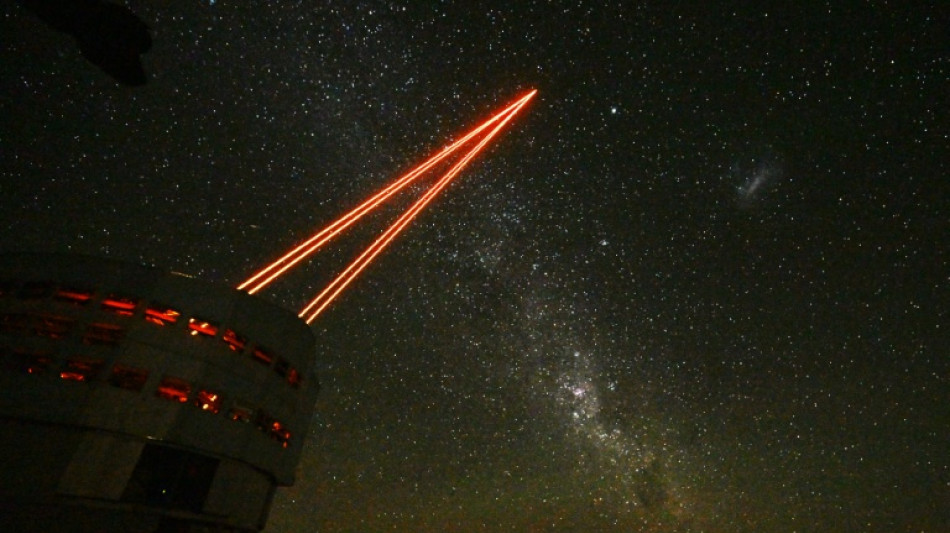
Exoplanets can have magnetic fields, 'hot Jupiter' winds reveal / Photo: RODRIGO ARANGUA - AFP/File

Exoplanets can have magnetic fields, 'hot Jupiter' winds reveal

Planets beyond our solar system can have magnetic fields similar to those closer to home, astronomers said Tuesday after observing extreme winds on scorching worlds known as "hot Jupiters".

Text size:

The observations offer the strongest evidence yet of magnetic fields outside our cosmic backyard, a subject which has long eluded scientists.

"It's the first time we can compare the magnetic environments of other worlds -- a key step toward ultimately understanding which planets can stay alive, keep their water, and perhaps even, one day, host life as we know it," said astronomer Julia Seidel of France's Cote d'Azur Observatory.

By deflecting the charged particles that bombard planets, magnetic fields play a "very complex role in atmospheric retention," Seidel, the lead author of a new study in Nature Astronomy, told AFP.

In our solar system, Earth, Jupiter and Saturn have active magnetic fields -- but Venus and Mars do not.

However exactly what is happening on far-away worlds known as exoplanets is difficult to measure.

Seidel and her colleagues did not originally intend to measure magnetic fields, but instead set out to look into wind.

The team studied seven "hot Jupiters", gas giants where temperatures can hit nearly 2,000 degrees Celsius. They have "compositions completely unknown in our solar system," Seidel explained.

These planets are so close to their stars that they are tidally locked.

This means they always have one side facing their star -- similar to how the same side of the Moon always faces Earth.

So it will always be a blisteringly hot day on one side of these planets, while the other sits in eternal night.

This extreme difference creates very violent winds, ranging from 7,200 to 25,000 kilometres (4,475 to 15,500 miles) an hour, the scientists found.

To measure these winds, they used the European Southern Observatory's Very Large Telescope in Chile and the Gemini North telescope in Hawaii.

- 'Totally counter intuitive' -

They also found something unexpected: the hotter the planet, the weaker the wind.

"This is totally counter intuitive," study co-author Vivien Parmentier said in a statement.

"Because, all things being equal, hot planets have more energy to accelerate the winds!"

The only plausible explanation was the presence of a magnetic field around these planets that slows down the movement of charged particles in their atmosphere.

The intensity of the magnetic fields was similar to those seen in our solar system, ranging from around four times stronger than Saturn's to half that of Jupiter's.

"This is the first study with such strong evidence" of magnetic fields on exoplanets, because it covers several worlds with the same traits, Seidel said.

"Now we know that exoplanets have magnetic fields" that are of "the same order of magnitude as what we see for Jupiter or even Earth," she added.

Previously, models had predicted exoplanets could have magnetic fields a hundred times more intense than those in our solar system.

By understanding the impact of magnetic fields in the "extreme laboratories" of hot Jupiters, "we are getting close to a comprehensive understanding of their role in planetary atmospheres," Seidel concluded.

I.Khan--DT