Dubai Telegraph - Rover discovers more building blocks of life on Mars

EUR -
AED 4.177527
AFN 72.223742
ALL 94.547257
AMD 418.839095
ANG 2.036307
AOA 1043.442074
ARS 1680.137834
AUD 1.644822
AWG 2.047222
AZN 1.931234
BAM 1.961501
BBD 2.29176
BDT 139.953663
BGN 1.923115
BHD 0.42879
BIF 3394.976033
BMD 1.137345
BND 1.47629
BOB 7.862782
BRL 5.909299
BSD 1.137907
BTN 107.359012
BWP 15.526989
BYN 3.23824
BYR 22291.969929
BZD 2.288531
CAD 1.614934
CDF 2580.637098
CHF 0.921375
CLF 0.026542
CLP 1044.58337
CNY 7.723137
CNH 7.73632
COP 3918.530243
CRC 517.905159
CUC 1.137345
CUP 30.139653
CVE 110.749043
CZK 24.26407
DJF 202.128941
DKK 7.474509
DOP 67.046428
DZD 151.753733
EGP 56.31304
ERN 17.060181
ETB 180.440211
FJD 2.57239
FKP 0.864326
GBP 0.861795
GEL 3.002355
GGP 0.864326
GHS 12.766703
GIP 0.864326
GMD 82.458527
GNF 9980.206539
GTQ 8.68123
GYD 238.079825
HKD 8.917664
HNL 30.390087
HRK 7.537412
HTG 148.722223
HUF 354.183579
IDR 20434.571149
ILS 3.392616
IMP 0.864326
INR 107.42318
IQD 1489.92248
IRR 1563906.798376
ISK 143.999143
JEP 0.864326
JMD 179.34121
JOD 0.806397
JPY 184.024737
KES 147.175616
KGS 99.461383
KHR 4560.755034
KMF 493.608245
KPW 1023.611262
KRW 1757.079237
KWD 0.352157
KYD 0.948248
KZT 551.482744
LAK 25095.526127
LBP 101849.281014
LKR 383.4845
LRD 207.281831
LSL 18.868763
LTL 3.358285
LVL 0.687969
LYD 7.284673
MAD 10.708676
MDL 20.197521
MGA 4805.284556
MKD 61.642041
MMK 2387.896327
MNT 4076.044786
MOP 9.189125
MRU 45.573116
MUR 54.830822
MVR 17.572346
MWK 1975.568451
MXN 19.925097
MYR 4.688144
MZN 72.688087
NAD 18.868935
NGN 1564.612203
NIO 41.638593
NOK 11.209337
NPR 171.770431
NZD 2.013335
OMR 0.437312
PAB 1.137897
PEN 3.891992
PGK 4.985269
PHP 69.763066
PKR 316.239064
PLN 4.284272
PYG 6953.146413
QAR 4.145568
RON 5.232701
RSD 117.388821
RUB 86.095889
RWF 1667.348363
SAR 4.270703
SBD 9.157851
SCR 16.72142
SDG 682.407518
SEK 11.070096
SGD 1.474312
SHP 0.849143
SLE 28.196739
SLL 23849.568628
SOS 649.997351
SRD 42.445914
STD 23540.753582
STN 25.021599
SVC 9.956937
SYP 125.713173
SZL 18.868914
THB 37.957194
TJS 10.51958
TMT 3.980709
TND 3.340954
TOP 2.738455
TRY 52.902823
TTD 7.728461
TWD 36.192947
TZS 2978.63486
UAH 51.1657
UGX 4210.235978
USD 1.137345
UYU 45.652678
UZS 13665.205331
VES 706.010555
VND 29934.931047
VUV 136.277564
WST 3.159291
XAF 657.863127
XAG 0.019589
XAU 0.000282
XCD 3.073733
XCG 2.050715
XDR 0.816619
XOF 651.698432
XPF 119.331742
YER 271.399101
ZAR 18.744993
ZMK 10237.478201
ZMW 20.538509
ZWL 366.224756
  • CMSC

    -0.0190

    22.046

    -0.09%

  • RBGPF

    0.0000

    61.3

    0%

  • RYCEF

    -0.1600

    18

    -0.89%

  • GSK

    0.8000

    51.89

    +1.54%

  • BP

    -0.1400

    37.72

    -0.37%

  • VOD

    0.0500

    13.86

    +0.36%

  • BCE

    0.0000

    23.2

    0%

  • RIO

    1.0800

    95.11

    +1.14%

  • BTI

    1.0900

    62.48

    +1.74%

  • CMSD

    -0.0900

    21.93

    -0.41%

  • NGG

    0.5900

    83.42

    +0.71%

  • RELX

    -0.2300

    30.92

    -0.74%

  • AZN

    2.6600

    185.68

    +1.43%

  • BCC

    2.1000

    79.76

    +2.63%

  • JRI

    0.0100

    12.58

    +0.08%

Rover discovers more building blocks of life on Mars
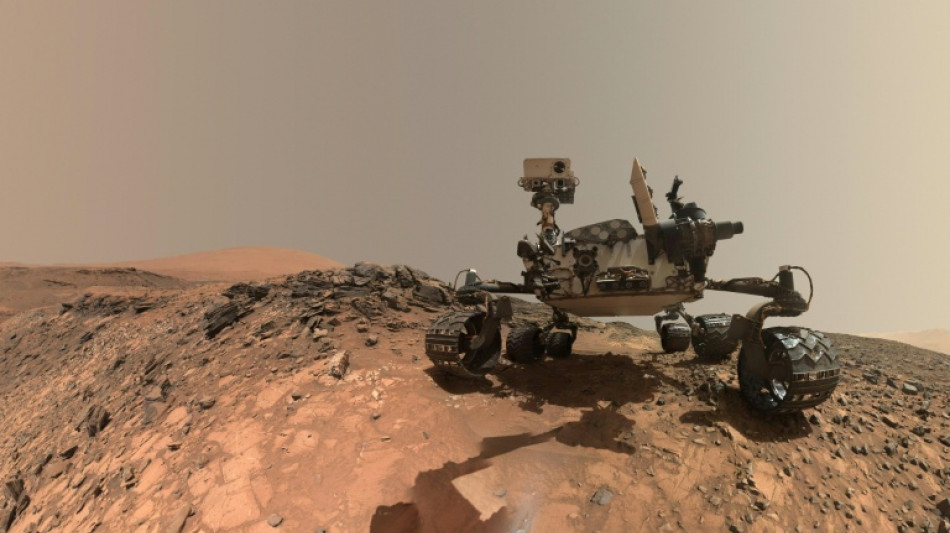
Rover discovers more building blocks of life on Mars / Photo: Handout - NASA/AFP/File

Rover discovers more building blocks of life on Mars

A NASA rover has discovered more building blocks of life on Mars after carrying out a chemistry experiment never before conducted on another planet, scientists said Tuesday.

Text size:

The organic molecules are not definitive evidence of past life, the NASA-led team emphasised, because they could also have formed on the red planet or crash-landed on meteorites.

But it proves that these important clues to Martian history have been preserved on the surface for more than three billion years, they added.

Back then, the surface of Mars was thought to have been dotted with huge lakes and rivers full of liquid water, a key ingredient for life as we know it.

NASA's Curiosity rover landed in a former lake bed called the Gale crater in 2012, and has been searching for signs of possible past life since.

The car-sized rover carried two tubes of a chemical called TMAH, which can break apart organic matter to see what it is made out of.

"This experiment's never been run before on another world," Amy Williams, an astrobiologist working on the Curiosity mission told AFP.

The team were under pressure because they only had "two shots to get it right", added Williams, the lead author of a new study describing the results.

The experiment, conducted in 2020, detected more than 20 organic molecules, including several that had never before been confirmed on Mars.

These included a molecule called benzothiophene, which has also been found in meteorites and asteroids.

"The same stuff that rained down on Mars from meteorites is what rained down on Earth, and it probably provided the building blocks for life as we know it on our planet," Williams said.

Another molecule containing nitrogen "is a precursor to how DNA is eventually built," she added.

"We're seeing the building blocks for life -- prebiotic chemistry on Mars -- preserved in these rocks for billions of years."

- Future missions -

But none of this can prove that life -- even tiny, microbial organisms -- once flourished on Mars.

One way to potentially make such an "extraordinary claim" would be to bring some Martian rocks back to Earth so scientists can study them more closely, Williams said.

NASA's Perseverance rover has already collected a bunch of rocks for such a mission, called Mars Sample Return.

However the mission has effectively been cancelled by the administration of President Donald Trump following a US Congress vote in January.

Future missions could still benefit from Curiosity's demonstration that experiments using the TMAH chemical work on other worlds, the new study in Nature Communications said.

The European Space Agency's Rosalind Franklin rover, which has a much longer drill than Curiosity, will take the chemical to Mars.

After years of delays, NASA announced last week that the ESA's rover is now scheduled to blast off towards the red planet in late 2028.

The chemical will also be on board the Dragon rotorcraft, which is planned to launch in 2028 on a mission to explore Saturn's moon Titan.

Y.Rahma--DT