Dubai Telegraph - Giant step for humankind: Artemis crew to set space distance record

EUR -
AED 4.186334
AFN 72.373386
ALL 91.819032
AMD 414.329313
ANG 2.040604
AOA 1046.308965
ARS 1736.438573
AUD 1.622565
AWG 2.052441
AZN 1.935038
BAM 1.954094
BBD 2.293688
BDT 140.13319
BGN 1.918735
BHD 0.429293
BIF 3430.040844
BMD 1.13977
BND 1.454987
BOB 13.956366
BRL 5.933183
BSD 1.138751
BTN 109.052098
BWP 15.506326
BYN 3.440732
BYR 22339.490623
BZD 2.290391
CAD 1.611464
CDF 2632.86865
CHF 0.944412
CLF 0.027869
CLP 1100.584154
CNY 7.649395
CNH 7.664498
COP 3771.430311
CRC 517.768407
CUC 1.13977
CUP 27.33014
CVE 110.173164
CZK 24.374949
DJF 202.790961
DKK 7.475814
DOP 67.723548
DZD 152.4335
EGP 59.007482
ERN 17.096549
ETB 184.742006
FJD 2.561348
FKP 0.862524
GBP 0.86109
GEL 2.980539
GGP 0.862524
GHS 13.226974
GIP 0.862524
GMD 83.771254
GNF 10015.651322
GTQ 8.696751
GYD 238.271386
HKD 8.940413
HNL 30.565522
HRK 7.532852
HTG 149.035769
HUF 365.880943
IDR 20451.347758
ILS 3.474087
IMP 0.862524
INR 109.244041
IQD 1491.856443
IRR 1566699.250831
ISK 137.194093
JEP 0.862524
JMD 180.16271
JOD 0.80806
JPY 179.359321
KES 147.634133
KGS 99.670824
KHR 4631.139653
KMF 493.520612
KPW 1025.793299
KRW 1547.043722
KWD 0.351778
KYD 0.948963
KZT 504.43199
LAK 25543.707706
LBP 101979.593567
LKR 375.995038
LRD 195.876724
LSL 18.579912
LTL 3.365444
LVL 0.689436
LYD 7.280644
MAD 10.928191
MDL 20.213176
MGA 5027.809004
MKD 61.521701
MMK 2392.945475
MNT 4101.841018
MOP 9.200287
MRU 45.812406
MUR 54.173732
MVR 17.610039
MWK 1974.654001
MXN 20.209238
MYR 4.643648
MZN 72.842889
NAD 18.579912
NGN 1511.072482
NIO 41.905069
NOK 10.826384
NPR 174.483557
NZD 2.014139
OMR 0.438243
PAB 1.138751
PEN 3.865977
PGK 5.073771
PHP 71.188322
PKR 315.551978
PLN 4.378101
PYG 6712.404787
QAR 4.15104
RON 5.274175
RSD 117.47723
RUB 95.91289
RWF 1683.015885
SAR 4.273917
SBD 9.118743
SCR 15.721688
SDG 685.570211
SEK 11.304968
SGD 1.456283
SHP 0.860528
SLE 28.095283
SLL 23900.396288
SOS 650.857469
SRD 42.932281
STD 23590.93636
STN 24.479595
SVC 9.964694
SYP 14819.288917
SZL 18.575516
THB 38.08598
TJS 10.505443
TMT 4.000592
TND 3.371157
TOP 2.744292
TRY 55.806899
TTD 7.745544
TWD 36.20588
TZS 3014.689163
UAH 50.994393
UGX 4460.282073
USD 1.13977
UYU 45.620571
UZS 13477.351914
VES 971.575734
VND 29606.663696
VUV 135.070044
WST 3.152014
XAF 655.957
XAG 0.017731
XAU 0.000266374203
XCD 3.080285
XCG 2.052155
XDR 0.805876
XOF 655.957
XPF 119.331742
YER 269.726859
ZAR 18.618062
ZMK 10259.293596
ZMW 22.214483
ZWL 367.005452
SSP 6511.040469
MXV 2.290148
  • CMSD

    -0.1200

    20.25

    -0.59%

  • CMSC

    -0.0350

    20.475

    -0.17%

  • JRI

    -0.1400

    11.03

    -1.27%

  • RIO

    -0.0800

    94.39

    -0.08%

  • RBGPF

    -1.0100

    65.99

    -1.53%

  • BCC

    1.1900

    77.29

    +1.54%

  • NGG

    -0.0600

    75.17

    -0.08%

  • BCE

    -0.2450

    21.055

    -1.16%

  • AZN

    1.5450

    166.105

    +0.93%

  • GSK

    -0.5300

    49.12

    -1.08%

  • BP

    -0.5600

    43.85

    -1.28%

  • RYCEF

    0.0000

    19.67

    0%

  • VOD

    0.0950

    16.585

    +0.57%

  • BTI

    -0.5100

    55.51

    -0.92%

  • RELX

    0.0850

    33.595

    +0.25%

Giant step for humankind: Artemis crew to set space distance record
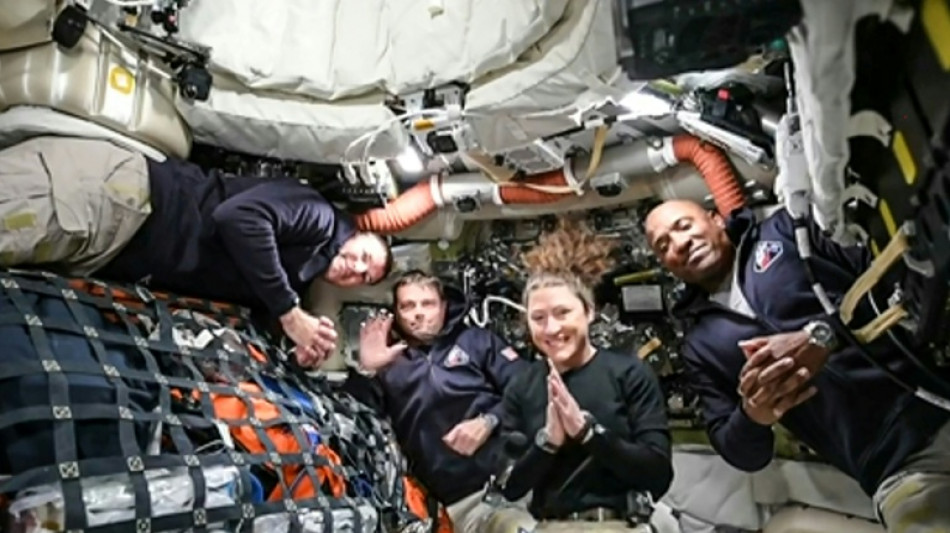
Giant step for humankind: Artemis crew to set space distance record / Photo: Handout - NASA TV/AFP

Giant step for humankind: Artemis crew to set space distance record

Four Artemis II astronauts are taking a giant step for humankind Monday when they shoot deeper into space than anyone before and glimpse parts of the Moon never seen by the naked eye.

Text size:

The NASA mission swept earlier into the Moon's gravitational sphere of influence, meaning their spacecraft is now in the natural satellite's neighborhood, with lunar gravity outmuscling any pull from Earth.

The Orion capsule will whip around the Moon, setting the crew up to reach an estimated record 252,757 miles (406,772 kilometers) from Earth, before starting the journey home. This will surpass the 1972 distance record set on Apollo 13 by 4,102 miles.

Swooping around the far side of the Moon, the crew of four will witness previously hidden lunar territory -- the sphere looming large through their capsule windows.

The Moon will appear to the astronauts "about the size of a basketball held at arm's length," Noah Petro, head of the US space agency's planetary geology lab, told AFP.

Adding to the historic nature of the mission led by Reid Wiseman, the Artemis II crew includes several firsts.

Victor Glover will be the first person of color to fly around the Moon, Christina Koch will be the first woman, and Canadian Jeremy Hansen the first non-American.

- Human eye vs camera -

The astronauts have already started seeing features never previously glimpsed directly.

An image sent back by the crew showed the Moon's Orientale basin visible, a massive crater that before had only been viewed by orbiting, uncrewed cameras.

Speaking to Canadian children live from space, Koch said the crew was most excited to see the basin -- sometimes known as the Moon's "Grand Canyon."

"It's very distinctive and no human eyes previously had seen this crater until today, really, when we were privileged enough to see it," Koch said during a question-and-answer session hosted by the Canadian Space Agency.

Near the end of their flyby, the astronauts will witness a solar eclipse, when the Sun will be behind the Moon.

Despite the technological advancements since the Apollo missions, NASA still relies on the eyesight of its astronauts to learn more about the Moon.

"The human eye is basically the best camera that could ever or will ever exist," Kelsey Young, the lead scientist for the Artemis II mission, told AFP. "The number of receptors in the human eye far outweighs what a camera is able to do."

And while the Orion crew will still be at a substantial distance from the Moon, their flyby is key to preparing for a later crewed mission to the planet's surface itself.

Over the next day, "they will be on the far side of the Moon, they will eclipse that record, and we're going to learn an awful lot about the spacecraft," NASA administrator Jared Isaacman told CNN on Sunday.

The information will be "pretty paramount to set up for subsequent missions like Artemis III in 2027 and, of course, the lunar landing itself on Artemis IV in 2028," he added.

The four astronauts will also spend some time testing their "Orion crew survival system" spacesuits.

The orange suits protect the crewmembers during launch and reentry, but are also available for emergency use -- they can provide up to six days of breathable air.

H.Pradhan--DT