Dubai Telegraph - Strange 'inside-out' planetary system baffles astronomers

EUR -
AED 4.358675
AFN 76.539015
ALL 96.168535
AMD 448.05318
ANG 2.124245
AOA 1088.182592
ARS 1657.786896
AUD 1.674063
AWG 2.138984
AZN 2.015543
BAM 1.953382
BBD 2.390641
BDT 145.170328
BGN 1.992869
BHD 0.447448
BIF 3506.628442
BMD 1.186676
BND 1.496548
BOB 8.202125
BRL 6.166446
BSD 1.186931
BTN 107.580384
BWP 15.563262
BYN 3.402788
BYR 23258.855315
BZD 2.387346
CAD 1.616514
CDF 2658.154663
CHF 0.913145
CLF 0.025758
CLP 1017.076371
CNY 8.188838
CNH 8.187799
COP 4356.870138
CRC 578.583907
CUC 1.186676
CUP 31.446922
CVE 112.585944
CZK 24.2524
DJF 210.895874
DKK 7.471925
DOP 74.31561
DZD 153.803318
EGP 55.59329
ERN 17.800144
ETB 183.994471
FJD 2.599056
FKP 0.869266
GBP 0.871442
GEL 3.192001
GGP 0.869266
GHS 13.059341
GIP 0.869266
GMD 87.222664
GNF 10419.017583
GTQ 9.103733
GYD 248.341008
HKD 9.275602
HNL 31.452857
HRK 7.535512
HTG 155.427633
HUF 379.032128
IDR 19955.919859
ILS 3.635887
IMP 0.869266
INR 107.497205
IQD 1555.13928
IRR 49988.738969
ISK 145.1893
JEP 0.869266
JMD 185.420511
JOD 0.84137
JPY 181.336408
KES 153.081003
KGS 103.77536
KHR 4782.305599
KMF 492.470631
KPW 1067.995386
KRW 1708.801692
KWD 0.363966
KYD 0.989209
KZT 587.317843
LAK 25448.27336
LBP 101520.156536
LKR 367.224782
LRD 221.374356
LSL 18.821296
LTL 3.503946
LVL 0.717809
LYD 7.475311
MAD 10.844738
MDL 20.113784
MGA 5256.975829
MKD 61.626498
MMK 2492.38186
MNT 4247.727033
MOP 9.558613
MRU 47.346026
MUR 54.469818
MVR 18.346035
MWK 2060.702321
MXN 20.448854
MYR 4.631004
MZN 75.840088
NAD 18.93967
NGN 1604.766003
NIO 43.568833
NOK 11.313552
NPR 172.126767
NZD 1.96634
OMR 0.456266
PAB 1.187071
PEN 3.981317
PGK 5.100926
PHP 68.936995
PKR 331.78856
PLN 4.21549
PYG 7815.327238
QAR 4.320985
RON 5.091437
RSD 117.349242
RUB 91.651927
RWF 1723.647314
SAR 4.45048
SBD 9.55084
SCR 15.963488
SDG 713.794354
SEK 10.592202
SGD 1.49857
SHP 0.890315
SLE 28.776668
SLL 24884.007626
SOS 678.18756
SRD 44.83146
STD 24561.803346
STN 24.860868
SVC 10.386145
SYP 13124.135322
SZL 18.820461
THB 36.88368
TJS 11.175645
TMT 4.153367
TND 3.364524
TOP 2.857231
TRY 51.795931
TTD 8.041048
TWD 37.312679
TZS 3085.358977
UAH 51.054711
UGX 4201.799577
USD 1.186676
UYU 45.513669
UZS 14596.11793
VES 460.731253
VND 30806.116529
VUV 141.641213
WST 3.217699
XAF 655.168205
XAG 0.015766
XAU 0.000241
XCD 3.207052
XCG 2.139252
XDR 0.814771
XOF 652.088658
XPF 119.331742
YER 282.905234
ZAR 18.943513
ZMK 10681.507456
ZMW 22.019489
ZWL 382.109282
  • RBGPF

    0.1000

    82.5

    +0.12%

  • RYCEF

    -0.0600

    16.87

    -0.36%

  • CMSC

    0.0000

    23.7

    0%

  • VOD

    -0.0600

    15.62

    -0.38%

  • NGG

    0.5800

    91.22

    +0.64%

  • RELX

    1.0800

    28.81

    +3.75%

  • RIO

    -1.6100

    97.91

    -1.64%

  • GSK

    0.0500

    58.54

    +0.09%

  • BCE

    0.1800

    25.83

    +0.7%

  • BCC

    -1.3500

    88.06

    -1.53%

  • BTI

    0.2800

    60.61

    +0.46%

  • CMSD

    -0.1280

    23.942

    -0.53%

  • JRI

    0.0300

    13.16

    +0.23%

  • BP

    -1.3600

    37.19

    -3.66%

  • AZN

    -0.2400

    204.52

    -0.12%

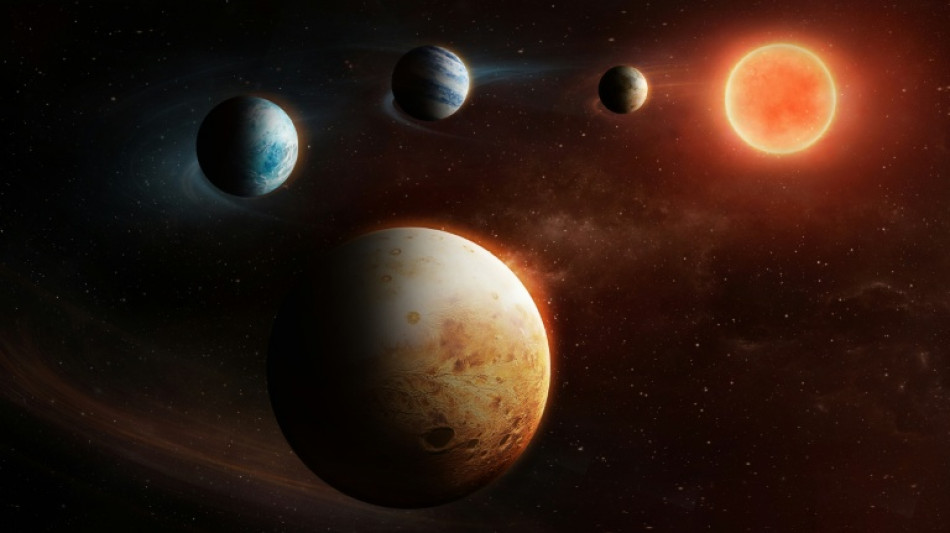
Strange 'inside-out' planetary system baffles astronomers
Strange 'inside-out' planetary system baffles astronomers / Photo: Handout - ESA/AFP

Strange 'inside-out' planetary system baffles astronomers

Surprised astronomers said Thursday they have discovered a star with planets in a bizarre order that defies scientific expectations -- and suggests these faraway worlds formed in a manner never seen before.

Text size:

In our Solar System, the four planets closest to the Sun are small and rocky, while the four farther out are gas giants.

Scientists had thought this planetary order -- rocky first, then gaseous -- was consistent across the universe.

However, a star called LHS 1903 discovered in the Milky Way's thick disc suggests otherwise.

An international team of astronomers analysing data from several different telescopes had already spotted three planets orbiting the red dwarf star, which is cooler and less bright than our Sun.

The closest planet to the star was rocky, followed by two gas giants. That is the order scientists expect.

But digging into observations made by Europe's exoplanet-probing Cheops space telescope revealed a fourth planet farther out in the system -- and it is rocky.

"That makes this an inside-out system, with a planet order of rocky-gaseous-gaseous-and then rocky again," explained Thomas Wilson, the lead author of a new study describing the discovery in the journal Science.

"Rocky planets don't usually form so far away from their home star," the planetary astrophysicist from University of Warwick in the UK said in a statement.

- One planet after another -

Inner planets are expected to be small and rocky because intense radiation from the nearby star blasts most of the gas away from their rocky core.

But farther out in the cold reaches of the system, a thick atmosphere can form around cores, creating gas giants.

Puzzled by the weird LHS 1903 planetary system, the team of astronomers tried to figure out what could have happened.

After ruling out several possibilities, they came up with a scenario: what if the planets formed one at a time?

According to the most widely accepted theory, planets form simultaneously in a massive ring of gas and dust called a protoplanetary disc. This involves tiny dust grains clumping together then snowballing into cores that eventually evolve into mighty planets.

However, by the time the fourth planet orbiting LHS 1903 formed, "the system may have already run out of gas," Wilson said.

"Yet here is a small, rocky world, defying expectations," he added.

"It seems that we have found first evidence for a planet which formed in what we call a gas-depleted environment."

Since the 1990s, astronomers have discovered more than 6,000 planets outside our Solar System -- called exoplanets -- mostly by spotting slight changes in brightness as they cross in front of their star.

"Historically, our planet formation theories are based on what we see and know about our Solar System," said Isabel Rebollido, a planetary disc researcher at the European Space Agency.

"As we are seeing more and more different exoplanet systems, we are starting to revisit these theories."

B.Gopalan--DT



