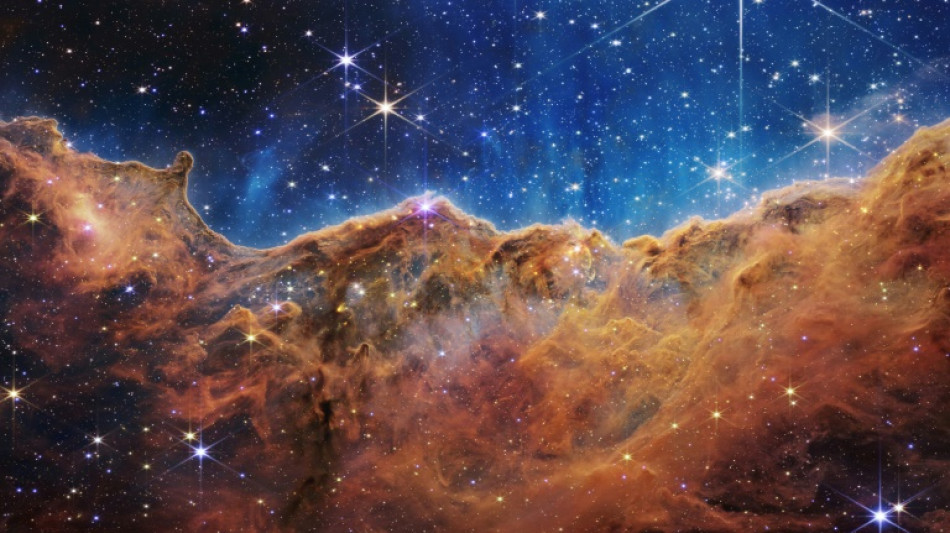
Cosmic cliffs and dancing galaxies: Webb begins new era of astronomy / Photo: Handout - NASA/AFP
The cosmic cliffs of a stellar nursery, a quintet of galaxies bound in a celestial dance: the James Webb Space Telescope released its next wave of images Tuesday, heralding a new era of astronomy.
"Every image is a new discovery," said NASA administrator Bill Nelson. "Each will give humanity a view of the universe that we've never seen before."
Released one by one, the new images demonstrated the full power of the $10 billion observatory, which uses infrared cameras to gaze into the distant universe in unprecedented clarity.
On Monday, Webb revealed the clearest image to date of the early universe, going back 13 billion years.
The latest tranche included the "mountains" and "valleys" of a star-forming region called NGC 3324 in the Carina Nebula, dubbed the "Cosmic Cliffs," 7,600 light years away.
"For the first time we're seeing brand new stars that were previously completely hidden from our view," said NASA astrophycisist Amber Straughn.
Webb also revealed never before seen details of Stephan's Quintet, a grouping of five galaxies including four that experience repeated close encounters, which provide insights into how early galaxies formed at the start of the universe.
The telescope dramatically captures shockwaves as one of the galaxies smashes through the center of the cluster.
A dim star at the center of the Southern Ring Nebula was revealed for the first time to be cloaked in dust, as it spews out rings of gas and dust in its death throes.
Understanding the molecules present in such stellar graveyards can help scientists learn more about the process of stellar death.
- Exploring the cosmos -
The telescope also found water vapor in the atmosphere of a faraway gas planet. The spectroscopy -- an analysis of light that reveals detailed information -- was of planet WASP-96 b, which was discovered in 2014.
Nearly 1,150 light-years from Earth, WASP-96 b is about half the mass of Jupiter and zips around its star in just 3.4 days.
"We've seen the effect of what happens when a planet and its atmosphere passes in front of the star, and the star light filters through the atmosphere, and you can break that down into wavelengths of light," said NASA's Knicole Colon.
"So you're actually seeing bumps and wiggles that indicate the presence of water vapor in the atmosphere of the planet."
Launched in December 2021 from French Guiana on an Ariane 5 rocket, Webb is orbiting the Sun at a distance of a million miles (1.6 million kilometers) from Earth, in a region of space called the second Lagrange point.
Here, it remains in a fixed position relative to the Earth and Sun, with minimal fuel required for course corrections.
A wonder of engineering, the total project cost is estimated at $10 billion, making it one of the most expensive scientific platforms ever built, comparable to the Large Hadron Collider at CERN.
Webb's primary mirror is over 21 feet (6.5 meters) wide and is made up of 18 gold-coated mirror segments. Like a camera held in one's hand, the structure must remain as stable as possible to achieve the best shots.
After the first images, astronomers around the globe will get shares of time on the telescope, with projects selected competitively through a process in which applicants and selectors don't know each other's identities, to minimize bias.
Thanks to an efficient launch, NASA estimates Webb has enough propellant for a 20-year life, as it works in concert with the Hubble and Spitzer space telescopes to answer fundamental questions about the cosmos.
K.Al-Zaabi--DT