Dubai Telegraph - At consumer tech show, German firms fret about US tariffs

EUR -
AED 4.183233
AFN 72.900796
ALL 94.178505
AMD 419.314312
ANG 2.039391
AOA 1044.526125
ARS 1682.963331
AUD 1.650836
AWG 2.050323
AZN 1.940938
BAM 1.953816
BBD 2.29467
BDT 140.137703
BGN 1.926028
BHD 0.429564
BIF 3383.764104
BMD 1.139068
BND 1.474203
BOB 7.873316
BRL 5.906116
BSD 1.139343
BTN 106.936538
BWP 15.483957
BYN 3.304345
BYR 22325.7403
BZD 2.291333
CAD 1.616088
CDF 2585.685641
CHF 0.921945
CLF 0.026716
CLP 1051.47848
CNY 7.750051
CNH 7.748997
COP 3924.853754
CRC 517.274756
CUC 1.139068
CUP 30.185312
CVE 110.152667
CZK 24.262503
DJF 202.435681
DKK 7.474852
DOP 66.942027
DZD 151.891398
EGP 56.388104
ERN 17.086026
ETB 183.690043
FJD 2.581248
FKP 0.861953
GBP 0.862588
GEL 3.012882
GGP 0.861953
GHS 12.846463
GIP 0.861953
GMD 83.152397
GNF 9982.863336
GTQ 8.692174
GYD 238.447299
HKD 8.931931
HNL 30.484046
HRK 7.534145
HTG 148.908797
HUF 353.806604
IDR 20318.644856
ILS 3.419541
IMP 0.861953
INR 107.482778
IQD 1492.484522
IRR 1566275.979936
ISK 143.990074
JEP 0.861953
JMD 179.437798
JOD 0.807645
JPY 184.248302
KES 147.464231
KGS 99.611968
KHR 4573.356185
KMF 494.356077
KPW 1025.161943
KRW 1749.07411
KWD 0.352667
KYD 0.949478
KZT 552.798685
LAK 25007.607115
LBP 102029.928944
LKR 382.987923
LRD 207.538374
LSL 18.727983
LTL 3.363373
LVL 0.689012
LYD 7.313542
MAD 10.683358
MDL 20.201374
MGA 4819.022121
MKD 61.650608
MMK 2391.4173
MNT 4078.140908
MOP 9.203718
MRU 45.46983
MUR 54.345384
MVR 17.599037
MWK 1975.671941
MXN 19.928917
MYR 4.656556
MZN 72.790718
NAD 18.727983
NGN 1569.96699
NIO 41.927427
NOK 11.321935
NPR 171.101263
NZD 2.019175
OMR 0.437978
PAB 1.139393
PEN 3.885055
PGK 4.999879
PHP 69.810658
PKR 317.086147
PLN 4.288536
PYG 6953.908432
QAR 4.152965
RON 5.240402
RSD 117.409287
RUB 89.840095
RWF 1668.578957
SAR 4.278556
SBD 9.171725
SCR 15.116694
SDG 683.441416
SEK 11.086063
SGD 1.474085
SHP 0.85043
SLE 28.253073
SLL 23885.698624
SOS 651.167384
SRD 42.695744
STD 23576.41575
STN 24.475148
SVC 9.968834
SYP 125.903618
SZL 18.716995
THB 37.997617
TJS 10.544809
TMT 3.986739
TND 3.377019
TOP 2.742604
TRY 53.107967
TTD 7.743002
TWD 36.285825
TZS 2987.418743
UAH 51.139324
UGX 4181.643799
USD 1.139068
UYU 45.735567
UZS 13685.704189
VES 707.080099
VND 29957.498463
VUV 136.632283
WST 3.172872
XAF 655.291613
XAG 0.019292
XAU 0.000279
XCD 3.07839
XCG 2.053315
XDR 0.816089
XOF 655.288739
XPF 119.331742
YER 271.810235
ZAR 18.752312
ZMK 10252.986409
ZMW 20.523521
ZWL 366.779554
  • RBGPF

    0.0000

    61.3

    0%

  • NGG

    -0.4100

    83.01

    -0.49%

  • AZN

    2.7300

    188.41

    +1.45%

  • BTI

    0.2800

    62.76

    +0.45%

  • GSK

    0.6100

    52.5

    +1.16%

  • BP

    -0.5900

    37.13

    -1.59%

  • RIO

    -1.3700

    93.74

    -1.46%

  • RELX

    0.4200

    31.34

    +1.34%

  • BCE

    -0.2800

    22.92

    -1.22%

  • CMSC

    -0.1160

    21.93

    -0.53%

  • CMSD

    -0.1600

    21.77

    -0.73%

  • BCC

    1.2600

    81.02

    +1.56%

  • JRI

    0.2100

    12.79

    +1.64%

  • VOD

    0.0300

    13.89

    +0.22%

  • RYCEF

    0.7000

    18.7

    +3.74%

At consumer tech show, German firms fret about US tariffs
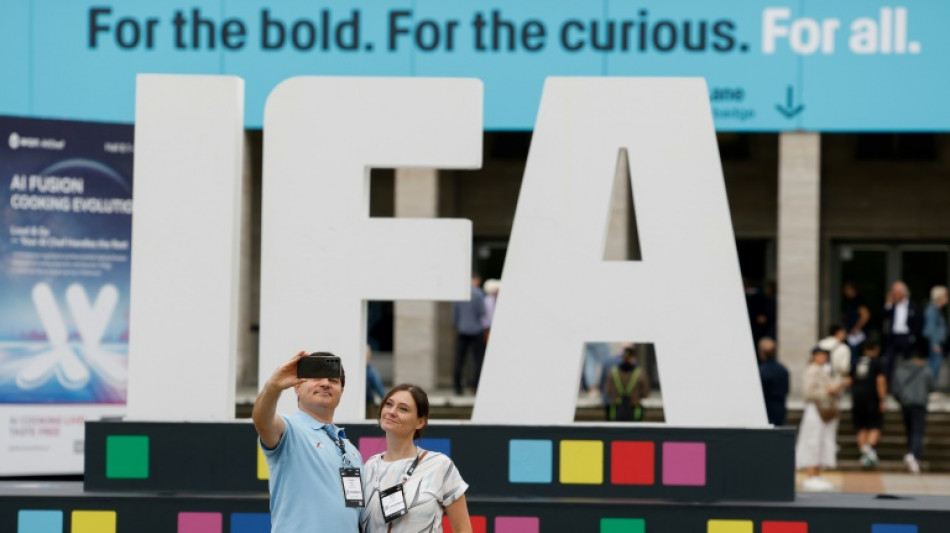
At consumer tech show, German firms fret about US tariffs / Photo: Odd ANDERSEN - AFP

At consumer tech show, German firms fret about US tariffs

Displaying one of her company's hot plates proudly labelled "Made in Germany", Sigrid Klenk concedes that maintaining production at home could become harder due in part to US tariffs.

Text size:

Continuing to make goods in Germany "is becoming less and less simple," Klenk, boss of the small firm Rommelsbacher, said at the IFA consumer tech show in Berlin.

Particularly problematic for Rommelsbacher, whose products range from kettles to coffee makers, is a 50-percent US levy on steel and aluminium.

"Now we have to specify the amount of steel contained in our products, especially our hot plates," she told AFP. "This has kept us very busy in recent days."

Europe's already struggling top economy is under huge pressure from President Donald Trump's tariff blitz -- official data released Monday showed German exports to the US plunged to their lowest level for nearly four years in July.

The concern was palpable at this year's IFA show in Berlin, where the ZVEI industry federation warned that German electronics exports to the US, the sector's second-largest market, could fall by as much as 20 percent.

While the European Union and Trump struck a deal in July agreeing on import levies of 15 percent on most goods from the bloc, there remains much uncertainty.

Businesses complain that, in reality, the list of products facing extra tariffs continues to grow.

As well as small- and medium-sized businesses, home appliance giants like Miele are worried.

"When consumers don't know what will happen tomorrow, it's the worst situation," and "it's the same for businesses", Markus Miele, the executive director of the group, told AFP.

The group has already had to raise prices as a result of the tariffs, he said.

- 'Costs too high' -

Adding to the company's problems is continued weak demand in many countries, he added -- pointing in particular to its home market, where consumers are reluctant to spend even after recent falls in inflation.

In contrast the economic situation is better in the US, he said, noting that Miele opened its first production site there even before the return of Trump, who is aiming with his tariffs to bring manufacturing jobs back to America.

The long-running woes of Germany's small businesses were plain to see at the IFA show -- even before the US tariffs, they had been battling problems from rising labour costs to high energy prices and a lack of skilled workers.

Vacuum cleaner maker Fakir, for instance, had to abandon production in Germany a year and a half ago.

"It was impossible to continue -- the costs were too high," said an employee, who spoke anonymously, at the show.

In contrast to ailing German manufacturers, Chinese companies at the event were attracting crowds with their innovations: such as robot vacuum cleaners that climb stairs and robotic arms that play chess.

Once considered of lower quality, their offerings are now giving German-made products a run for their money.

German companies are racing to keep up but it is an uphill battle. For now, many simply hope that consumers at home begin to spend again.

"I hope the Christmas season will bring a bit more enthusiasm to German consumers," said Klenk.

A.Ragab--DT