Dubai Telegraph - US, India to launch powerful Earth-monitoring satellite

EUR -
AED 4.311612
AFN 77.565377
ALL 96.656855
AMD 447.600202
ANG 2.10198
AOA 1076.581534
ARS 1691.478308
AUD 1.765918
AWG 2.113247
AZN 2.01835
BAM 1.954927
BBD 2.360846
BDT 143.246058
BGN 1.954927
BHD 0.440503
BIF 3464.553505
BMD 1.174026
BND 1.513824
BOB 8.099385
BRL 6.362867
BSD 1.172177
BTN 106.003682
BWP 15.531067
BYN 3.455558
BYR 23010.908476
BZD 2.357448
CAD 1.616643
CDF 2629.818358
CHF 0.934639
CLF 0.027241
CLP 1068.656894
CNY 8.282164
CNH 8.28179
COP 4464.207284
CRC 586.338272
CUC 1.174026
CUP 31.111687
CVE 110.215802
CZK 24.26806
DJF 208.736825
DKK 7.469934
DOP 74.516737
DZD 151.543355
EGP 55.577962
ERN 17.610389
ETB 183.151046
FJD 2.667147
FKP 0.877594
GBP 0.877448
GEL 3.180196
GGP 0.877594
GHS 13.455994
GIP 0.877594
GMD 85.703785
GNF 10194.449439
GTQ 8.977992
GYD 245.230535
HKD 9.139264
HNL 30.860225
HRK 7.534546
HTG 153.641418
HUF 384.603841
IDR 19528.454024
ILS 3.783645
IMP 0.877594
INR 106.348557
IQD 1535.514583
IRR 49452.902642
ISK 148.402175
JEP 0.877594
JMD 187.676226
JOD 0.832394
JPY 183.001239
KES 151.152529
KGS 102.668504
KHR 4692.905198
KMF 492.51368
KPW 1056.619069
KRW 1731.582749
KWD 0.360073
KYD 0.976864
KZT 611.327118
LAK 25411.656839
LBP 104967.345065
LKR 362.198323
LRD 206.88765
LSL 19.776072
LTL 3.466593
LVL 0.710156
LYD 6.367158
MAD 10.783786
MDL 19.815155
MGA 5192.68211
MKD 61.522538
MMK 2465.245374
MNT 4163.064053
MOP 9.399304
MRU 46.91006
MUR 53.910734
MVR 18.074307
MWK 2032.592699
MXN 21.156206
MYR 4.810333
MZN 75.032113
NAD 19.776072
NGN 1705.354848
NIO 43.140743
NOK 11.89627
NPR 169.606292
NZD 2.024882
OMR 0.449269
PAB 1.172177
PEN 3.946438
PGK 5.052745
PHP 69.402543
PKR 328.499066
PLN 4.223365
PYG 7873.485463
QAR 4.271993
RON 5.090456
RSD 117.327628
RUB 93.59064
RWF 1706.038465
SAR 4.405178
SBD 9.599718
SCR 17.642061
SDG 706.203215
SEK 10.890253
SGD 1.516524
SHP 0.880824
SLE 28.323378
SLL 24618.741306
SOS 668.701507
SRD 45.256347
STD 24299.966664
STN 24.489069
SVC 10.256422
SYP 12980.992867
SZL 19.769176
THB 37.093387
TJS 10.772192
TMT 4.120831
TND 3.42667
TOP 2.826773
TRY 50.124839
TTD 7.954449
TWD 36.788219
TZS 2901.105015
UAH 49.527192
UGX 4166.140334
USD 1.174026
UYU 45.999467
UZS 14121.696409
VES 313.981204
VND 30883.926447
VUV 141.687325
WST 3.258488
XAF 655.664327
XAG 0.01895
XAU 0.000273
XCD 3.172863
XCG 2.112557
XDR 0.815436
XOF 655.664327
XPF 119.331742
YER 280.008712
ZAR 19.813126
ZMK 10567.643175
ZMW 27.047926
ZWL 378.035875
  • SCS

    0.0200

    16.14

    +0.12%

  • RBGPF

    0.0000

    81.17

    0%

  • JRI

    -0.0200

    13.7

    -0.15%

  • NGG

    0.2400

    74.93

    +0.32%

  • BCC

    0.2500

    76.51

    +0.33%

  • RYCEF

    -0.2500

    14.6

    -1.71%

  • BTI

    -1.2700

    57.1

    -2.22%

  • RIO

    -1.0800

    75.66

    -1.43%

  • CMSC

    -0.1300

    23.3

    -0.56%

  • GSK

    -0.0700

    48.81

    -0.14%

  • BCE

    0.3100

    23.71

    +1.31%

  • RELX

    0.1000

    40.38

    +0.25%

  • CMSD

    -0.1500

    23.25

    -0.65%

  • BP

    -0.2700

    35.26

    -0.77%

  • VOD

    0.0500

    12.59

    +0.4%

  • AZN

    -0.4600

    89.83

    -0.51%

US, India to launch powerful Earth-monitoring satellite
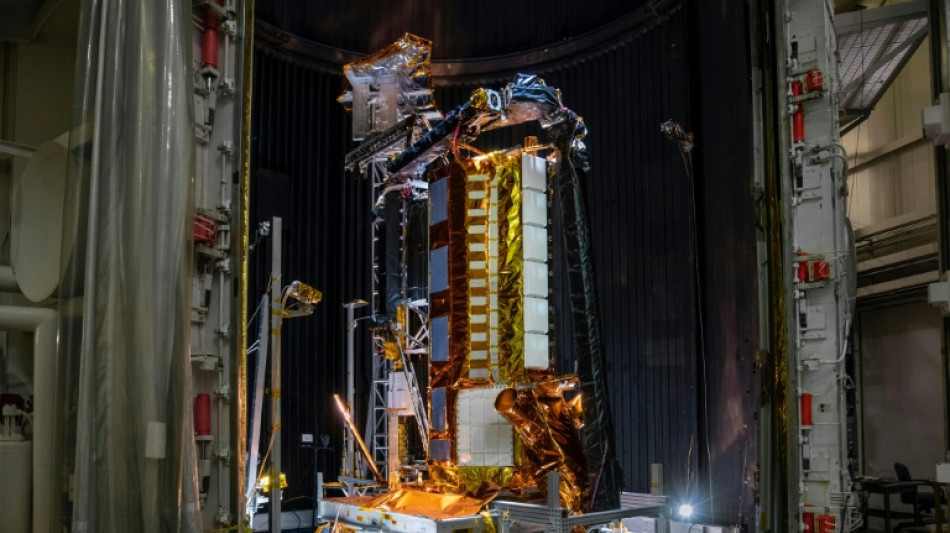
US, India to launch powerful Earth-monitoring satellite / Photo: - - NASA/AFP

US, India to launch powerful Earth-monitoring satellite

A formidable new radar satellite jointly developed by the United States and India is set to launch Wednesday, designed to track subtle changes in Earth's land and ice surfaces and help predict both natural and human-caused hazards.

Text size:

Dubbed NISAR (NASA-ISRO Synthetic Aperture Radar), the pickup truck-sized spacecraft is scheduled to lift off at 5:40 pm (1210 GMT) from the Satish Dhawan Space Centre on India's southeastern coast, riding an ISRO Geosynchronous Satellite Launch Vehicle rocket.

Highly anticipated by scientists, the mission has also been hailed as a milestone in growing US-India cooperation between President Donald Trump and Prime Minister Narendra Modi.

"Our planet surface undergoes constant and meaningful change," Karen St Germain, director of NASA's Earth Science division, told reporters.

"Some change happens slowly. Some happens abruptly. Some changes are large, while some are subtle."

By picking up on tiny changes in the vertical movement of the Earth's surface -- as little as one centimeter (0.4 inches) -- scientists will be able to detect the precusors for natural and human-caused disasters, from earthquakes, landsides and volcanoes to aging infrastructure like dams and bridges.

"We'll see land substance and swelling, movement, deformation and melting of mountain glaciers and ice sheets covering both Greenland and Antarctica, and of course, we'll see wildfires," added St Germain, calling NISAR "the most sophisticated radar we've ever built."

Equipped with a 12-meter dish that will unfold in space, NISAR will record nearly all of Earth's land and ice twice every 12 days from an altitude of 464 miles (747 kilometers).

- Microwave frequencies -

As it orbits, the satellite will continuously transmit microwaves and receive echoes from the surface.

Because the spacecraft is moving, the returning signals are distorted -- but computer processing will reassemble them to produce detailed, high-resolution images.

Achieving similar results with traditional radar would require an impractically large 12-mile-wide dish.

NISAR will operate on two radar frequencies: L-band and S-band. The L-band is ideal for sensing taller vegetation like trees, while the S-band enables more accurate readings of shorter plants such as bushes and shrubs.

NASA's Jet Propulsion Laboratory and India's ISRO shared the workload, each building components on opposite sides of the planet before integrating and testing the spacecraft at ISRO's Satellite Integration & Testing Establishment in the southern Indian city of Bengaluru.

NASA's contribution came to just under $1.2 billion, while ISRO's costs were around $90 million.

India's space program has made major strides in recent years, including placing a probe in Mars orbit in 2014 and landing a robot and rover on the Moon in 2023.

Shubhanshu Shukla, a test pilot with the Indian Air Force, recently became the second Indian to travel to space and the first to reach the International Space Station -- a key step toward India's own indigenous crewed mission planned for 2027 under the Gaganyaan ("sky craft") program.

H.Yousef--DT