Dubai Telegraph - Webb telescope directly observes exoplanet CO2 for first time

EUR -
AED 4.21081
AFN 73.380876
ALL 95.821367
AMD 434.905178
ANG 2.052472
AOA 1051.413124
ARS 1598.904666
AUD 1.629082
AWG 2.063842
AZN 1.94815
BAM 1.953805
BBD 2.323693
BDT 141.535462
BGN 1.959858
BHD 0.432824
BIF 3420.777931
BMD 1.146579
BND 1.473185
BOB 7.971763
BRL 6.019431
BSD 1.153753
BTN 106.983876
BWP 15.64616
BYN 3.516599
BYR 22472.950295
BZD 2.320396
CAD 1.57407
CDF 2602.734703
CHF 0.909206
CLF 0.026588
CLP 1049.842202
CNY 7.880495
CNH 7.914451
COP 4251.916593
CRC 538.855456
CUC 1.146579
CUP 30.384346
CVE 110.164988
CZK 24.455843
DJF 205.451403
DKK 7.472726
DOP 69.752456
DZD 152.054803
EGP 59.895114
ERN 17.198686
ETB 180.146883
FJD 2.544033
FKP 0.859302
GBP 0.864354
GEL 3.112902
GGP 0.859302
GHS 12.576583
GIP 0.859302
GMD 84.846638
GNF 10111.658098
GTQ 8.836977
GYD 241.360884
HKD 8.986944
HNL 30.535809
HRK 7.531859
HTG 151.205259
HUF 393.429124
IDR 19487.258327
ILS 3.571474
IMP 0.859302
INR 107.05179
IQD 1511.228056
IRR 1507751.511799
ISK 143.216573
JEP 0.859302
JMD 181.150555
JOD 0.812866
JPY 183.156266
KES 148.539438
KGS 100.2684
KHR 4620.188443
KMF 490.735959
KPW 1031.896421
KRW 1719.633639
KWD 0.351839
KYD 0.961378
KZT 556.553574
LAK 24756.252748
LBP 103330.654412
LKR 359.238936
LRD 211.11834
LSL 19.257861
LTL 3.385549
LVL 0.693554
LYD 7.361959
MAD 10.796099
MDL 20.115493
MGA 4805.056884
MKD 61.648715
MMK 2407.934705
MNT 4094.550606
MOP 9.313745
MRU 46.048011
MUR 53.327419
MVR 17.726477
MWK 2000.558306
MXN 20.431294
MYR 4.515167
MZN 73.268833
NAD 19.257861
NGN 1563.566729
NIO 42.454976
NOK 10.999878
NPR 171.188773
NZD 1.971474
OMR 0.440833
PAB 1.153653
PEN 3.939777
PGK 4.977893
PHP 68.883603
PKR 322.29402
PLN 4.274842
PYG 7456.88075
QAR 4.195092
RON 5.092302
RSD 117.454414
RUB 96.173121
RWF 1684.110645
SAR 4.305014
SBD 9.224504
SCR 16.621753
SDG 689.093572
SEK 10.790324
SGD 1.471256
SHP 0.860231
SLE 28.263454
SLL 24043.20278
SOS 659.356045
SRD 42.853431
STD 23731.872367
STN 24.479805
SVC 10.094188
SYP 126.795321
SZL 19.263192
THB 37.591168
TJS 11.034483
TMT 4.013027
TND 3.394818
TOP 2.760687
TRY 50.815525
TTD 7.820446
TWD 36.667914
TZS 2982.515766
UAH 50.737264
UGX 4340.059947
USD 1.146579
UYU 46.717588
UZS 14068.228386
VES 517.041634
VND 30172.228929
VUV 137.122676
WST 3.134408
XAF 655.416296
XAG 0.015356
XAU 0.000237
XCD 3.098687
XCG 2.079131
XDR 0.815131
XOF 655.419151
XPF 119.331742
YER 273.545132
ZAR 19.480092
ZMK 10320.594636
ZMW 22.561486
ZWL 369.198001
  • RBGPF

    0.1000

    82.5

    +0.12%

  • CMSC

    -0.1200

    22.83

    -0.53%

  • BCC

    -1.0800

    71.84

    -1.5%

  • RYCEF

    -0.2100

    16.6

    -1.27%

  • RELX

    -0.4300

    33.86

    -1.27%

  • CMSD

    0.0100

    22.89

    +0.04%

  • RIO

    -2.0800

    87.72

    -2.37%

  • NGG

    -3.0200

    87.4

    -3.46%

  • BCE

    -0.2600

    25.75

    -1.01%

  • GSK

    -1.3500

    52.06

    -2.59%

  • JRI

    -0.1370

    12.323

    -1.11%

  • BTI

    -2.4600

    58.09

    -4.23%

  • AZN

    -2.8700

    188.42

    -1.52%

  • BP

    0.7600

    44.61

    +1.7%

  • VOD

    -0.3800

    14.37

    -2.64%

Webb telescope directly observes exoplanet CO2 for first time
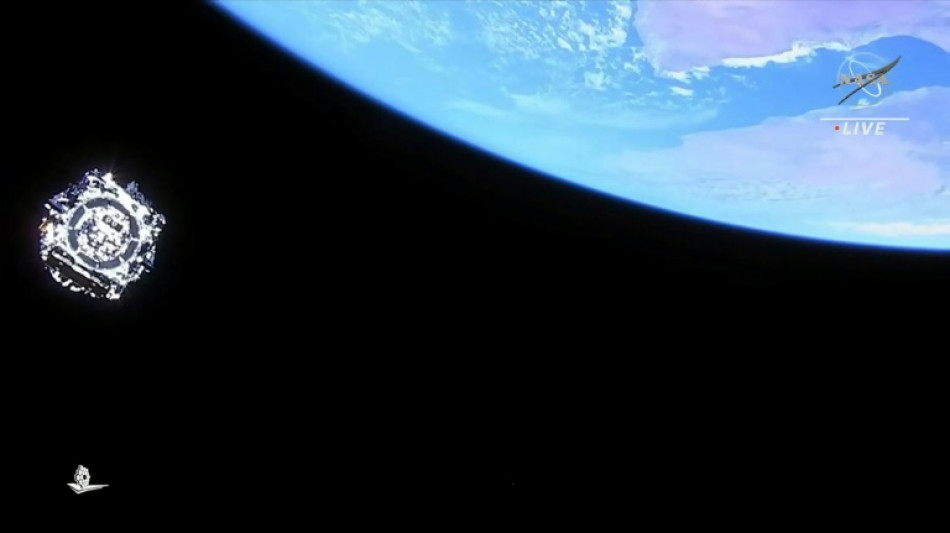
Webb telescope directly observes exoplanet CO2 for first time / Photo: - - NASA TV/AFP/File

Webb telescope directly observes exoplanet CO2 for first time

The James Webb Space Telescope has directly observed the key chemical of carbon dioxide in planets outside of our solar system for the first time, scientists announced Monday.

Text size:

The gas giants are not capable of hosting extraterrestrial life, but do offer clues in a lingering mystery about how distant planets form, according to a study in The Astrophysical Journal.

The HR 8799 system, 130 light years from Earth, is only 30 million years old -- just a baby compared to our solar system's 4.6 billion years.

A US-led team of researchers used Webb to directly detect carbon dioxide in the atmosphere of all four of the system's known planets, according to the study.

They used Webb's coronagraph instruments, which block the light from bright stars to get a better view of the planets revolving around them.

"It's like putting your thumb up in front of the Sun when you're looking up at the sky," lead study author William Balmer, an astrophysicist at Johns Hopkins University, told AFP.

Normally, the Webb telescope only detects exoplanets by glimpsing them when they cross in front of their host star.

This "transiting method" was how Webb indirectly detected CO2 in the atmosphere of the gas giant WASP-39 in 2022.

But for latest discovery, "we're actually seeing the light that is emitted from the planet itself, as opposed to the fingerprint of that light from the host star," Balmer said.

This is not easy -- Balmer compared the process to using a torch to spot fireflies next to a lighthouse.

While these gas giants may not be able to host life, it is possible that they had moons that could, he added.

There are missions currently under way to find out if there could be life in the vast oceans underneath the icy shells of several of Jupiter's moons.

- 'Key piece of proof' -

Carbon dioxide (CO2) is essential for life on Earth, making it a key target in the search for life elsewhere.

Because CO2 condenses into little ice particles in the deep cold of space, its presence can shed light on planetary formation.

Jupiter and Saturn are believed to have first formed from a "bottom up" process in which a bunch of tiny, icy particles came together into a solid core which then sucked in gas to grow into giants, Balmer said.

So the new discovery is a "key piece of proof" that far-off planets can form in a similar way to those in our celestial backyard, Balmer said.

But how common this is throughout the universe remains unclear.

Astronomers have now discovered nearly 6,000 exoplanets, many of them massive -- and none of them known to be habitable.

The "huge leap forward we need to make" is to focus on smaller Earth-sized worlds, Balmer said.

NASA's Nancy Grace Roman space telescope will use a coronagraph to do that just after its planned launch in 2027.

Balmer hopes to use Webb to observe more four-planet systems, but added that future funding was now in question.

Last week the Trump administration announced that NASA's chief scientist has been dismissed, indicating that more cuts were to come for the US space agency.

Y.Chaudhry--DT