Nickel Steel Forgings: Essential for Cryogenic Cooling / Photo: © A cryogenic valve body of a nickel-alloy steel: seawater resistant, non-embrittling, and sealed! (The image rights are held by the author of the message.)
Forgings of Nickel Steels, like Valves and Fittings, Make Cooling of Superconductive Coils Possible for Strong Magnetic Fields in Science and Medicine
Cryogenics plays a crucial role in various essential fields, including hydrogen and nitrogen processing, LNG transportation, scientific research involving nuclear fusion reactors and particle accelerators, as well as medical imaging technologies like MRI. Building on our articles on "Grain Flow Forging" and "Monel® and 316L for Cryogenics", which covered the basics of forging techniques and cryogenic steel, this article delves deeper into practical and detailed applications.
Nickel (Ni) is used as an alloying element in steels to enhance their toughness and ductility at low temperatures. Steels with a nickel content of 9% or higher are considered resistant to low temperatures and free from embrittlement. Two chromium-nickel steels play a crucial role, not only in cryogenics: 304 and 316, which are two of the most widely used stainless steel grades, each suited to specific applications due to their unique properties.
**Stainless Steels 304 and 316 - The Major Chromium-Nickel Alloys Across Industries**
304 stainless steel, often marked as "18/8" or "18/10" on cutlery and cookware due to its 18% chromium and 8-10% nickel content, offers excellent corrosion resistance. It is ideal for general applications such as kitchen equipment, piping, valves, and boiler components. However, its resistance to chlorides and saltwater is limited, making it less suitable for more aggressive environments. While commonly used for cutlery, it is not recommended for kitchen knives, where carbon steels like Damascus steel and specialised knife alloys, such as X50CrMoV15, should be preferred. Some further knife steels renowned for their superior edge retention and sharpening properties include: S35VN, 440C; XC75; VG-10, all of which are generally harder than 304 steel.
316 stainless steel, by contrast, contains about 16-18% chromium, 10-13% nickel, and 2-3% molybdenum. The addition of molybdenum enhances its resistance to pitting and crevice corrosion, especially in chloride-rich or marine environments. This makes 316 the preferred choice for chemical processing, the food industry, marine equipment, medical devices, and, of course, cryogenics. Many sub-varieties with specific properties, such as 1.4404, 1.4435, and 1.4571, exist. With the abbreviation "F" for forged and "L" for reduced (low) carbon content to improve weldability, F316L is the most requested variant of 316 for forged components in the industrial valve, boiler, and piping industries.
While 316 is better for corrosion resistance, it is less hard. Steels with even higher corrosion resistance are duplex steels and copper-nickel superalloys such as Monel®, which are also great for high-temperature applications like rocket engines and power plants, even when they cannot undergo the same high levels of hardening.
**Liquefied Gases: Hydrogen, Methane, and LNG - Fundamentals of the Energy Transition**
Cryogenics plays a crucial role in the storage and transport of liquefied gases such as hydrogen and LNG (Liquefied Natural Gas). Hydrogen is liquefied at extremely low temperatures (-253°C), significantly increasing its density and enabling efficient storage. LNG, liquefied at -162°C, is a key component in global energy supply. Methane (CH4), the main constituent of natural gas, is used in certain concepts through methanation as an intermediate storage medium, binding hydrogen in a more transportable form. These technologies are vital for the energy transition and, when applied correctly, can contribute to reducing CO2 emissions. Because of the pressures involved, forgings such as valve bodies and fittings must comply with the stringent requirements of the Pressure Equipment Directive (PED). The same applies to pipelines and pressure vessels.
**Science Applications**
While cryogenics is already crucial for the processing of "cold" fluids and gases, it is absolutely essential for the cooling of superconducting magnetic coils in particle storage rings where powerful electromagnets keep particles away from the reactor walls, whether it be the 27-kilometre-long particle accelerator at CERN or the fusion reactors like ITER, with a core (the Tokamak) measuring almost 20 metres in diameter and 12 metres in height. These technologies enable the precise control required for high-energy physics experiments, such as particle collisions and the containment of plasma in fusion reactions, pushing the boundaries of scientific discovery.
These cutting-edge facilities rely on advanced cryogenic technology to maintain the extreme conditions required for their operations. Nuclear fusion is still at the science level, and viable solutions are still decades away. However, for generations to come, it could provide an option for endless, clean energy.
**Advancements in Medical Engineering and Biotechnological Applications**
Cryogenic technology enables the generation of the strong magnetic fields required for high-resolution imaging, which has revolutionised diagnostic medicine and advanced our understanding of the human body. The same mechanism described earlier is applied in large magnetic coils in MRI - the sophisticated medical imaging technology of today. Without ultra-deep cooling using liquid helium at -269°C, superconducting magnetic coils would not exist, and MRI would not be possible.
Cryo-Cooling technology is crucial for biological preservation. Liquid nitrogen is used to store cells such as sperm and eggs, tissues, and even entire organs for transplants or long-term storage, preserving their viability for decades. An extreme example is the controversial cryopreservation of deceased individuals (cryonics), with the hope of future revival. This unproven field relies on currently unattainable assumptions but still has a small niche market.
**About the Author**
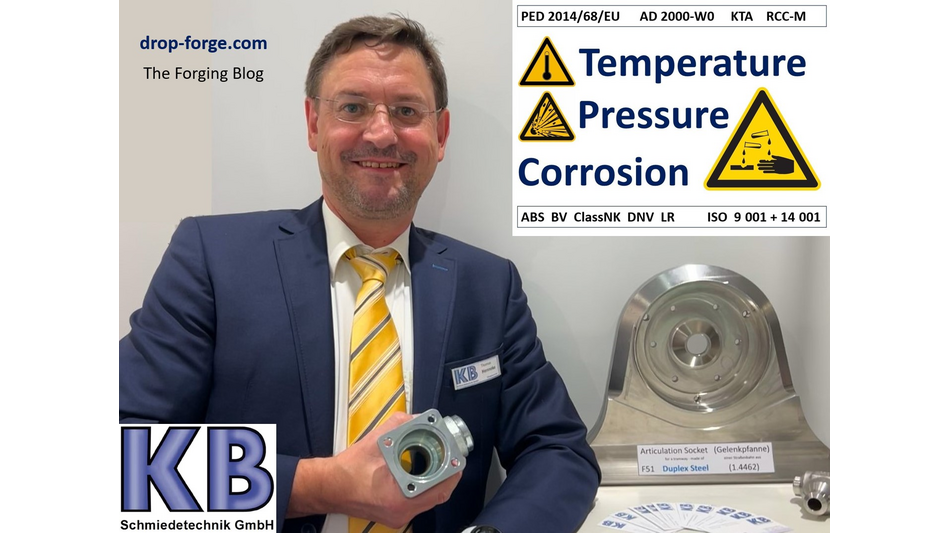
Thomas Henneke is a graduate mathematician with a focus on physics, mechanics, and geometry. Since 2010, he has been the Technical Director and co-partner of the precision drop forge KB Schmiedetechnik GmbH in Western Germany. An enthusiast for energy technology and innovative steel applications, he occasionally writes popular science articles on forging techniques, advanced materials, and the charm of his home region: Hagen-Iserlohn-Sauerland. On his blog at drop-forge.com, one can also find further information about the forging equipment and services of the company, as well as additional material about forged valves for cryo, hydro, and nuclear applications. The same applies to pipelines and pressure vessels.
Company description
The drop forge KB Schmiedetechnik GmbH in Germany boasts decades worth of experience as a trusted supplier of pressurised forgings, including valve bodies for pressure applications in the energy sector, such as nuclear-grade forged components and ultra-high-pressure applications. Additionally, the company has extensive expertise in working with chromium-nickel steels like F304, F316L, and duplex steels, as well as nickel-based superalloys like Monel®, tailored for embrittling environments and demanding media or fluids such as seawater, hydrogen, LNG, nitrogen, and cryogenics.
Company-Contact
KB Schmiedetechnik GmbH - precision forge
Thomas Henneke
Buschmühlenstr. 62
58093 Hagen
+49233135080
https://kb-schmiedetechnik.de/about-us.html
Press
KB Schmiedetechnik GmbH - a German drop forge
Thomas Henneke
Buschmühlenstr. 62
58093 Hagen
+492331350855
https://drop-forge.com
I.El-Hammady--DT