
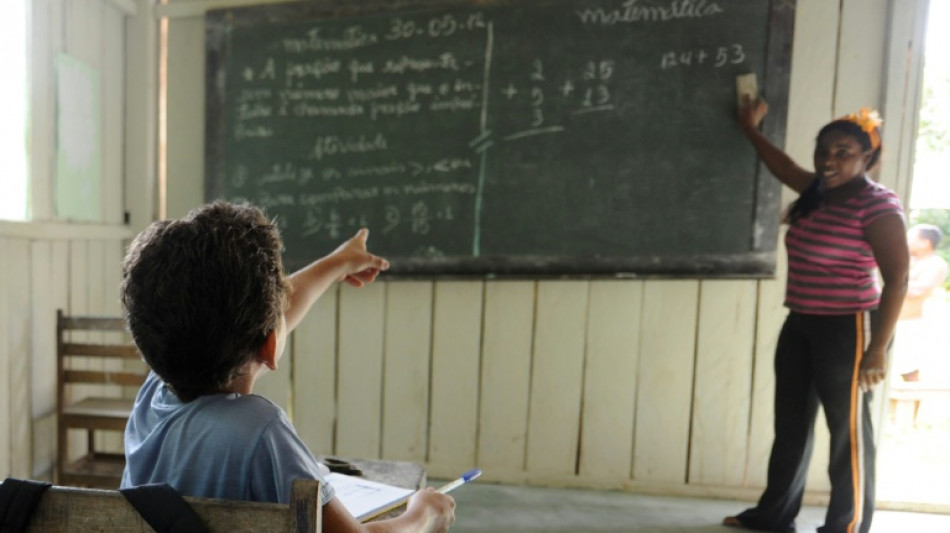
Schools targeted with AI learning apps despite experts' doubts / Photo: EVARISTO SA - AFP/File
Apps infused with AI are being marketed to schools across the world and governments are rushing to embrace the technology, despite experts raising serious doubts.
The sector known as Ed Tech exploded during the Covid pandemic as schools closed to stop the spread of infection and millions of children were forced to learn in front of screens at home.
As demand dried up after schools reopened, Ed Tech startups tried to win back investment by adding AI to their products and marketing.
Tech titans like Microsoft, Meta and OpenAI have also spied an opportunity, promoting their AI products to schools or partnering with startups.
While many education ministries have announced plans to deploy AI apps, there are plenty of dissenting voices.
The UN's education body UNESCO last year eviscerated the record of online learning during Covid, saying the rapid rollout of tech solutions was a "tragedy" that had increased inequality and worsened learning outcomes.
UNESCO's Manos Antoninis told AFP that AI might have some utility in education but right now it "seems to be creating more problems than it is solving".
He cited concerns that companies were using data for commercial purposes, deployed biased algorithms and overall were less concerned with educational outcomes than with their bottom line.
"I think the unfortunate thing is that education has been used as a bit of a Trojan horse to access future consumers," he said.
- 'Ease the pressure' -
During the pandemic boom in 2021, venture capitalists pumped more than $17 billion into Ed Tech. But that has slumped to $3 billion this year, about the same as last year, according to analysts PitchBook.
But from North Carolina to South Korea it is a different story, where education officials have been encouraging teachers to use generative AI.
Britain has already rolled out a homework app called Sparx Maths that uses algorithms to tailor children's learning.
It recently announced a further multimillion-dollar outlay on AI programmes to "ease the pressure" on hard-working teachers by helping with lesson plans, marking and assessment.
The European Union supports several learning apps, and several EU countries have experimented with them.
China is a huge booster of AI in the classroom and has a national strategy for digitising education -- its centrepiece being a national education platform of tools and online courses.
Yet the on-the-ground reality is often messy.
India boasted one of the liveliest startup scenes in the sector during the pandemic, including a firm called BYJU's which was once the world's most valuable Ed Tech startup.
Yet when schools in New Delhi were forced to close because of smog last month, there were no flashy apps to help.
"It is not feasible for them to take online classes," 29-year-old teacher Vandana Pandey told AFP, saying many of her pupils had no smartphones or connectivity at home.
BYJU's has faced allegations of financial misconduct and only narrowly avoided bankruptcy in a recent court hearing.
In richer countries, the arrival of AI has received a tepid reception.
Only six percent of US secondary school teachers polled by Pew Research Center in May thought using AI in education would do more good than harm.
France announced it would roll out an AI-powered homework app called MIA in secondary schools earlier this year, but quietly dropped the project as a political crisis rumbled on.
Many British parents are also not keen on Sparx Maths.
"Don't know a single child that likes it," said one user on the popular Mumsnet forum.
Another said the app "ruins any enjoyment of the subject" while a flood of other parents said their children "hated" the app.
- 'More like isolation' -
Aside from grievances over individual apps, educators doubt whether many of these firms are aiming at the right target.
Almost all Ed Tech products promise to "personalise" education, often deploying AI to monitor a child's work and tailor workplans to suit their needs.
Officials from Britain to Beijing have lauded this goal.
But Antoninis said the rhetoric around personalisation "risks making us forget that a lot of learning is actually social, and children learn from interaction with each other".
Leon Furze, a former teacher who now works as a consultant focusing on generative AI in education, was also wary about personalisation.
"AI is touted as a solution to personalised learning, but it's a very specific kind of 'personal' which I think seems more like isolation," he told AFP.
Both Antoninis and Furze warned that technology was no panacea, rather it was a tool that could help in some limited situations.
The hard work, as ever, would be done by humans.
"Tech solutions aren't going to solve the bigger socio-economic, cultural, and political challenges being faced by teachers and students," said Furze.
Y.Amjad--DT



