Dubai Telegraph - Latest sandstorm brings Iraq to standstill

EUR -
AED 4.32145
AFN 75.308617
ALL 95.344815
AMD 432.885163
ANG 2.106168
AOA 1080.216545
ARS 1644.790435
AUD 1.62497
AWG 2.121013
AZN 1.96537
BAM 1.95566
BBD 2.370251
BDT 144.659675
BGN 1.962866
BHD 0.444172
BIF 3503.013705
BMD 1.176706
BND 1.494325
BOB 8.13142
BRL 5.767629
BSD 1.176836
BTN 112.105428
BWP 15.823005
BYN 3.290993
BYR 23063.437841
BZD 2.366861
CAD 1.608133
CDF 2665.23869
CHF 0.916325
CLF 0.026653
CLP 1048.97409
CNY 8.002484
CNH 7.995035
COP 4405.716748
CRC 539.366086
CUC 1.176706
CUP 31.182709
CVE 110.211708
CZK 24.33328
DJF 209.568604
DKK 7.472689
DOP 69.675619
DZD 155.645536
EGP 62.132784
ERN 17.65059
ETB 183.753846
FJD 2.570456
FKP 0.863046
GBP 0.864932
GEL 3.147731
GGP 0.863046
GHS 13.286165
GIP 0.863046
GMD 86.489882
GNF 10326.394586
GTQ 8.981581
GYD 246.144523
HKD 9.212743
HNL 31.292032
HRK 7.533033
HTG 154.022279
HUF 355.96887
IDR 20489.393439
ILS 3.422508
IMP 0.863046
INR 112.08566
IQD 1541.709613
IRR 1543249.935145
ISK 143.805346
JEP 0.863046
JMD 185.658326
JOD 0.834331
JPY 184.89523
KES 151.983825
KGS 102.902841
KHR 4721.66299
KMF 491.863379
KPW 1059.03536
KRW 1733.232385
KWD 0.362296
KYD 0.980738
KZT 545.225718
LAK 25816.376745
LBP 105385.873658
LKR 379.076165
LRD 215.367373
LSL 19.341984
LTL 3.474507
LVL 0.711777
LYD 7.443595
MAD 10.729934
MDL 20.170732
MGA 4892.692362
MKD 61.6406
MMK 2470.52538
MNT 4208.732973
MOP 9.490444
MRU 46.991045
MUR 54.987238
MVR 18.123661
MWK 2040.671689
MXN 20.259042
MYR 4.615631
MZN 75.203378
NAD 19.341984
NGN 1605.721178
NIO 43.308749
NOK 10.829465
NPR 179.367722
NZD 1.978702
OMR 0.452325
PAB 1.176816
PEN 4.043011
PGK 5.111722
PHP 71.930848
PKR 327.840572
PLN 4.239825
PYG 7233.452974
QAR 4.299921
RON 5.210927
RSD 117.376466
RUB 86.961918
RWF 1721.091783
SAR 4.414745
SBD 9.436514
SCR 16.472104
SDG 706.593251
SEK 10.874763
SGD 1.493969
SHP 0.87853
SLE 29.005976
SLL 24674.932214
SOS 672.557712
SRD 44.007618
STD 24355.438695
STN 24.498668
SVC 10.297396
SYP 130.08242
SZL 19.335949
THB 38.147639
TJS 11.015254
TMT 4.118471
TND 3.414478
TOP 2.833226
TRY 53.396924
TTD 7.977498
TWD 36.935979
TZS 3071.203
UAH 51.719148
UGX 4424.721787
USD 1.176706
UYU 46.917313
UZS 14289.162258
VES 587.453968
VND 30976.785774
VUV 139.531196
WST 3.185457
XAF 655.915758
XAG 0.014498
XAU 0.000252
XCD 3.180107
XCG 2.120976
XDR 0.815749
XOF 655.921332
XPF 119.331742
YER 280.791457
ZAR 19.35199
ZMK 10591.767529
ZMW 22.250695
ZWL 378.898856
  • RBGPF

    0.7000

    63.61

    +1.1%

  • AZN

    0.3300

    182.85

    +0.18%

  • RIO

    2.2700

    105.38

    +2.15%

  • CMSC

    0.1400

    23.11

    +0.61%

  • BCE

    -0.4300

    24.14

    -1.78%

  • BP

    -0.4700

    43.34

    -1.08%

  • CMSD

    0.1140

    23.534

    +0.48%

  • GSK

    -0.0900

    50.41

    -0.18%

  • BTI

    0.2000

    58.28

    +0.34%

  • NGG

    0.9800

    86.89

    +1.13%

  • RYCEF

    -0.4100

    16.37

    -2.5%

  • VOD

    0.5100

    16.2

    +3.15%

  • JRI

    0.0000

    13.15

    0%

  • RELX

    0.0759

    33.58

    +0.23%

  • BCC

    -2.0900

    70.67

    -2.96%

Latest sandstorm brings Iraq to standstill
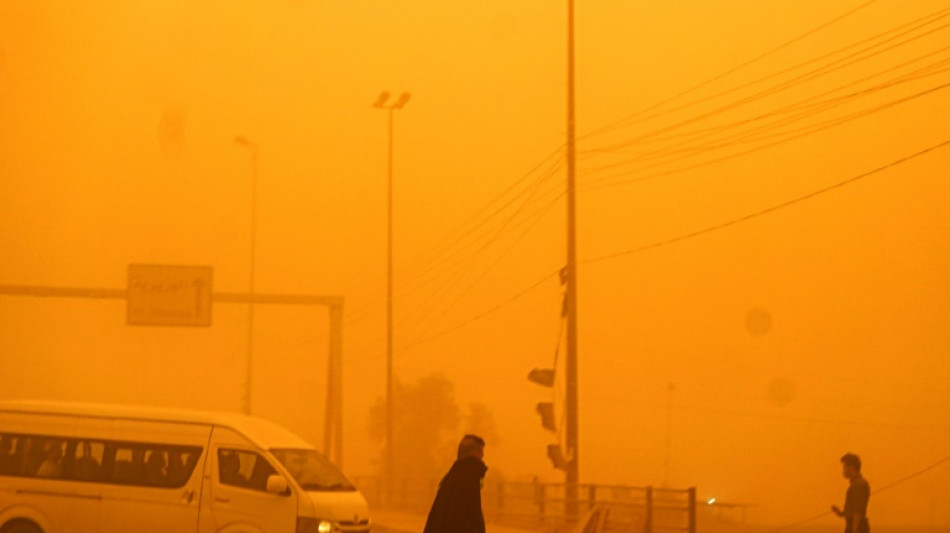
Latest sandstorm brings Iraq to standstill / Photo: Sabah ARAR - AFP

Latest sandstorm brings Iraq to standstill

Another sandstorm that descended Monday on Iraq sent at least 2,000 people to hospital with breathing problems and led to the closure of airports, schools and public offices across the country.

Text size:

It is the eighth duststorm since mid-April to hit Iraq, which has been battered by soil degradation, intense droughts and low rainfall linked to climate change.

The last one earlier this month led to the death of one person while 5,000 others had to be hospitalised for respiratory problems.

On Monday a thick cloud of dust enveloped the capital Baghdad in an orange glow and blanketed many other cities including the Shiite shrine city of Najaf to the south, and Sulaimaniyah, in the northern Kurdish autonomous region, AFP correspondents said.

Yellow and orange sand covered building roofs, cars and even crept into homes.

Authorities in seven of Iraq's 18 provinces, including Baghdad, ordered government offices to shut.

But health facilities remained open to assist those most at risk, including the elderly and people suffering from chronic respiratory diseases and heart ailments.

By midday at least 2,000 people were admitted to hospitals across Iraq in need of oxygen, said health ministry spokesman Seif al-Badr.

AFP correspondents saw around 20 patients, most of them elderly men, at Baghdad's Sheikh Zayed Hospital.

One of them was Hadi Saada, 70, lying on his side on a bed in the intensive care unit hooked to a respirator. He struggled to breathe.

- 'Suffocating from dust' -

"It is his third time in hospital" since the sandstorms began in April, said his son Mohammed Saada, adding that his father had a heart condition.

Another patient, Khaled Jassem, 70, was also hooked to an oxygen tank.

"We've been here since 8:00 am... My father has a heart ailment, diabetes, hypertension and is suffocating on the dust," said his son Walid Jassem.

At least 75 people struggling to breathe were admitted Monday to Sheikh Zayed, said Talib Abdelmoneim Nejm, one of the ICU officials.

The sandstorm drastically reduced visibility to just 300 metres (yards) at Baghdad airport, prompting authorities to close airspace and halt flights, state-run INA news agency reported.

Airports in Najaf and Sulaimaniyah were also closed for the day, the agency said.

Schools nationwide were also shuttered and end of year exams postponed to Tuesday. Universities also delayed exams.

The latest sandstorm was expected to gradually dissipate by Monday evening, weather services said.

The Middle East has always been battered by dust and sandstorms but they have become more frequent and intense in recent years.

The trend has been associated with overuse of river water, more dams, overgrazing and deforestation.

Iraq is rich in oil and is known in Arabic as the land of the two rivers -- in reference to the legendary Tigris and Euphrates rivers.

In April, an environment ministry official warned that Iraq could face "272 days of dust" a year over the next two decades.

tgg/hkb/it

J.Chacko--DT