
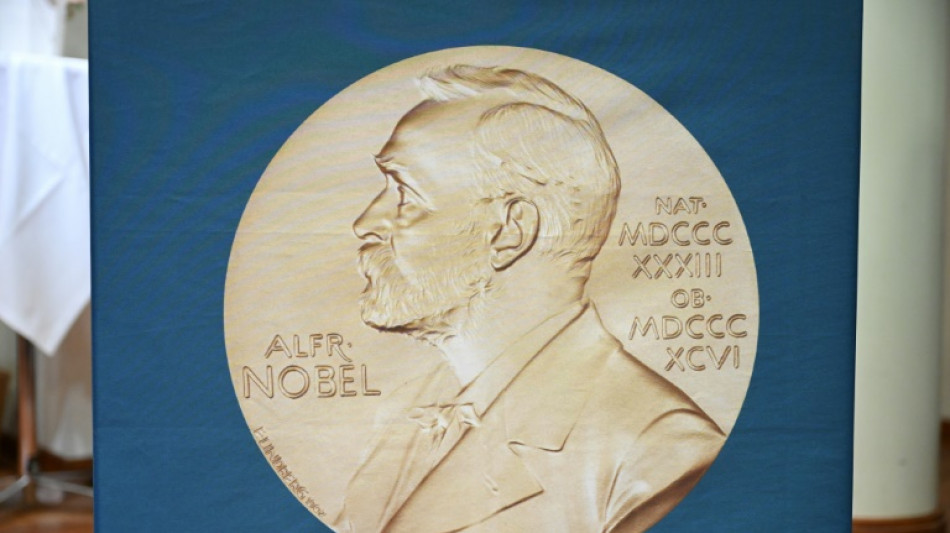
Light or new materials tipped for Nobel Physics Prize / Photo: Jonathan NACKSTRAND - AFP
Research into light, new materials and cosmic exploration are seen as possible contenders for Tuesday's Nobel Physics Prize, though experts warn it is difficult to predict a winner in the vast field.
The award, to be announced at 11:45 am (0945 GMT) in Stockholm, is the second Nobel of the season after the Medicine Prize on Monday went to mRNA researchers Katalin Kariko and Drew Weissman for their groundbreaking technology that paved the way for messenger RNA (mRNA) Covid-19 vaccines.
Lars Brostrom, science editor at Swedish Radio, told AFP ahead of the Physics Prize announcement that while it was "as usual hard to know" who would win, one potential laureate was French-Swedish atomic physicist Anne L'Huillier.
She could be honoured for her work into "really short laser pulses that allow you to follow the super-fast movement of electrons inside molecules," Brostrom said.
L'Huillier was one of the recipients of last year's prestigious Wolf Prize, whose laureates occasionally go on to win the Nobel.
Only four women have won the Nobel Physics Prize since the award was first handed out in 1901: Marie Curie (1903), Maria Goeppert Mayer (1963), Donna Strickland (2018) and Andrea Ghez (2020).
Another woman believed to be in the running this year, according to Brostrom, is Denmark's Olga Botner, whose work focuses on exploring the universe with cosmic neutrinos -- technology used in the IceCube Observatory in Antarctica.
- Another quantum prize? -
Magazine Physics World noted that three of the last six Physics Prizes have honoured research in astronomy, astrophysics and cosmology, making it unlikely that work associated with the James Webb Space Telescope would receive the nod this year.
But it would likely be in the committee's sights in the future, it said.
Last year, Alain Aspect of France, John Clauser of the United States and Austria's Anton Zeilinger won the Nobel for their work into quantum entanglement, a concept once dismissed by Albert Einstein as "spooky action".
Physics World admitted it "might seem foolish" to predict another prize in the field of quantum mechanics, but the field still had many deserving scientists, it said.
"Quantum computing has grown in leaps and bounds over the past few decades," it said, citing Spain's Ignacio Cirac, the UK's David Deutsch, Peter Shor of the US and Austria's Peter Zoller as potential candidates.
Other notables in the field of quantum mechanics are Israeli Yakir Aharonov and Briton Michael Berry, who have both made discoveries which now bear their names.
David Pendlebury, head of analytics group Clarivate that keeps an eye on potential Nobel science laureates, told AFP the prize "may come back to something more practical" this year.
He pointed to the work of Stuart P. Parkin of Britain, a pioneer in the field of spintronic materials, which has been critical in the increased data density and storage capabilities of computer disk drives.
- Light -
Clarivate also put US physicist Sharon Glotzer among its top picks, for "introducing strategies to control the assembly process to engineer new materials."
Italian-American Federico Capasso was also mentioned for research into photonics -- the science of lightwaves -- and contributing to the invention and development of the quantum cascade laser.
Previous years have also seen work into light tipped for the prize, with many pointing to Britain's John B. Pendry, who has become famous for his "invisibility cloak," where he uses materials to bend light to make objects invisible.
Research into photovoltaics -- the conversion of light into electricity -- and work into the conductive properties of twisted graphene have also sparked buzz among commentators.
The Physics Prize will be followed by the Chemistry Prize on Wednesday, with the highly watched Literature and Peace Prizes to be announced on Thursday and Friday respectively.
The Economics Prize -- created in 1968 and the only Nobel not included in the 1895 will of Swedish inventor and philanthropist Alfred Nobel founding the awards -- closes out the 2023 Nobel season on Monday.
D.Naveed--DT



