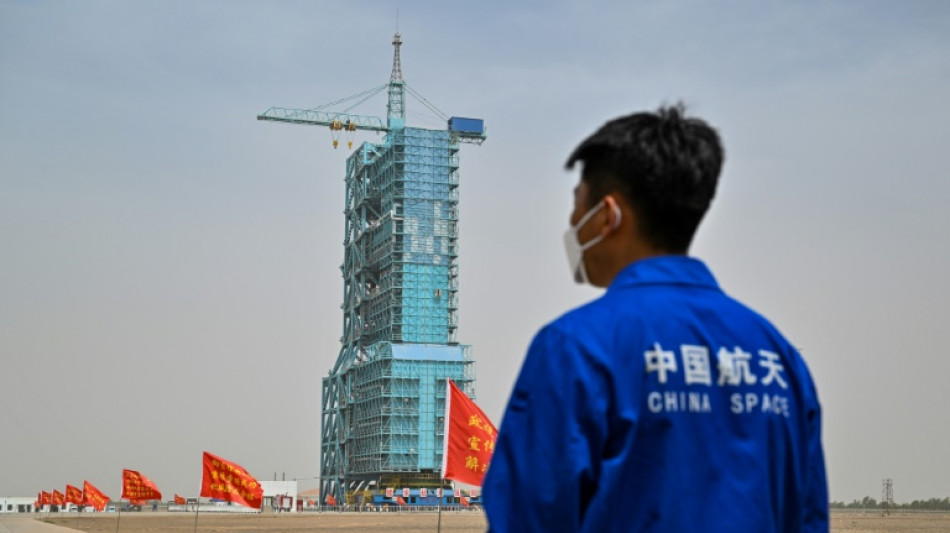
China to send first civilian astronaut to space station / Photo: Hector RETAMAL - AFP
China will send three astronauts to its Tiangong space station on Tuesday, putting a civilian scientist into space for the first time as Beijing pursues plans to send a manned mission to the Moon by the end of the decade.
The world's second-largest economy has invested billions of dollars in its military-run space programme, trying to catch up with the United States and Russia.
The Shenzhou-16 spacecraft will take off atop a Long March 2F rocket from the Jiuquan Satellite Launch Centre in northwest China at 9:31 am (0131 GMT), the China Manned Space Agency (CMSA) said.
It will be carrying mission commander Jing Haipeng on his fourth extra-terrestrial trip, as well as engineer Zhu Yangzhu and Beihang University professor Gui Haichao, the first Chinese civilian in space.
The Tiangong is the crown jewel of China's programme, which has also seen it land robotic rovers on Mars and the Moon and made it the third country to put humans in orbit.
The mission is the first to the Tiangong space station since it entered its "application and development" stage, Beijing said.
Once in orbit, the Shenzhou-16 will dock at the space station's Tianhe core module, before the crew meet three colleagues from the previous manned Shenzhou-15 flight, who have been at the space station for six months and will return to Earth in the coming days.
The mission will "carry out large-scale, in-orbit experiments... in the study of novel quantum phenomena, high-precision space time-frequency systems, the verification of general relativity, and the origin of life," CMSA spokesperson Lin Xiqiang told reporters on Monday.
The space station was resupplied with drinking water, clothing, food and propellant this month in preparation for Shenzhou-16's arrival.
One expert told AFP that Tuesday's flight represented "a regular crew rotation flight as one crew hands over to another", but even that was significant.
"Accumulating depth of experience in human spaceflight operations is important and doesn't involve new spectacular milestones all the time," said Jonathan McDowell, an astronomer and astrophysicist at the Harvard–Smithsonian Center for Astrophysics.
- 'Heavenly palace' -
Plans for China's "space dream" have been put into overdrive under President Xi Jinping.
China is planning to build a lunar base, and CMSA spokesman Lin reaffirmed on Monday Beijing's plan to land a manned mission on the Moon by 2030.
"The overall goal is to achieve China's first manned landing on the Moon by 2030 and carry out lunar scientific exploration and related technological experiments," he said.
The final module of the T-shaped Tiangong -- which means "heavenly palace" -- successfully docked with the core structure last year.
The station carries several pieces of cutting-edge scientific equipment, state news agency Xinhua reported, including "the world's first space-based cold atomic clock system".
The Tiangong is expected to remain in low Earth orbit at between 400 and 450 kilometres (250 and 280 miles) above the planet for at least 10 years.
It is constantly crewed by rotating teams of three astronauts.
China has been effectively excluded from the International Space Station since 2011, when the United States banned NASA from engaging with the country -- pushing Beijing to develop the Tiangong.
China's space agency reiterated on Monday it is actively seeking international cooperation in the project.
China "is looking forward to and welcomes the participation of foreign astronauts in the country's space station flight missions", Lin said.
Beijing plans to send two manned space missions to the space station every year, according to the CMSA.
The next will be Shenzhou-17, which is expected to be launched in October.
D.Farook--DT