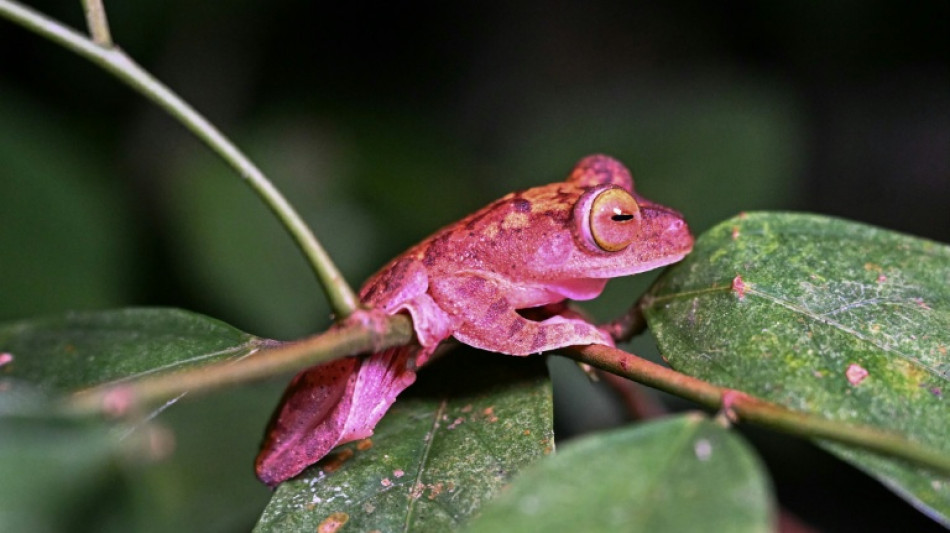
The painstaking task of cataloguing the world's species / Photo: Mohd RASFAN - AFP
A bumblebee-like insect that was last seen in France 150 years ago was spotted again in the Paris region in 2025.
Had the creature, known by its scientific name Pocota personata, disappeared and returned after all those years? Or did it simply fly around unnoticed this whole time?
The mystery illustrates the challenge facing scientists seeking to catalogue the world's biodiversity, as so much of nature remains poorly understood.
The gap in scientific data on the state of species could feature prominently at the UN's COP17 biodiversity summit opening Monday in Armenia, where countries will take stock of progress in commitments to protect nature.
In order to close that gap in France, the National Museum of Natural History (MNHN) and the National Centre for Scientific Research (CNRS) launched a project in June to build a database of the country's plants and invertebrates.
"We know biodiversity is declining, but we are sometimes quite helpless when it comes to quantifying it due to a critical lack of data on the current and past monitoring of species," Rodolphe Rougerie, head of the Dynabiod project, told AFP.
- Staggering unknown -
The scale of the unknown is huge.
A 2011 study estimated that 86 percent of terrestrial species and 91 percent of marine creatures had yet to be formally described.
Even among identified species, their status is often poorly understood. In 2025, scientists had assessed the extinction risk of only about eight percent of known species, according to the International Union for Conservation of Nature.
The tools used to identify species include field observations.
While spotting large mammals or certain birds can be relatively simple, the exercise gets trickier when it comes to smaller species, such as insects, fungi or microscopic organisms.
The job can be painstaking.
Every week, MNHN researcher Fanny Kratz checks large white tents that serve as insect traps at the Jardin des Plantes, a botanical garden in the heart of Paris, and 16 other sites. She then uses their DNA to fill gaps in the data.
The task is "very, very long" and "very, very complicated", she said.
A single trap can contain as many as 261 types of DNA, but those genetic traces do not necessarily correspond to 261 different species.
And there are always a few "unknowns" -- DNA that does not match with anything in existing databases.
- 'We are stuck' -
"The difficulty with biodiversity is having reference databases that are rich enough ... so that field work or genetic identification can actually be effective," Kratz said.
The smallest details can make all the difference when trying to identify a specimen, from the size of a leg to the shape of the wing.
And there are relatively few experts in this field.
Researchers often turn to citizen science, enlisting amateur naturalists and the public to put more eyes on the ground.
But that cannot replace scientific expertise and can introduce biases. Observations tend to be concentrated in easily accessible locations while others remain unexplored.
That is particularly true in tropical regions, where areas can be hard to reach and data is scarce despite their extraordinary biodiversity, Kratz said.
While artificial intelligence can analyse enormous quantities of data, it is only as good as the information it has been trained on.
"If we don't have the reference database, we're stuck," Kratz said.
- Muddled message -
It's not just the amount of data that matters. Scientists also need to be able to compare data collected in different places and at different times.
Different monitoring methods can make that difficult.
Rougerie said the result can be a muddled scientific picture.
When data are sparse, scattered or collected using different methods, separate studies can sometimes reach conflicting conclusions about what is happening to the same species.
That can, in turn, fuel claims that the biodiversity crisis is being exaggerated or is difficult to prove.
Without reliable reference databases, Kratz said, "we cannot know what is happening ... what we are capturing or what is disappearing or not ... and therefore how to combat a possible decline or protect this or that species".
B.Krishnan--DT