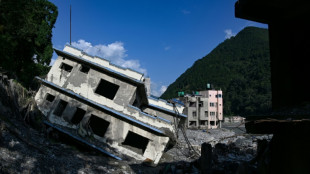
Climate hopes shift from politics to the courts / Photo: Frederick FLORIN - AFP
The political fight against global warming may be losing steam, but the legal battle is heating up.
Over the past decade, legal activists have successfully taken a number of national governments to court, triggering the adoption of more climate-friendly policies in countries including the Netherlands, Pakistan, Switzerland, South Korea and others.
"There is momentum for climate litigation in the courts," Dennis van Berkel of the Climate Litigation Network, which supports legal action against states and corporations, told AFP.
In one such victory earlier this week, Australia's highest court blocked the expansion of a coal mine in New South Wales, citing its climate impact.
"Climate change litigation is growing domestically and internationally," said Margaret Young, a law professor at the University of Melbourne.
On the political front, from Europe to the United States, governments have been scaling back climate ambitions and policies, and global climate negotiations at the upcoming COP in November are not expected to deliver major progress in cutting the fossil fuels that drive global warming.
But over the past two years, three international courts have affirmed in advisory opinions that countries have legal obligations to address climate change: the International Tribunal for the Law of the Sea, the Inter-American Court of Human Rights, and the International Court of Justice (ICJ). A fourth opinion is expected from the African Court on Human and Peoples' Rights.
"A lot has been achieved in a short period of time", said Margaretha Wewerinke-Singh, a law professor at the University of Amsterdam who served as a legal expert in proceedings before all three courts.
While an advisory opinion issued by such a court is not legally binding in the same way as a judgment in a contentious case, van Berkel said the legal principles set out in those opinions are already being used in national courts.
"That norm is now flowing back to being picked up by the plaintiffs in different countries (and) used in their litigation," he explained.
A Paris court cited the ICJ opinion in a ruling last June that ordered TotalEnergies to include emissions linked to the use of its products in its corporate vigilance plan. In January, a Dutch court also cited the opinion when it ordered the Netherlands to strengthen its climate plan in a case brought by residents of the Dutch Caribbean island of Bonaire. Both rulings are being appealed.
"Despite what politicians say about the international legal system, judges still respect and apply international law in many countries around the world," said Sophie Marjanac, legal director at the Redwater Insights think tank.
- 'Tightening net' for oil firms -
When it comes to corporations, the legal precedent is less established than for states, but there is a "tightening net" for oil companies, said Jasper Teulings, who also works for the Climate Litigation Network.
In some cases, years of litigation have led to permits for oil, gas and coal projects being overturned, including in the UK. Norway's Supreme Court is expected to rule soon on licenses for projects in the North Sea.
And in 2027, the Supreme Court of the Netherlands is expected to rule in a closely watched case brought by the environmental group Milieudefensie against Shell, deciding whether to impose a specific emissions-reduction target on the energy giant.
- Making polluters pay? -
Another potential breakthrough would be a ruling requiring a major polluter to compensate people harmed or threatened by climate change, wherever they live, in proportion to the company's greenhouse gas emissions.
German courts moved toward that principle last year in a case brought by Peruvian farmer Saul Luciano Lliuya against energy company RWE. Although they rejected his claim for compensation, the courts left the door open to holding major emitters liable for climate-related payments.
Similar lawsuits are now pending in several countries, including cases brought by Philippine victims of Typhoon Odette against Shell in the UK, residents of Indonesia's Pari island against cement maker Holcim in Switzerland, and Pakistani farmers affected by 2022 floods against RWE and Heidelberg Materials in Germany.
There have also been setbacks.
Climate groups have lost lawsuits against oil companies in the US. And in New Zealand, the government changed the law to block a lawsuit brought by Maori activist Mike Smith against six domestic companies, but he has vowed to continue the fight.
I.Khan--DT