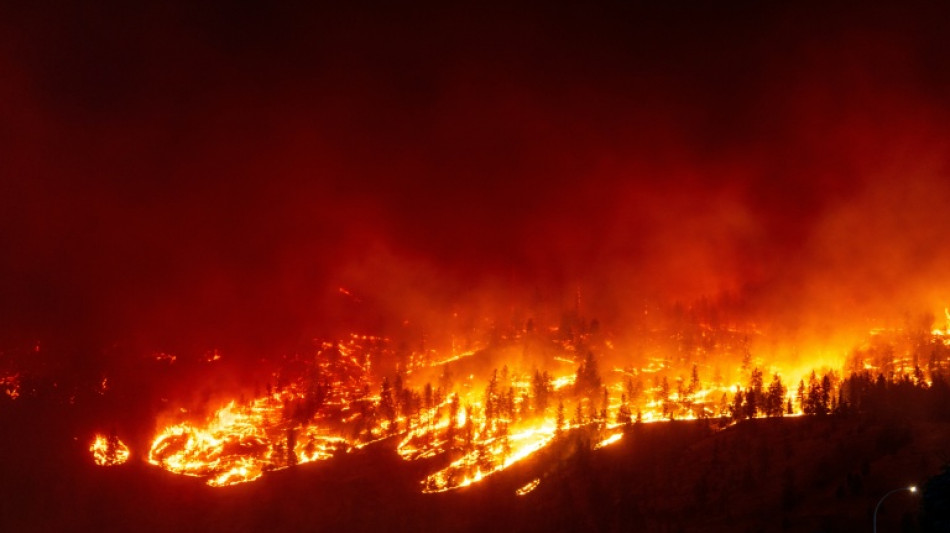
Young Canadians sue government over alleged climate failures / Photo: Darren HULL - AFP/File
When a wildfire threatened her northern Canada home three years ago, Kira Young packed what she could and fled.
Later this month, she'll be in court, suing Ottawa over allegations it is failing to respond to climate change.
Young is one of 15 people from across the country, all aged 17-24, pursuing a case unprecedented in Canadian legal history.
Over five weeks of hearings beginning on October 26, the group will argue that successive governments have violated their constitutional rights to life, liberty and security by not sufficiently cutting greenhouse gas emissions.
The trial in the west coast city of Vancouver is part of a growing global movement of environmental activists using courts to force government action on climate change, with major victories already recorded internationally.
Young is from Yellowknife, a city a few hundred kilometres south of the Arctic Circle, where a wildfire forced an evacuation order for all nearly 20,000 residents in the summer of 2023.
The 20-year-old said she and her family "had to pack up everything we could into our car and leave our home," driving 18 hours south to safety.
The message of her lawsuit is that climate change "is a challenge we can address. There is hope," she said.
Lauren Wright, a co-plaintiff, told AFP that devastating events fueled by rising global temperatures "can't just keep happening."
"It can't just be a 'oops, we missed (our emissions targets) again because we were looking somewhere else,'" the 22-year-old said.
"There has to be accountability and Canadians deserve that."
- Long legal battle -
The ongoing legal battle by the 15 young Canadians began in 2019. Their case was initially dismissed, but in 2023 a federal appeals court ruled they were entitled to a trial.
A victory would add to a series of legal successes for climate activists.
In 2024, the European Court of Human Rights ruled in favor of retired Swiss women, who argued Switzerland had not done enough to confront climate change, the first decision of its kind.
The following year, the International Court of Justice issued a landmark advisory opinion that states are obligated to protect the climate for present and future generations, guidance that could influence legal processes in several jurisdictions.
But a setback for the climate movement came in the United States last year, where a federal judge rejected an argument from young plaintiffs claiming President Donald Trump's pro-fossil-fuel policies violated their fundamental rights.
- Canada 'backsliding?' -
A federal government report released last month said that since 1970 temperatures in Canada have risen nearly twice as fast as the global average.
Wildfires made more common and severe by global warming have scorched record amounts of land in recent years.
For Albert Lalonde, a 24-year-old plaintiff in the Vancouver case, "young people are confronted with the question of how to plan ahead, how to build a life in a world that is going through collapse."
He argued the current policies of Prime Minister Mark Carney's government are making things worse.
Carney has voiced support for increased oil production, citing the industry as a key tool to help reduce Canada's economic reliance on the United States.
He has also conceded the ambitious climate targets set by his predecessor, Justin Trudeau, are not feasible.
"We could never have imagined that our lawsuit would take place in the current context of backsliding on every front of the climate and environmental question," Lalonde told AFP.
"We are literally going back to the 1970s," he said, voicing hope the trial will "send a signal."
K.Al-Zaabi--DT