
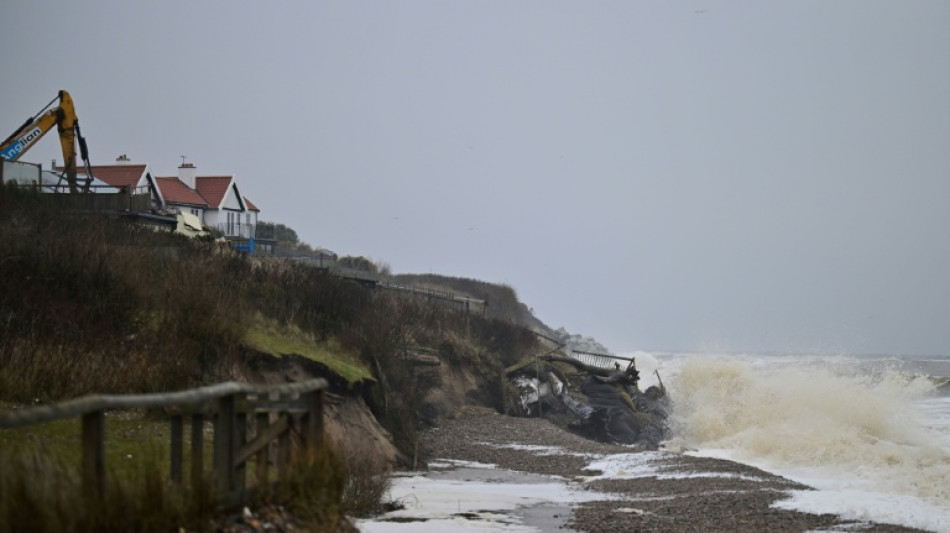
In sea-change, UK may abandon homes to coastal erosion / Photo: Ben STANSALL - AFP
In an English seaside village, researchers discuss options for relocating a graveyard threatened with slipping into the sea, or moving back a car park perilously close to a cliff edge.
The team from the Coastwise project have been granted over £15 million ($20 million) in government funding to adapt the coastline in North Norfolk, eastern England, to accelerating erosion worsened by climate change.
There is one caveat: it cannot spend that money on traditional coastal defences like sea walls or rock-filled cages known as gabions.
Instead, the team is assessing the best ways to lose at-risk homes to the sea and helping better inform cliffside property purchases.
Some measures it has considered include selective buyouts, government insurance schemes, replacing houses with mobile homes and early warning systems for when people may have to vacate their residences.
"It is quite groundbreaking... different countries are trying different things, but there's nothing quite similar," Robert Goodliffe from Coastwise told AFP.
"It will take a shift in how we think about this," he added.
For decades, the default approach in Britain and elsewhere was to "hold the line" against erosion using human-made defences.
But, with some defences reaching the end of their design life and sea levels rising, the government and coastal experts warn the tide cannot be held back everywhere.
The UK's Environment Agency has determined some communities on the soft, sandy eastern English coast -- among the fastest-eroding in Europe -- will need to conduct a "managed retreat" and move back from the shoreline.
The government is funding pilots like Coastwise, tasked with preparing parts of the coastline that may not be defended in the future.
"When it comes to building a defence there's a process and a system, and a way of applying for funding," explained Sophie Day, a coastal adaptation specialist working on the project.
"But when it comes to losing places, there isn't."
- Creeping anxiety -
The team hopes measures it assesses in Norfolk, like the logistics and legal complications of exhuming bodies and moving a graveyard, can be applied to other parts of the country.
But some locals feel the government's managed retreat policy is failing communities at imminent risk.
Shelley Cowlin's home of five decades was demolished in January after winter storms lashed the coast of a resort in Suffolk, eastern England.
"On the cliff top, here, lovely, big white house... which gave me a fantastic view," Cowlin, 89, told AFP in Thorpeness, where 10 clifftop properties have been demolished since October.
In January, a wall at the edge of her property was destroyed in a storm, the gabions "floated away" and "the gate was just swinging and all very sad".
"They won't give you any money," she said, criticising the government for the lack of compensation.
As she spoke, a bulldozer was breaking down another residence in the holiday village, which the government has recommended should move back from the coast rather than invest in more defences.
Shelley's son, Simon Carrick Cowlin, described creeping anxiety as neighbouring houses were pulled down.
"When's it my turn? ... A horrible space to be living in," said Simon.
"Any defences that have been put in historically or that will continue to be put in will (only) slow down the erosion, it cannot stop it," said local councillor Katie Graham.
"We do need more money, we do need more support from government. This is a very urgent situation," she added.
- 'Far-sighted' -
Thorpeness residents say storms have grown fiercer, as scientists warn climate change will make such extreme weather more intense and frequent.
"In the UK we seem to (be) like: I'll just let the sea take what it wants," said Craig Block, the boatman at Thorpeness' lake.
Local Nicholas Millor said it was a "traumatic time" for the small village with some 130 residents and dozens of holiday homes.
The community had to prepare "for a much more liminal, uncertain kind of future", he said.
"What Thorpeness is going through now is a microcosm, is an example actually of what many, many communities will go through."
But experts insist costly traditional defences will not solve erosion, and that adaptation projects like Coastwise are needed to help communities move away from the coastline.
According to climate adaptation researcher Robert Nicholls, the government's policy is "deliberately experimental" and "translating these ideas elsewhere is a good idea".
"They're trying to learn what can and can't be done. They're trying to innovate," said the University of East Anglia professor.
"To me, it seems very rational that you follow the approach that Britain's doing... I think it's quite wise and far-sighted."
I.Khan--DT



