Dubai Telegraph - Arctic blast to wallop N. America -- is climate change to blame?

EUR -
AED 4.360754
AFN 77.775898
ALL 96.807642
AMD 449.861184
ANG 2.125556
AOA 1088.853384
ARS 1708.180809
AUD 1.711333
AWG 2.139117
AZN 1.950307
BAM 1.958866
BBD 2.391805
BDT 145.307231
BGN 1.994099
BHD 0.447722
BIF 3499.684162
BMD 1.187409
BND 1.507054
BOB 8.223356
BRL 6.256689
BSD 1.187539
BTN 107.917278
BWP 15.629385
BYN 3.3862
BYR 23273.208178
BZD 2.388379
CAD 1.625355
CDF 2588.550702
CHF 0.920996
CLF 0.025925
CLP 1024.436321
CNY 8.280515
CNH 8.252009
COP 4367.656856
CRC 587.654464
CUC 1.187409
CUP 31.466327
CVE 110.444383
CZK 24.244331
DJF 211.473474
DKK 7.468473
DOP 74.361404
DZD 153.407226
EGP 55.90417
ERN 17.811129
ETB 185.557681
FJD 2.622451
FKP 0.871532
GBP 0.866963
GEL 3.194
GGP 0.871532
GHS 12.950088
GIP 0.871532
GMD 86.681148
GNF 10401.894683
GTQ 9.113879
GYD 248.454584
HKD 9.258866
HNL 31.322027
HRK 7.53375
HTG 155.63409
HUF 381.099377
IDR 19888.856242
ILS 3.702928
IMP 0.871532
INR 108.9014
IQD 1555.63976
IRR 50019.586641
ISK 145.421838
JEP 0.871532
JMD 186.935193
JOD 0.841913
JPY 182.534411
KES 153.116208
KGS 103.838848
KHR 4784.791572
KMF 498.711287
KPW 1068.688524
KRW 1710.450425
KWD 0.363977
KYD 0.989603
KZT 596.689138
LAK 25619.719245
LBP 106343.221899
LKR 367.667162
LRD 219.69683
LSL 19.042589
LTL 3.506109
LVL 0.718251
LYD 7.49918
MAD 10.792229
MDL 20.033454
MGA 5355.721276
MKD 61.730262
MMK 2493.480693
MNT 4234.38001
MOP 9.537651
MRU 47.357918
MUR 54.050517
MVR 18.345713
MWK 2059.153133
MXN 20.50131
MYR 4.708666
MZN 75.887667
NAD 19.041304
NGN 1680.372995
NIO 43.701347
NOK 11.589434
NPR 172.666717
NZD 1.983061
OMR 0.456547
PAB 1.187529
PEN 3.982502
PGK 5.15337
PHP 70.10581
PKR 332.537705
PLN 4.202601
PYG 7980.491392
QAR 4.329232
RON 5.095647
RSD 117.407338
RUB 90.708811
RWF 1732.606792
SAR 4.452882
SBD 9.646045
SCR 16.909518
SDG 714.225786
SEK 10.599236
SGD 1.506412
SHP 0.890864
SLE 28.970589
SLL 24899.363359
SOS 677.480389
SRD 45.269915
STD 24576.960248
STN 24.540064
SVC 10.390877
SYP 13132.234127
SZL 19.027064
THB 36.885647
TJS 11.085652
TMT 4.15593
TND 3.429299
TOP 2.858995
TRY 51.499686
TTD 8.070175
TWD 37.327344
TZS 3033.828857
UAH 51.198256
UGX 4209.802077
USD 1.187409
UYU 44.562378
UZS 14351.309294
VES 418.282976
VND 31095.262202
VUV 142.210926
WST 3.27201
XAF 657.026905
XAG 0.010621
XAU 0.000233
XCD 3.209031
XCG 2.140176
XDR 0.817034
XOF 657.024134
XPF 119.331742
YER 282.961133
ZAR 18.968616
ZMK 10688.099102
ZMW 23.18666
ZWL 382.345078
  • CMSC

    -0.0900

    23.66

    -0.38%

  • SCS

    0.0200

    16.14

    +0.12%

  • JRI

    0.0770

    13.757

    +0.56%

  • CMSD

    0.0700

    24.2

    +0.29%

  • BCC

    -1.6900

    82.64

    -2.05%

  • NGG

    0.8900

    82.39

    +1.08%

  • RBGPF

    -1.5400

    82.5

    -1.87%

  • BCE

    -0.1150

    25.085

    -0.46%

  • RYCEF

    -0.1200

    17

    -0.71%

  • RIO

    1.2100

    91.64

    +1.32%

  • GSK

    0.9150

    50.065

    +1.83%

  • AZN

    1.2700

    94.22

    +1.35%

  • RELX

    -0.3750

    39.525

    -0.95%

  • VOD

    0.1450

    14.315

    +1.01%

  • BTI

    0.0300

    59.19

    +0.05%

  • BP

    0.0850

    36.615

    +0.23%

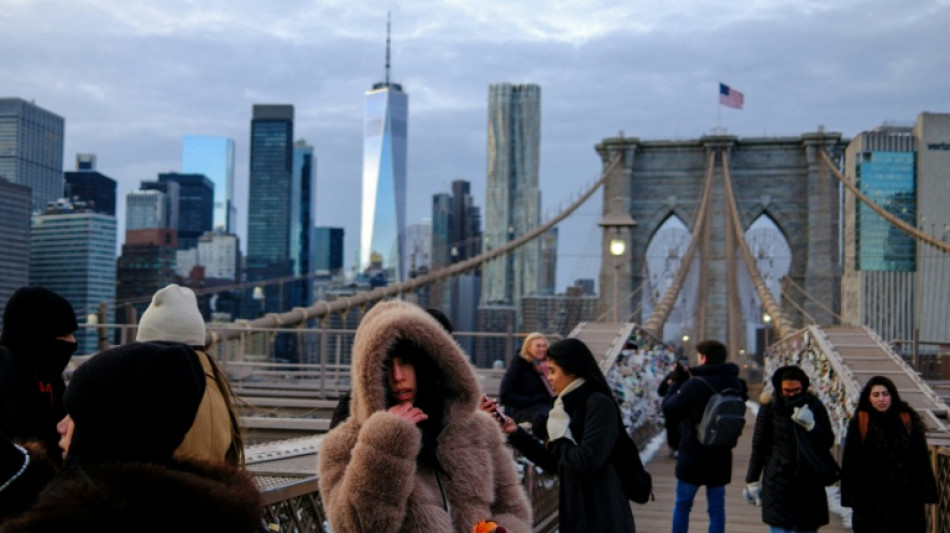
Arctic blast to wallop N. America -- is climate change to blame?
Arctic blast to wallop N. America -- is climate change to blame? / Photo: CHARLY TRIBALLEAU - AFP

Arctic blast to wallop N. America -- is climate change to blame?

An unusually brutal winter storm is set to pummel more than 160 million Americans from Friday, as a stretched "polar vortex" sends a devastating blast of Arctic air, bringing heavy snows and freezing rains.

Text size:

Winter Storm Fern is forecast to engulf an area well over half the length of the continental United States, stretching from Texas and the Great Plains region to the mid-Atlantic and northeastern states.

Scientists say the increasing frequency of such disruptions of the polar vortex may be linked to climate change, though the debate is not yet settled and natural variability also plays a role.

– What is the polar vortex? –

The polar vortex is a large region of cold, low-pressure air that circulates counterclockwise high above the Arctic, in the stratosphere some 10 to 50 kilometers (six to 30 miles) above Earth's surface.

In a typical winter, it forms a relatively compact, circular system that helps lock in the coldest air to high northern latitudes.

"Usually the vortex spins merrily along and has little effect on our weather, but occasionally it moves or stretches southward over North America, bringing with it a jolt of cold," Jennifer Francis, a senior scientist at the Woodwell Climate Research Center, told AFP.

– What happens when it stretches? -

At times, big atmospheric waves that form closer to the ground can travel upward and knock the polar vortex out of whack.

Rather than completely breaking down -- as happens during dramatic "sudden stratospheric warming" events -- the vortex can stretch out into a more oval shape.

"Think of it like a rubber band being pulled," Judah Cohen, a climate dynamics scientist at MIT, told AFP.

"That allows the cold air to expand much further south, like we're like we're seeing this week here in the United States."

Jason Furtado, a meterologist at the University of Oklahoma whose research focuses on long-range forecasting, said these stretching events aren't as long-lasting as complete breakdowns, but are significant nonetheless, especially for North America.

-Is it linked to climate change? –

This is where the science becomes more debated.

There is broad agreement -- reflected in assessments by the UN's climate science body -- that the Arctic is warming much faster than the global average, through a process known as Arctic amplification, and human-caused climate change is behind it.

Cohen argues that this uneven warming helps amplify large atmospheric waves over Eurasia, which in turn makes the polar vortex spill more frequently over North America.

"Studies suggest these aberrations in the vortex are happening more often in a warming world, which favors more frequent winter extremes," said Francis.

Furtado said observations from the past 20 years do show an increase in such events, but he cautioned against drawing strong long-term conclusions tying them directly to human-caused climate change.

"In my opinion, it's harder to make that connection going out much further, simply because I think we just don't have enough data."

A.El-Sewedy--DT



