
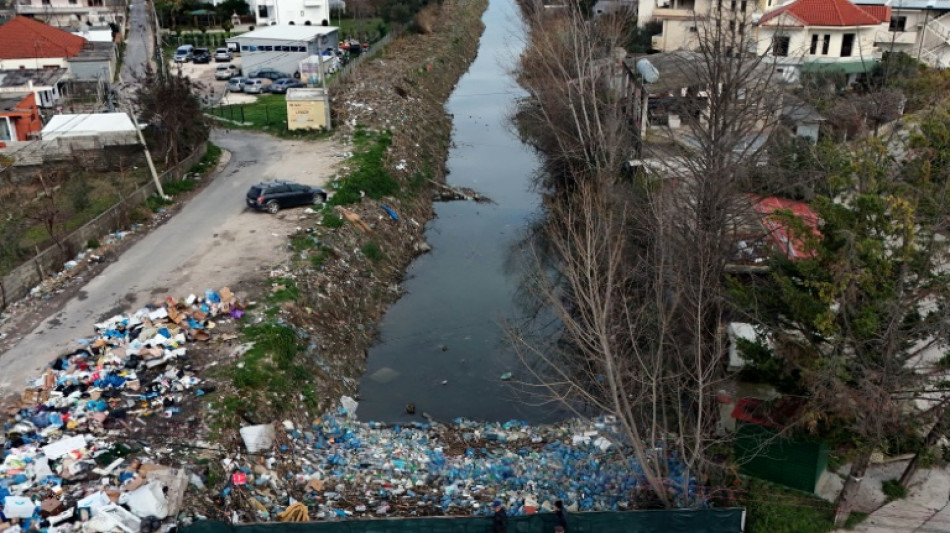
Plastics everywhere, and the myth that made it possible / Photo: Adnan Beci - AFP/File
If there's one material that defines modern life more than any other, it's plastic: present from the moment we're born in newborn stool, in product packaging, in the soil beneath our feet and the air we breathe.
Hard as it is to imagine, it wasn't always thus -- and doesn't have to remain this way, argues Judith Enck in her new book, "The Problem with Plastics."
"Half of all plastic ever produced was since 2007," the year the iPhone debuted, she told AFP in an interview.
"We have a fighting chance to reduce plastics because it's very much a contemporary issue."
Enck, a former senior environment official under Barack Obama, is clear-eyed about the challenges posed by the "rabidly anti-environmental" President Donald Trump.
Last year, the administration helped derail a global plastics treaty and reversed a phase-out of single-use plastics in national parks.
Nevertheless, she sees momentum building at the state and local level -- hailing, for example, New Jersey's "Skip the Stuff" law enacted this week, which requires restaurants to provide single-use cutlery only upon request, a measure shown to significantly reduce waste.
- 'Myth' of plastic recycling -
Enck's book traces the history of plastic: from its earliest incarnation in 1909, when Belgian chemist Leo Baekeland invented Bakelite, through the "myth" of plastic recycling promoted by industry from the mid-20th century onward.
Along the way, Enck argues that responsibility for the crisis has been systematically shifted onto consumers, even as plastic production continues to soar.
"In the United States, only five to six percent of plastics actually get recycled," she notes. Unlike metal, paper or glass, consumer plastics are made up of thousands of different types, or polymers, making large-scale recycling economically unviable.
Early advertising campaigns helped popularize terms like "litterbug," while today the focus has shifted to "chemical recycling," promoted by industry as a way to break plastics down into their basic building blocks.
Dig deeper, though, and this too is a "false solution," Enck said: a report by the Beyond Plastics nonprofit she leads found just 11 such facilities handling about one percent of US plastic waste -- three of which have since shut down.
Around 33 billion pounds of plastic enter the ocean every year, "the equivalent of two large garbage trucks filled with plastic being dumped into the ocean every minute."
Microplastics, along with ultra-tiny nanoplastics, can kill or severely sicken marine life before entering the food web and ultimately ending up on our plates.
Research into the health effects is ongoing, and some findings are contested. But a 2024 study found that people with microplastics in their heart arteries face an increased risk of heart attack, stroke and premature death.
For those living in the shadow of the expanding petrochemical industry, the impacts of toxic emissions have long been felt. Nowhere is this more evident than Louisiana's "Cancer Alley," where cancer rates are seven times the national average.
"Our zip code is dictating our health, and plastics therefore are a major environmental justice issue, because these are communities of color and low-income communities," Enck said.
- No to shaming -
The recent surge in plastic production, she argues, is driven by a "glut" of gas generated since the mid-2000s by the hydraulic fracturing industry, which has sought new markets for its product even as it fuels climate change.
It may be easy to lose hope, but Enck says it is not too late to make a difference -- pointing to a twofold approach that combines personal action with collective pressure. Her book is replete with advice on how to organize, lobby local governments and advance model legislation.
While Enck would prefer consumers shop at stores that sell toiletry refills, ditch plastic coffee pods and take other steps, she acknowledges that such choices are not yet realistic for many people.
"I am not into plastic shaming," she said. "We don't have a lot of choice when we go to the supermarket, so you do the best you can. But what we really need is systemic change -- and what I mean by that is new laws that require less plastic."
D.Farook--DT



