
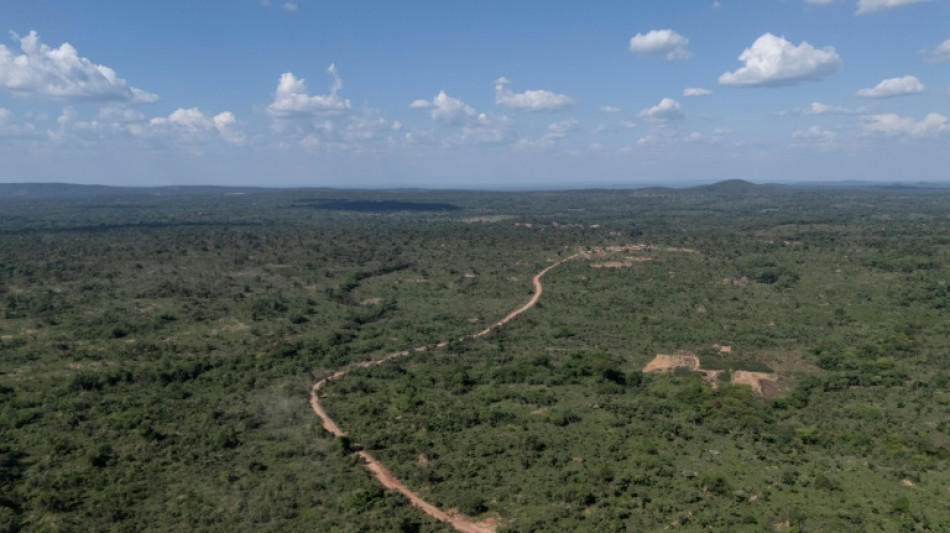
Protected forests under threat in DRC's lucrative mining belt / Photo: Glody MURHABAZI - AFP
Valery Kyembo was leading an inspection of his community's protected forest reserve deep in the Democratic Republic of Congo's mining belt when two armed Congolese soldiers blocked their way.
Behind the troops, a barrier restricted access to a developing mine site. One soldier brandished his weapon in a clear warning -- Kyembo should turn back instead of reaching the reserve.
As US and other companies jostle with China over the DRC's critical minerals, communities like Lukutwe in the southern province of Haut-Katanga fear increasing restrictions and incursions into nature reserves as they seek to protect their land.
Kyembo's Lukutwe community forest reserve obtained official land titles to help avoid unauthorised exploitation, as huge metal reserves draw more investors.
But community leaders fear displacement from traditional lands despite the communities' protected status.
Haut-Katanga produces a host of minerals, but none more in demand than the silver-tinged cobalt, essential for electric batteries and in defence technology.
The DRC produces around 70 percent of the world's cobalt.
In Lukutwe, 70 kilometres (45 miles) from the mining capital Lubumbashi, community leaders said they established a forest concession to legalise customary land titles after watching mining firm SEK, a subsidiary of Australia's Tiger Resources, displace other villages a decade ago.
"We wanted to have our own titled land," Kyembo said, echoing people from surrounding villages.
Demand for minerals under Katanga's earth is heating up.
US President Donald Trump, who has sought to broker an end to decades of conflict in eastern DRC, has made "mineral diplomacy" key to his approach, looking for access for American companies in exchange.
- Customary land -
For villages like Lukutwe, which often hold land rights dating back generations but lack formal paperwork, the concessions are a way to secure land titles and protect the region's vast savannah forest systems.
Since 2016, forest concessions, known as CFCL by their French acronym, have been part of the DRC's strategy to let communities manage their forests.
They "effectively constitute a safeguard against pressure over their land... relocations and expropriations by mining companies," said Heritier Khoji, a specialist in the region's forests and an agronomy professor at the University of Lubumbashi.
In Haut-Katanga, there are now 20 reserves, covering 239,000 hectares (60,000 acres). Twelve more are in the process of approval.
The DRC's south is covered in what are known as Miombo forests, the largest dry tropical forest ecosystem in the world. But, as in other parts of Africa, forests are shrinking due to agriculture, deforestation and mining.
From 2001 to 2024, the Lualaba and Haut-Katanga provinces lost 1.38 million hectares of tree cover, much of it along the copper-cobalt belt, according to Global Forest Watch.
The DRC's mining registry shows the copper-cobalt belt has one of the country's highest concentrations of exploration and mine licences.
Overseen by Indigenous and local communities, the forest reserves allow environmental management through sustainable projects, reforestation and controlled charcoal production, and set aside specific areas for conservation and rural development.
In theory, mining companies that overlap with or impact the reserves can pay royalties to communities for their operations.
Each reserve has a volunteer brigade to monitor access points and boundaries, said Kibole Kahutu, vice-president of the CFCL Katanga.
- Mining pressure -
Environmentalists and rights groups meanwhile worry over threats to waterways, farming and health.
A leak of waste from a facility run by Congo Dongfang Mining (CDM), a subsidiary of China's Huayou Cobalt, flooded suburbs of Lubumbashi in November, prompting the Congolese government to suspend the miner's operations.
Many of the Haut-Katanga reserves are surrounded by or overlap with mining companies.
For example, the Kambala forest initiative, which is yet to be fully approved, overlaps with the exploration permit of MMG Kinsevere SARL, a subsidiary of Australia-based MMG Limited, whose main shareholder is the Chinese company China Minmetals.
Khoji, the agronomy professor, said community forest concessions are not perfect. Sometimes, even communities mine in environmentally destructive ways.
Companies can operate in a concession after obtaining community consent. But local communities complain miners still obtain licences on secured lands even without consent or benefit-sharing agreements.
For communities, "obtaining the concession is a safeguard against land pressures, but the difficult application of laws, decrees, orders... is an obstacle," Khoji said.
Politics also plays a role, with poor communities lacking clout.
In villages like Lukutwe, forestry concessions often do not generate immediate returns, and the lack of funds discourages some residents, said Veronique Sebente, representative of a committee managing collective land ownership.
Katanga also faces incursions and attacks by loggers from Lubumbashi who come to produce charcoal to sell in the regional capital.
"These people sometimes surprise us by surrounding us and attacking. We have difficulty securing the concession," said Kahutu, the vice-president of the CFCL Katanga.
Community members say forest concessions with the government offer at least some protection.
But a road built across the CFCL Katanga to reach a mining site is a reminder that one day a mining company may try to come for their land.
"Our only support in this case consists of the CFCL documents obtained from the government," Kahutu said.
The DRC's environment and mines ministers as well as mining companies SEK and MMG were contacted, but none responded before publication.
This article is part of a reporting project between Mongabay and Agence France-Presse (AFP).
burs/jhb
Y.Rahma--DT



