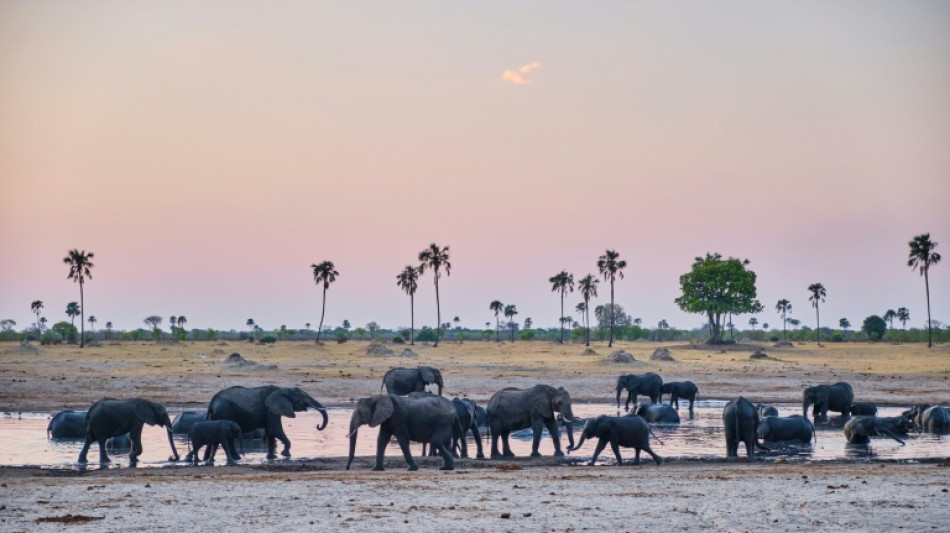
Tech tracking to tackle human-wildlife conflict in Zimbabwe / Photo: Zinyange Auntony - AFP
In the sun-scorched lands bordering Zimbabwe's largest wildlife sanctuary, Takesure Moyo pedals through his village each morning on a mission to help his community coexist with the elephants and predators that roam nearby.
The 49-year-old is among several locals trained as community monitors under an initiative by the International Fund for Animal Welfare (IFAW) and Zimbabwe's National Parks and Wildlife Authority (Zimparks).
Equipped with a mobile phone, he uses an app to log sightings, spoor and incidents -- data that enables authorities to respond swiftly and issue alerts to prevent potential confrontation with dangerous animals, including ones straying from the nearby Hwange National Park.
"We have always lived with wild animals around us, but our responses to human-wildlife conflict were rather individual and uncoordinated," Moyo, speaking in vernacular Ndebele, told AFP.
"The initiative has helped the community become more knowledgeable about animal behaviour and ultimately minimise conflict."
Wild animals have killed around 300 people in Zimbabwe over the past five years, according to Zimparks, with crops and livestock also suffering heavy losses. Nearly 70 percent of reported incidents occur in communities bordering national parks such as Hwange, it says.
A few years ago, Moyo lost six cattle to lions. It prompted him to become involved in the project to protect his community.
Equipped with a bicycle provided by IFAW, he patrols the area around his village daily, sending updates to Zimparks with a focus on "problem animals" like elephants and lions.
His input complements data received by satellite from GPS collars fitted to 16 elephants in the area, both feeding a mobile application called EarthRanger that allows real-time monitoring and rapid response.
- Swift reaction -
Zimbabwe is home to nearly 100,000 elephants, the world's second-largest population of savannah elephants after neighbouring Botswana, according to a 2022 aerial survey conducted under the Kavango Zambezi Transfrontier Conservation Area.
"During the dry season, elephants sometimes come for water at the nearby dam, which is the source of water for our communal gardens," Moyo said. "And during the cropping season, they can come to eat our crops."
The EarthRanger app -- used in 80 countries, according to its developers -- is "highly effective," Zimparks acting public relations manager, Tamirirashe Mudzingwa, told AFP.
As a live early warning system, it gives communities time to protect themselves, their livestock and property from approaching wildlife, he said.
A separate project collects data from collars fitted to some elephants that have been rescued, rehabilitated and reintroduced to free-roaming herds by the Wild Is Life organisation.
At a monitoring centre, technical officer Simbarashe Mupanhwa pointed to multi-coloured lines on his computer screen that tracked the movements of Samson, a seven-year-old elephant back in the bush after being saved when he was abandoned at birth.
"Other than helping monitor the elephants' movements, the application is also able to track the organisation's rangers and vehicles, helping ensure that if there are any incidents of poaching, reaction is as swift as possible," Mupanhwa told AFP.
- Growing elephant population -
The satellite telemetry "offers critical spatial insights into habitat use, movement patterns, and the identification of frequently utilised areas, including ecological corridors and dispersal zones," said Phillip Kuvawoga, IFAW's conservation senior director.
Community-based conservation has become a common ground for IFAW and Zimparks, which have different philosophies over Zimbabwe's ballooning elephant population.
The government argues the country cannot sustain so many of the animals and has lobbied for the lifting of a global ban on the trade in tusks, saying its ivory stockpile is worth millions of dollars that could be used to bolster ranger welfare and conservation.
Zimparks, a government agency, supports "consumptive tourism" such as safari hunting, including of elephants, while IFAW promotes photographic safaris.
"The collaboration embodies a pragmatic agreement: conservation efforts must be inclusive, science-based, and adaptable," said Alleta Nyahuye, country director of IFAW, which flags as its mission the ideal of "helping animals and people to thrive together".
In villages like Moyo's, the impact is tangible.
"It's not just about protecting animals," Moyo said. "It's about protecting our way of life, too."
D.Farook--DT