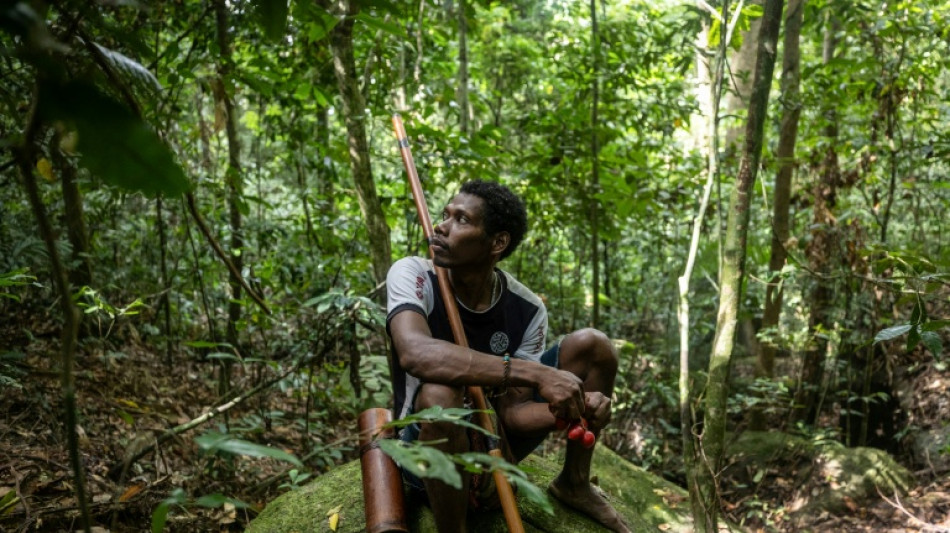
Thailand's last hunter-gatherers seek land rights / Photo: Luke Duggleby - Courtesy of Luke Duggleby/AFP
Deep in a Thai forest a young man sprints through the undergrowth, blowpipe in hand, before pumping a poisoned dart at a monkey.
The group closes in, shouting out to each other, and the animal falls to the ground.
The kill was in keeping with centuries of tradition for the Maniq, one of Thailand's smallest ethnic minorities, who were the country's last hunter-gatherers.
But the lures of a settled home, among them education and healthcare, mean their way of life is changing.
The Maniq are now demanding ownership rights to land they say has effectively been theirs for generations, but is today protected by Thai law.
As the youngest of the Maniq hunters, still learning the ways of the jungle, Dan Rakpabon, 18, carried the kill back to the thap –- seven leaf-covered bamboo shelters in a clearing in Pa Bon.
Singeing the animal over a fire to burn off the fur, he carefully butchered it and divided the meat among the community, with the largest families receiving the biggest shares.
"I feel happy every time we hunt. This is our food," he said.
But wildlife is protected in Thailand's conservation zones, making the kill illegal.
It is a predicament faced by many Indigenous people globally, under pressure to abandon traditional lifestyles and fighting for rights to land they have long called home.
In many cases, they are effectively the victims of environmental conservation efforts, despite studies showing the low-intensity forest use associated with Indigenous peoples often protects biodiversity.
It is a point some officials in Thailand recognise.
"We are not concerned about the Maniq's traditional way of life," said Chutiphong Phonwat, head of the Khao Banthat Wildlife Sanctuary.
"They do not destroy the forest."
- 'I can write my name' -
For centuries the Maniq, part of the wider Negrito ethnic lineage, lived as hunter-gatherers, roaming the rainforests of the Malay Peninsula, moving with the seasons in search of food.
Just 415 Maniq remain, according to the Indigenous Peoples' Foundation for Education and Environment, scattered across southern Thailand's Banthat mountains.
Most have abandoned the nomad lifestyle of their ancestors and settled on the edges of forests, drawn by access to education for their children and healthcare, as in Pa Bon, in Phattalung province.
The change comes with challenges: living in the modern world requires cash, so men work on rubber plantations for $3-8 a day, while women make pandanus leaf bags to sell.
Some have smartphones and the community's children live in a village 10 kilometres (six miles) away during the week for school.
"One day, my child came to me and said, 'Today I can write my name.' Just hearing that made me proud," said mother Jeab Rakpabon, who weaves for a living.
Hunting has become an occasional activity rather than a source of daily sustenance.
"I grew up following my father into the forest to hunt and forage," said Tom Rakpabon, leader of the 40-strong community -- all of whom were given the same surname by officials when they obtained identity cards.
"Now we have to buy rice, meat and vegetables from the market," he added.
Caught between their old traditions and modern lives, the Maniq and their supporters want ownership rights in perpetuity over protected forest to provide them with settled livelihoods.
"We want proper houses, land to grow our own vegetables," said Jeab adding that, "leaf shelters like this are only temporary".
- Title deed -
The forest is now classified as a conservation zone where Thai law bars private landownership and puts strict limits on resource use.
"Not only the Maniq people, but everyone must obey the law equally," said Chalerm Phummai, director of Thailand's Wildlife Conservation Office.
Under Thai regulations, established Indigenous communities on protected land can request 20-year usage permits -- and several have been issued.
But critics say the process reduces Indigenous groups to temporary occupants of their ancestral forests.
One Maniq community have lived for more than 30 years in Plai Khlong Tong in Trang province, establishing their own rubber plantations and permanent but sparsely-furnished wooden and concrete houses among the forest's towering resin trees.
But it is not easy.
"It's frustrating to live like this," said Thawatchai Paksi, whose mother's marriage to a Thai rubber-grower was the catalyst for the transition. "We need permission for almost everything — even cutting down a tree or building a house."
Living without title deeds leaves the community in a precarious position, explained local leader Sakda Paksi.
"If the Maniq had land, we could stand on our own feet."
- Hard lessons –
The situation has created real hardship for some.
Some Maniq in Satun province have been reduced to begging because they cannot find work.
"If nobody gives us food, it's difficult," said their leader Jin Sri Thung Wa.
The group travels several kilometres from their forest shelter to beg on a roadside.
"There's nothing left in the forest here, and no work we can do," she said.
The Maniq also face discrimination.
Kritsada Inchalerm, a Thai who stopped to give them food and money, said they reminded him of a film, Sagai United –- a title that incorporated a Malay word for slave used as a derogatory term for the minority.
"The Maniq are not savages," said Tao Khai, leader of another community. "We are people who live in the forest."
The owners of a resort and rubber plantation allow his group to live on their property, but they have no fields to cultivate and survive on daily wage work in the area, supplemented by hunting.
Every morning a plantation staffer drives Duan Srimanang, 13, and dozens of other children from several local Maniq communities to school.
She has been put into second grade according to her abilities and learns alongside seven-year-olds, but can now write her name and is learning to read.
"When I grow up, I want to have a job and earn money so I can take care of my mother and make her comfortable and happy," she said.
- Land security -
A new Thai law in September introduced "protected ethnic areas" for Indigenous groups, with a more flexible regulatory regime.
"The Maniq will not be granted land ownership, but they will receive rights to use the land in accordance with their traditional way of life," said anthropologist Apinan Thammasena.
"Land security does not necessarily have to come in the form of ownership. It can come in the form of guaranteed, permanent rights to use the land," he added.
But MP Laofang Bundidterdsakul, who helped draft the bill and is from the Hmong hill tribe, said existing environmental rules were left in place, potentially undermining the new measure's impact.
"Land rights remain largely unchanged," he said. "For example, land matters remain under the same forestry law. Road construction, access to electricity and water still require permission from the Forestry Department."
At the rubber plantation, where Duan and her friends did their homework under the glow of headtorches, Tao Khai returned home from a hunt.
"This land was given to us only temporarily," he said. "The Maniq want a home where we can live forever."
This story is a collaboration between AFP and HaRDstories, with support from the Pulitzer Center.
K.Al-Zaabi--DT