Dubai Telegraph - Zimbabwe rallies allies to push for legal ivory trade

EUR -
AED 4.236376
AFN 76.133616
ALL 93.420643
AMD 421.8111
AOA 1058.949439
ARS 1713.530983
AUD 1.646514
AWG 2.076371
AZN 1.958861
BAM 1.957818
BBD 2.322964
BDT 142.415095
BHD 0.43492
BIF 3412.21077
BMD 1.153539
BND 1.479129
BOB 14.041502
BRL 5.845791
BSD 1.153319
BTN 109.902159
BWP 15.686288
BYN 3.371457
BYR 22609.369221
BZD 2.319631
CAD 1.618303
CDF 2624.302102
CHF 0.932031
CLF 0.02712
CLP 1070.854022
CNY 7.787893
CNH 7.788795
COP 3639.450927
CRC 523.90606
CUC 1.153539
CUP 30.56879
CVE 110.369697
CZK 24.208986
DJF 205.377491
DKK 7.47573
DOP 66.904916
DZD 153.477055
EGP 57.913554
ERN 17.303089
ETB 186.154206
FJD 2.556701
FKP 0.855633
GBP 0.856451
GEL 3.016504
GGP 0.855633
GHS 13.476959
GIP 0.855633
GMD 84.785821
GNF 10127.607036
GTQ 8.799538
GYD 241.672393
HKD 9.04658
HNL 30.913995
HRK 7.538959
HTG 150.795659
HUF 363.957818
IDR 20738.328564
ILS 3.519863
IMP 0.855633
INR 109.943652
IQD 1510.86595
IRR 1586260.655293
ISK 142.035017
JEP 0.855633
JMD 182.698059
JOD 0.817844
JPY 180.742869
KES 149.325704
KGS 100.877274
KHR 4660.542191
KMF 492.56182
KRW 1645.592583
KWD 0.357139
KYD 0.961137
KZT 547.100836
LAK 26085.423004
LBP 103285.119208
LKR 387.237404
LRD 208.182896
LSL 19.021156
LTL 3.406102
LVL 0.697765
LYD 7.351164
MAD 10.753881
MDL 20.137626
MGA 4912.788032
MKD 61.580016
MMK 2422.066909
MNT 4145.276222
MOP 9.31628
MRU 46.191819
MUR 54.146996
MVR 17.833369
MWK 1999.879747
MXN 19.978931
MYR 4.724433
MZN 73.722409
NAD 19.021156
NGN 1571.985528
NIO 42.440259
NOK 10.994527
NPR 175.844617
NZD 1.963491
OMR 0.44354
PAB 1.153309
PEN 3.895295
PGK 5.089961
PHP 70.289782
PKR 320.256224
PLN 4.303105
PYG 6879.675151
QAR 4.204479
RON 5.246639
RSD 117.369172
RUB 92.456578
RWF 1691.348398
SAR 4.317154
SBD 9.321872
SCR 15.546683
SDG 692.12388
SEK 10.984531
SGD 1.478532
SLE 28.489446
SOS 659.139544
SRD 43.58244
STD 23875.933406
STN 24.523795
SVC 10.091573
SZL 19.024459
THB 38.451495
TJS 10.651042
TMT 4.048923
TND 3.384384
TRY 54.835138
TTD 7.820554
TWD 37.44123
TZS 3051.416957
UAH 51.735221
UGX 4316.2066
USD 1.153539
UYU 46.385207
UZS 13828.417316
VES 860.19006
VND 30323.086159
VUV 137.329026
WST 3.154343
XAF 656.596923
XAG 0.019892
XAU 0.000284
XCD 3.117497
XCG 2.078617
XDR 0.815358
XOF 656.596923
XPF 119.331742
YER 274.883152
ZAR 18.99412
ZMK 10383.236811
ZMW 21.674843
ZWL 371.439167
  • RBGPF

    0.0000

    69.21

    0%

  • CMSC

    0.0300

    21.84

    +0.14%

  • BCC

    1.0000

    76.38

    +1.31%

  • CMSD

    0.0900

    22.11

    +0.41%

  • AZN

    -1.7000

    169.64

    -1%

  • BTI

    -1.0400

    60.65

    -1.71%

  • RIO

    -0.3300

    96.85

    -0.34%

  • NGG

    -0.4200

    79.97

    -0.53%

  • BCE

    -0.0200

    21.68

    -0.09%

  • GSK

    -0.3800

    51.69

    -0.74%

  • RYCEF

    -0.3100

    19.55

    -1.59%

  • JRI

    0.0900

    12.96

    +0.69%

  • RELX

    -1.1900

    35.42

    -3.36%

  • VOD

    -0.3600

    15.78

    -2.28%

  • BP

    1.0000

    45.22

    +2.21%

Zimbabwe rallies allies to push for legal ivory trade
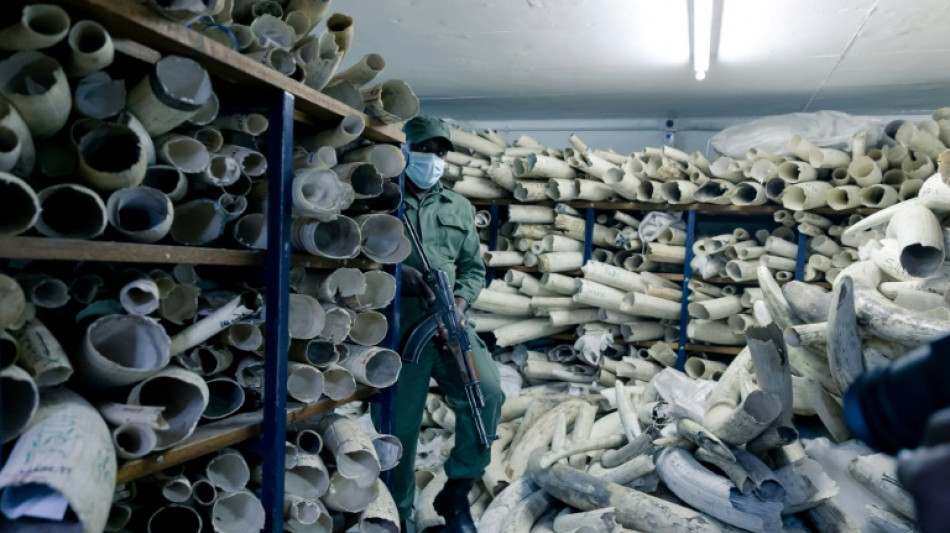
Zimbabwe rallies allies to push for legal ivory trade / Photo: Jekesai NJIKIZANA - AFP/File

Zimbabwe rallies allies to push for legal ivory trade

Zimbabwe will this week press a drive to legalise the ivory trade, inviting officials from 15 nations to meet in a national park that's a beacon of success in protecting elephants.

Text size:

Hwange National Park is overflowing with elephants, which now routinely wander outside the boundaries to feed, sometimes running into deadly conflicts with people living in the surrounds.

Zimbabwe and its neighbours in southern Africa have seen their elephant herds thrive in recent years and are now home to about 70 percent of the continent's elephants.

That's a markedly different story than in the rest of Africa, where poaching and habitat loss have seen numbers declining.

Zimbabwe, by contrast, is home to 100,000 elephants -- nearly double the number that conservationists say the country's parks can support.

Elephants require vast areas for feeding. Even Hwange, a park nearly half the size of Belgium, isn't big enough to support its population.

Zimbabwe and other countries with large herds say they're left protecting vast stockpiles of ivory they can't sell to raise funds for either conservation work or to support communities affected by the growing elephant numbers.

"These are pertinent issues that are difficult to address in a balanced manner," Tourism and Environment Minister Mangaliso Ndhlovu said in a statement.

Zimbabwe last week urged European ambassadors to allow a one-off sale of $600 million worth of elephant ivory, kept in a warehouse outside central Harare.

International trade in ivory and elephants has been banned since 1989 under the Convention on International Trade in Endangered Species of Wild Fauna and Flora (CITES). One-off sales were allowed in 1999 and 2008, despite fierce opposition.

Countries in southern Africa say the ban prevents them even from supporting each other's conservation efforts, for example, by moving elephants from Zimbabwe to countries that want to repopulate.

The conference brings together countries likely to support a legalisation move, including China and Japan, where ivory is highly prized.

Kenya and Tanzania, which fear legalisation will encourage more poaching, were not invited. But the island nations of Seychelles and Madagascar, which have no elephants, are attending.

- Dangerous signal -

A collection of 50 anti-ivory trade organisations issued a statement warning that opening the ivory market would decimate the African herd, which in some regions is near extinction.

"The conference is sending a dangerous signal to poachers and criminal syndicates that elephants are mere commodities, and that ivory trade could be resumed heightening the threat to the species," they said.

But growing elephant herds pose real dangers to nearby communities.

Zimbabwe says 60 people have been killed by elephants so far this year, compared with 72 in all of last year.

"Governments of elephant range states are faced with social and political pressures on why elephants are prioritised over their own life and livelihoods," Ndhlovu said.

C.Akbar--DT



