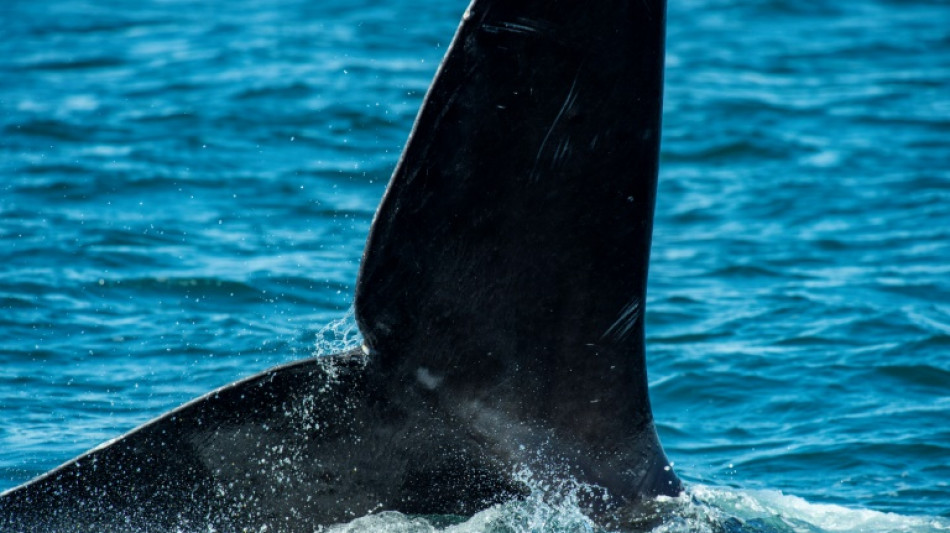
Endangered North Atlantic right whales make a stand in Cape Cod / Photo: Joseph Prezioso - AFP
After many hours scouring Cape Cod Bay and a few false alarms, those aboard the Research Vessel Shearwater on a bright April day make their first sighting: three North Atlantic right whales, including a rare mother-calf pair.
The captain cuts the engines and a trio of marine biologists spring into action, rapidly snapping photos and noting markings that can be used to identify individual animals and track injuries -- a vital part of conservation efforts for a species believed to have 336 members.
While the whaling that drove them to near-extinction has long been banned, unintended collisions with ships and entanglements with fishing gear are today the main threats for Eubalaena glacialis, one of the most endangered mammals in the world.
Approaching 60 feet in length and weighing over 70 tons, the North Atlantic right whale is the third largest whale in existence. Their life spans are similar to humans, with individuals living up to a century.
"Unfortunately, since 2010, their population has been decreasing," explains Christy Hudak, the leader of the Center for Coastal Studies' expedition that set off from Provincetown, a historic New England fishing village that is today popular for whale watching and gay tourism.
"We're trying to spread the word regarding these amazing creatures and just how a key species they are in the circle of life."
The CCS crew coordinates with an aerial survey plane, while a vessel from another research group flies mini-drones equipped with cameras over the whales as part of a study on the impact of rope entanglements on their growth rate.
Despite strict ship speed limits of 10 knots in some protected areas, and new rules brought in by authorities to limit the number of ropes between buoys to crab and lobster traps on the seafloor, conservationists worry it's not enough.
The problems are compounded by climate change: as the waters of the North Atlantic warm, a tiny oil-rich crustacean called Calanus finmarchicus that is the whales' main food resource is becoming more scarce in their habitat, which stretches from Florida to Canada.
Cape Cod Bay isn't warming as fast as the whales' more northern waters in the Gulf of Maine, and as a result, it is here, in their traditional feeding and nursing grounds, that the marine giants are now more commonly spotted.
Apart from photography and detailed note-taking, the crew also carry out plankton surveys: casting nets and using water pumps to take samples at various depths for lab analysis.
Knowledge of the composition and density of these zooplankton helps scientists predict peak whale arrivals and departures.
- The 'right' whale to hunt -
Right whales were the favored prey of commercial hunters for more than a millennium -- by the Vikings, Basques, English, Dutch and finally Americans -- who sought their blubber for whale oil and their baleen plates, which they use to filter their food, as a strong, flexible material used in the pre-plastic era.
According to David Laist, an author of a book on the species, their numbers prior to commercial whaling ranged up to 20,000, but by the early 20th century, the species was decimated.
There was just one reliable sighting anywhere in the North Atlantic between the mid-1920s to 1950, Laist writes.
"The early whalers thought of them as the correct whale to catch because they were so valuable, great thick layers of blubber that produced oil that was used in lamps," CCS founder Charles "Stormy" Mayo says, explaining the name.
A baby boom in the 2000s led to a recent peak of more than 483 animals by 2010, but numbers are once more in decline -- and in 2017, the species was rocked by a mass-die off due to a shift to new foraging grounds.
"Fourteen right whales died in a very short period, because they moved into an area in the Gulf of St. Lawrence that was not previously known and was not managed," he said.
That move due to declining prey abundance elsewhere appears to have been caused by climate change, and left the whales highly vulnerable to the collisions and ropes that kill them.
And since the population is already so depleted, even a few deaths are enough to trigger a downward spiral, said Mayo, who was part of the first team to disentangle a whale in 1984. Mayo's own father had hunted pilot whales, and their family has lived in the area since the 1600s.
The whales' calving rate in its southern waters is also down.
While three years is considered a normal interval between births, the current average is three to six years, according to the National Oceanic and Atmospheric Administration.
The stressors placed on females -- including non-fatal rope entanglements and ocean noise from human activities -- are thought to be behind the steep decline.
- Playful calf, and a whale party -
Right whales are distinguished by their stocky, black appearance with no dorsal fins, as well as heads adorned with knobby patches of rough skin called callosities, which are colored white from the tiny "whale lice" (cyamids) that cling to their hosts in what is thought to be a symbiotic relationship.
Following tips relayed by their colleagues in the air, the R/V Shearwater finds more right whales including a playful calf copying its mother, and a huddle that biologists call a surface active group -- an opportunity to socialize.
The whales "are getting together, rolling around touching each other. The main part of it is to mate, but also just to interact with other right whales. It's not always about sex," Hudak says.
Back on land, Hudak says she was encouraged by what she saw over the day: a total of 10 right whales, two mother-calf pairs, and the social group, the "piece de resistance."
The long term future of the species is far from assured, but there is hope.
Technologies are being tested to reduce entanglements -- from weak rope that breaks more easily, to ropeless fishing traps that use floats triggered by remote control to ascend by themselves.
Other ideas include deploying more acoustic monitoring devices on buoys to track the whales' movements better, and quickly respond with ship speed limits in those areas.
Also vital, said Hudak, is increasing public awareness and desire to protect the creatures.
The ship's spotter Sarah Pokelwaldt, a recent graduate doing an internship with CCS, said she was blown away by what for her was her first encounter with calves.
"Being able to see the babies shows a lot of promise for the work that we do. It's really fulfilling to see," she said.
A.Ansari--DT