
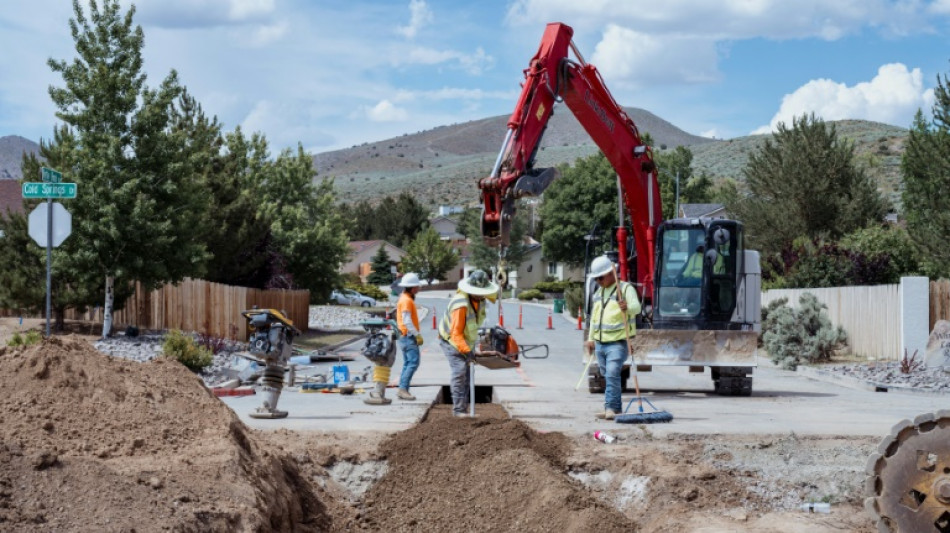
Private firms scour booming Nevada desert for water profits / Photo: Andri Tambunan - AFP
Beneath a bone-dry Nevada lakebed, close to the dusty desert where the Burning Man festival is held each year, an ambitious water project is reshaping this pocket of the US West.
A giant, natural underground aquifer containing enough water to supply 25,000 homes annually is fed by rainfall and snowmelt from the surrounding volcanic mountains.
For the past few years, a little-known company called Vidler Water Resources has been quietly pumping much of this water out through a buried pipeline, under the mountains -- and straight into the rapidly sprawling northern suburbs of Reno, some 30 miles (50 kilometers) away.
"We, everybody, had to start buying from Vidler," said developer Robert Lissner. "Anybody who is building."
Diverting often-scarce water to cities is, in itself, nothing new in the West. But this pipeline is unusual because it was fully constructed and paid for by a private company.
Such projects could help solve water-shortage issues as development expands rapidly in the desert, but they raise serious concerns for the area's aquifers – and with high building costs, the path forward will depend on whether the strategy ultimately proves profitable.
Vidler spent around $100 million to purchase the ranch atop the aquifer, and build the infrastructure -- an outlay that local government officials say they could not contemplate.
"If Vidler hadn't constructed this project, it wouldn't have gotten done," said John Enloe, of the water utility covering Reno.
"They took quite a risk," agreed Lissner.
- 'Salivating' -
Nevada is the nation's driest state, and consistently among its fastest-growing. Builders cannot break ground on new homes here unless they have procured enough "water rights" to supply them indefinitely.
Developers typically buy these coveted and highly limited licenses from local farmers. In districts where local water rights have all been reallocated, building grinds to a halt.
"The land is completely worthless in our area without the water," said rancher David Stix, whose farm is surrounded by newbuild houses.
Several companies have "water importation" plans, similar to Vidler's.
IWS Basin, formerly Intermountain Water Supply, planned to pipe water to northern Reno, but had its permits canceled in 2018. Similar schemes in nearby Lower Smoke Creek and Red Rock Valley are at various stages of development.
A giant industrial park containing Tesla and Panasonic factories, unable to procure local water rights, is constructing a pipeline taking "recycled" water from a Reno treatment plant.
But water importation projects raise ecological concerns.
The US West remains in the grip of a decades-long drought, driven by climate change. Environmentalist Kyle Roerink believes that, if over-pumped, aquifers like Vidler's "very well could be tapped out."
As basins are interconnected, the negative impacts of pumping water into one valley might not be noticed in another until "it is too late," he said.
Vidler declined to comment, instead directing queries to local water utility, the Truckee Meadows Water Authority (TMWA).
TMWA reduced its dependence on a major river flowing from Lake Tahoe by using Vidler's pipeline -- which can currently meet almost 10 percent of the region's total demand.
The authority said a federal environmental impact review had been carried out, and that the amount of water the pipeline is permitted to take is well below the aquifer's annual capacity.
Still, Roerink fears the Vidler pipeline could become a "bellwether" for similar projects, which may not prove sustainable in a few decades.
"There are other basins just like this, where you have developers who are salivating to tap it, salivating to export," he warned.
"Salivating to build their next subdivision, and shopping mall, off of groundwater that comes from 50 or 100 miles away."
Environmental issues aside, the process of moving water across -- or beneath -- mountains is very challenging.
"There are lots of proposals... Every year or two, we get a call from somebody saying 'I want to do a water importation project,'" said water lawyer David Rigdon.
"But they're very, very difficult to get approved. They're super expensive to build. And a lot of times, the market is not there for the water."
Vidler's pipeline, for example, sat unused for nearly a decade after it was completed in 2008, as recession brought housebuilding to a halt.
Vidler currently charges $45,000 per acre-foot of water rights, while water rights in central Reno tend to trade for between $10,000-$15,000. (An acre-foot is equivalent to around half an Olympic-size swimming pool.)
Those costs are borne by the developers, who must calculate whether the additional price makes construction viable.
"It doesn't help," admitted Lissner, the developer.
That said, one of the nation's largest homebuilders seems to think Vidler is a good bet: Last year the company was bought by construction giant DR Horton for just under $300 million.
But whether such pipelines ultimately succeed largely depends on one factor, Stix, the rancher said: "Ultimately, at the end of the day, the almighty dollar wins out."
I.Viswanathan--DT



