
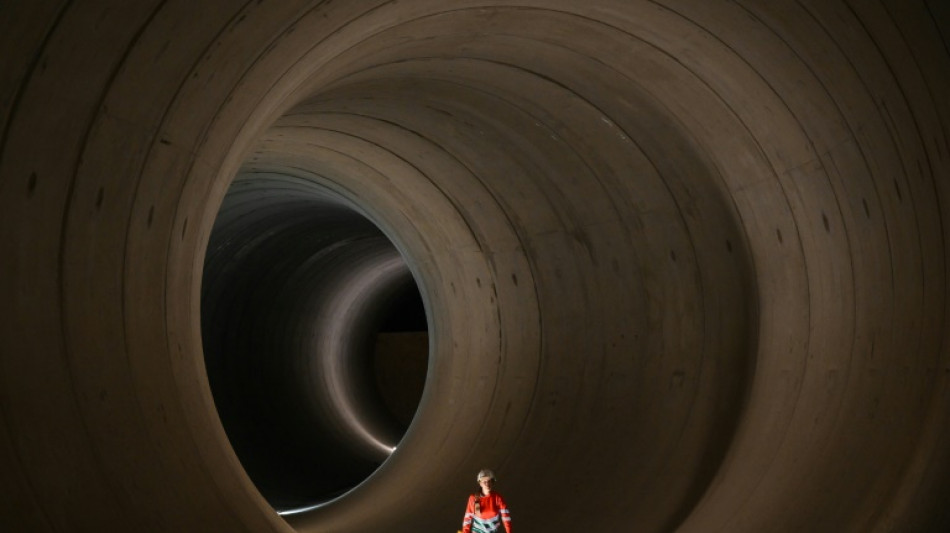
London's new 'super sewer' to end Thames pollution blight / Photo: Daniel LEAL - AFP
The door of the steel box lift clanks shut and a crane slowly lowers construction workers building London's "super sewer" 40 metres (130 feet) to the bottom of an enormous vertical shaft.
Here, a world away from the city's busy streets, thousands of engineers and construction staff have spent the past seven years creating the biggest-ever upgrade to the city's 19th-century sewers.
London's existing sewerage network dates back to the second half of the 1800s when it was designed by civil engineer Joseph Bazalgette in response to the infamous "Great Stink".
In July and August 1858, a combination of soaring temperatures and a sewerage system that emptied straight into the Thames resulted in the city being engulfed in a cloud of putrid air.
The unbearable stench led to the construction of the sewerage system that is still in use today.
But in recent decades, lack of capacity due to the British capital's population growth has meant that raw sewage has once again flowed into the river.
Although an engineering wonder of the 19th century, Bazalgette's network used the same pipes to transport both sewage and rainwater, resulting in effluent often spilling into the Thames due to lack of capacity.
- Growing population -
"Any time it rains, even a light drizzle, the sewers fill up and pour directly into the river," said Taylor Geall of the construction firm Tideway, which is behind the project.
"At the moment, in an average year 40 million tonnes of sewage spills into the Thames completely untreated," he said
Although the old brick-lined sewers -- built between 1859 and 1875 -- are still in "pristine condition" they are just not big enough.
"The issue is capacity," Geall added.
The network was constructed when London's population stood at just four million compared to about nine million today.
With the size of the population set to continue to swell, the need for the £4.3-billion ($5.6-billion) upgrade has become critical.
The new 25-kilometre (15-mile) "super sewer", which is 7.2 metres in diameter, snakes from west to east following the curves of the river.
When operational, it will carry sewage only when rain means the existing sewers are full to overflowing.
Overflow points will allow the sewage that would otherwise have flowed into the Thames to be diverted into the new tunnel.
At its height, 10,000 people were working on the project, which has seen six tunnel-boring machines forge through three distinct geologies -- clay in the west of the city, sand and gravel in the centre and chalk in the east.
- Sewage spills -
The final stages of the mega project, however, come amid controversy for the privatised water sector which stands accused of chronic underinvestment in their networks.
The latest figures released by the government-sponsored Environment Agency show an average of 825 sewage spills a day last year into UK rivers and coastal areas.
A number of beaches on the Isle of Wight off England's southern coast had to be closed during last year's summer heatwave due to the high proportion of bacteria from water pollution.
Surfers Against Sewage, a pressure group, recently published a list of 83 beaches to avoid in Britain due to the discharge of raw sewage.
The government this week confirmed that water companies, as well as others such as energy and waste operators, will face unlimited fines for polluting practices.
The head of Thames Water, whose customers are funding the tunnel through a levy on their bills, stepped down in late June amid a furore over the company's £14 billion debt.
With the tunnelling phase of the "super sewer" completed last year, it is on track to be trialled in 2024 and fully operational by 2025.
"What we're doing is intercepting and taking away 95 percent of the spills," Geall said.
"So once we're finished the river won't look much different -- it's always going to be quite a silty river -- but it will be a much healthier environment for the fish, the marine mammals and the birds that live in it as well as for the rowing communities that use it."
Mathew Frith of the London Wildlife Trust agreed that the new sewer would make a "major contribution" to the River Thames' recovery, but warned it would not solve the problem elsewhere.
"Some (water companies) are taking their responsibilities quite innovatively. But whether there's that level of investment that we've got in London, I'm not sure that's the case yet," he said.
G.Gopinath--DT



