Dubai Telegraph - Toxic foam blights river crucial to Brazil's biggest city

EUR -
AED 4.246011
AFN 72.838394
ALL 95.900007
AMD 432.670294
ANG 2.069629
AOA 1060.201196
ARS 1612.785171
AUD 1.631697
AWG 2.083985
AZN 1.96758
BAM 1.955189
BBD 2.311377
BDT 140.815959
BGN 1.976241
BHD 0.436492
BIF 3407.948889
BMD 1.156163
BND 1.47234
BOB 7.930554
BRL 6.037467
BSD 1.147641
BTN 106.919948
BWP 15.660102
BYN 3.54859
BYR 22660.802746
BZD 2.308078
CAD 1.58721
CDF 2630.271542
CHF 0.912364
CLF 0.026733
CLP 1055.566138
CNY 7.978048
CNH 7.973447
COP 4269.514908
CRC 536.929751
CUC 1.156163
CUP 30.63833
CVE 110.231478
CZK 24.467774
DJF 204.366084
DKK 7.470608
DOP 69.387999
DZD 152.897099
EGP 60.398557
ERN 17.342451
ETB 179.181285
FJD 2.551767
FKP 0.866034
GBP 0.862186
GEL 3.139009
GGP 0.866034
GHS 12.52719
GIP 0.866034
GMD 85.556476
GNF 10057.854367
GTQ 8.779368
GYD 240.096985
HKD 9.056771
HNL 30.376368
HRK 7.533103
HTG 150.53292
HUF 390.449684
IDR 19565.753309
ILS 3.615716
IMP 0.866034
INR 107.439086
IQD 1503.329828
IRR 1520499.398226
ISK 143.803649
JEP 0.866034
JMD 180.303609
JOD 0.819667
JPY 183.061713
KES 148.856534
KGS 101.104059
KHR 4600.561157
KMF 494.837917
KPW 1040.490233
KRW 1730.01369
KWD 0.354145
KYD 0.956401
KZT 551.897392
LAK 24621.299593
LBP 102773.857076
LKR 357.679463
LRD 210.017041
LSL 19.336952
LTL 3.41385
LVL 0.699352
LYD 7.349701
MAD 10.783421
MDL 20.11171
MGA 4775.506442
MKD 61.619725
MMK 2427.680761
MNT 4127.12739
MOP 9.259504
MRU 45.803477
MUR 53.773403
MVR 17.862421
MWK 1990.077595
MXN 20.522305
MYR 4.554122
MZN 73.881892
NAD 19.336952
NGN 1563.69962
NIO 42.23679
NOK 10.988478
NPR 171.068758
NZD 1.964547
OMR 0.44454
PAB 1.147641
PEN 3.952981
PGK 4.953451
PHP 69.199276
PKR 320.500462
PLN 4.26885
PYG 7457.667585
QAR 4.185227
RON 5.093134
RSD 117.453481
RUB 99.602209
RWF 1675.37602
SAR 4.340832
SBD 9.305477
SCR 17.168814
SDG 694.853891
SEK 10.753528
SGD 1.47934
SHP 0.867422
SLE 28.499321
SLL 24244.181045
SOS 654.695242
SRD 43.358429
STD 23930.248207
STN 24.49234
SVC 10.041859
SYP 128.06281
SZL 19.341951
THB 37.747573
TJS 10.988463
TMT 4.046572
TND 3.389584
TOP 2.783763
TRY 51.227637
TTD 7.778567
TWD 36.90359
TZS 2992.051478
UAH 50.467616
UGX 4337.680891
USD 1.156163
UYU 46.485461
UZS 13989.685172
VES 525.690886
VND 30426.75234
VUV 137.625456
WST 3.172703
XAF 655.751911
XAG 0.015594
XAU 0.000245
XCD 3.124589
XCG 2.068253
XDR 0.815545
XOF 655.751911
XPF 119.331742
YER 275.80244
ZAR 19.377588
ZMK 10406.858107
ZMW 22.464974
ZWL 372.284145
  • RBGPF

    -13.5000

    69

    -19.57%

  • CMSD

    0.0100

    22.9

    +0.04%

  • CMSC

    0.0200

    22.85

    +0.09%

  • BTI

    0.6300

    58.72

    +1.07%

  • RIO

    -2.0700

    85.65

    -2.42%

  • NGG

    -1.8700

    85.53

    -2.19%

  • GSK

    0.3100

    52.37

    +0.59%

  • BP

    1.2500

    45.86

    +2.73%

  • AZN

    0.5100

    188.93

    +0.27%

  • BCE

    -0.0200

    25.73

    -0.08%

  • RYCEF

    -0.5900

    16.01

    -3.69%

  • JRI

    -0.1630

    12.16

    -1.34%

  • RELX

    -0.0400

    33.82

    -0.12%

  • BCC

    -1.9800

    69.86

    -2.83%

  • VOD

    0.0500

    14.42

    +0.35%

Toxic foam blights river crucial to Brazil's biggest city
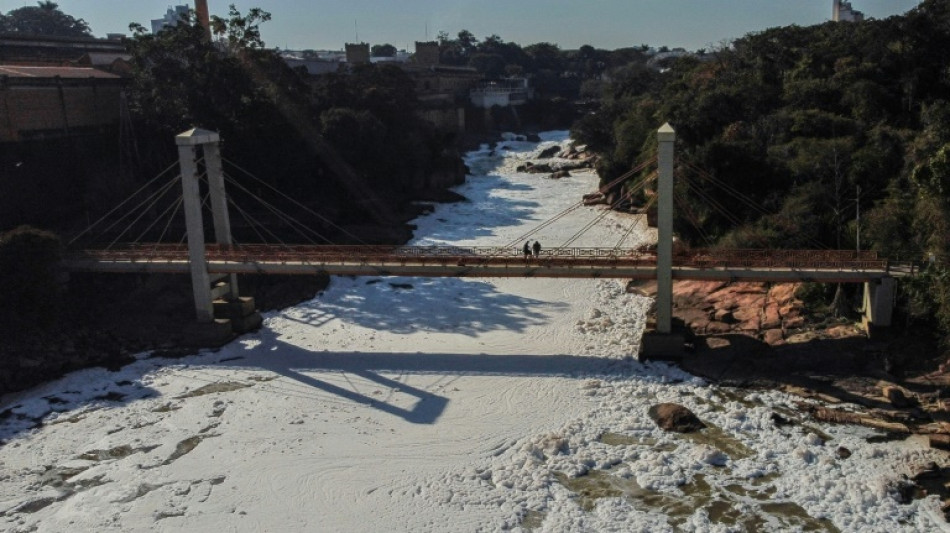
Toxic foam blights river crucial to Brazil's biggest city / Photo: NELSON ALMEIDA - AFP

Toxic foam blights river crucial to Brazil's biggest city

Not far from Latin America's biggest city, Sao Paulo, a river is covered in a white layer that resembles fresh snow but is in fact a smelly, toxic foam.

Text size:

The Tiete river, some 1,100 kilometers long, is crucial for potable water, irrigation and energy production in southeast Brazil, the country's most populated area.

But parts of the waterway, including one area just 100 kilometers (62 miles) from the metropolis, have been befouled by phosphate and phosphorus residues from household detergents used by Sao Paulo's 22 million inhabitants and washed down the sewers.

A tributary of the Parana river, the waterway has been covered in a visible foam layer since last week, at one point spread over more than 10 kilometers and also spotted blighting several waterfalls.

"When these residues enter the fast-running waters of the Tiete, it is as if a washing machine has been turned on," said Malu Ribeiro of the NGO SOS Mata Atlantica, describing the foamy mess.

The NGO warns that fumes from the foam can cause sore throats and breathing problems, and contact could irritate the skin.

The impact on animal and plant life was likely similar to that caused by "acid rain," said Ribeiro.

The phenomenon is not a new one: The foam is a frequent feature of the river in the dry winter months when there is less water to dissolve the chemicals.

In the 1990s, the situation was sometimes so bad that the foam ran down the streets of some cities near the river's shore.

Improvements to water treatment have alleviated the problem, but some years are still worse than others.

Ribeiro said the foam is worse in periods with big temperature fluctuations. In winter the contrast can be quite extreme, with very cold mornings and very hot afternoons.

"Cold water is heavier, and it carries polluting residues to the bottom... But when it is heated by the sun, these residues rise to the surface and form a thicker foam," he explained.

SOS Mata Atlantica is advocating for a ban on phosphate and phosphorus in domestic cleaning products.

Water treatment must be improved too: In the Alto Tiete basin that serves Sao Paolo, just over half of wastewater is treated, according to official data from 2021.

Sao Paulo's environment secretariat has promised to invest 5.6 billion reais (about $1.1 billion) in the water treatment network by 2026.

A.El-Nayady--DT



