
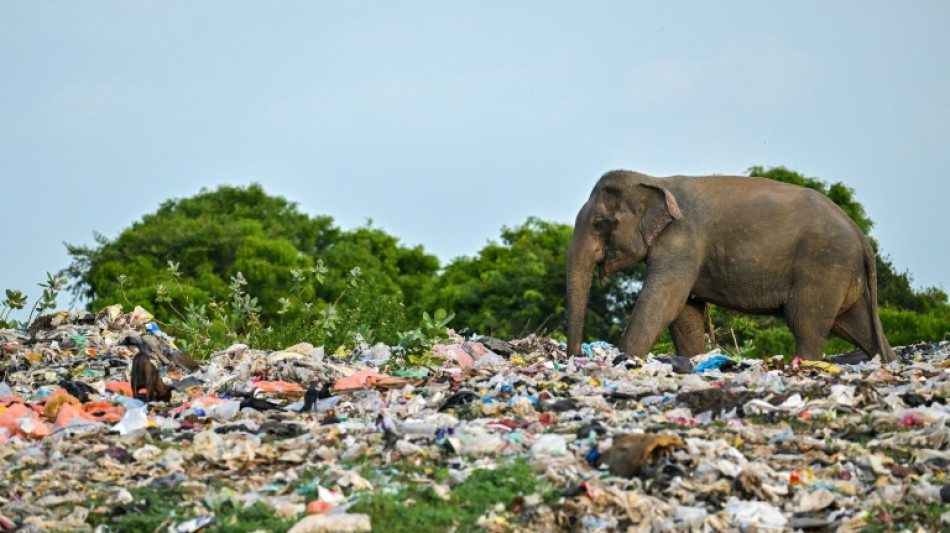
Jumbo problem: Sri Lanka's battle with plastic pollution / Photo: Ishara S. KODIKARA - AFP
Heart-wrenching images of revered elephants and cattle eating plastic in Sri Lanka have prompted politicians to toughen pollution laws, but sceptical conservationists warn past bans were repeatedly ignored.
After an estimated 20 elephant deaths and countless other wild animals perishing due to single-use plastics in the past decade, officials say a law banning many such items is expected to come into force within weeks.
Bags, bottles and packaging are also blamed for clogging drains and causing urban flooding, as well as encouraging a surge in potentially deadly dengue -- spread by mosquitoes that breed in stagnant water.
"We want to create an awareness about the responsible use of plastics," Anil Jasinghe, the country's top environment official, told AFP.
Jasinghe said regulations to be published soon will outlaw the sale of a string of single-use plastic items, including cutlery, cups, drinking straws and plastic flower garlands.
But it is not Sri Lanka's first attempt to tackle the problem.
- Repeated raids ineffectual -
Jasinghe admits that implementation has been a problem, noting that a 2006 ban on super-thin plastic bags and food wrapping was openly flouted by manufacturers.
"Of course, we raid them time and again, but by raiding we cannot solve the issue," he said.
"We need to have that environmental literacy, so that you change your production lines to better, more environmentally friendly production."
In 2017, a notorious garbage dump on the edge of the capital Colombo was shut when a mountain of rotting rubbish collapsed, killing more than 30 people and damaging hundreds of homes.
Soon afterwards, Sri Lanka banned all plastic shopping bags -- but the rules were once again not strictly enforced.
Similarly, a ban on plastic sachets -- popular for small portions of everything from washing powder to shampoo -- was sidestepped by manufacturers who increased the volume to just above the legal minimum.
In addition to manufacturers subverting laws, cash-strapped Sri Lanka also struggles to process what it produces.
The island's unprecedented economic crisis that began late in 2021 means there has been a pile-up of trash because of a shortage of fuel for garbage trucks.
The United Nations says Sri Lanka recycles just three percent of the plastic products it consumes, less than half the world average of 7.2 percent.
Plastic bottles are not included in the ban, but the country's largest recycler of them says it can handle nearly two-thirds more than it is currently processing -- if it could collect the refuse.
"We have the capacity to recycle 400 tonnes a month, but currently we do only 250 tonnes," said Prasantha Malimbadage, CEO of recycling at Eco Spindles.
The company is turning throwaway plastic bottles into polythene yarn that goes into the manufacture of clothing by top international brands.
At Eco Spindles' recycling facility south of Colombo, nearly 350 workers sort bottles that are crushed and torn into small plastic flakes, the raw material for yarn.
"Ten bottles go to make a T-shirt and 27 bottles go to make a graduation gown," Malimbadage said.
- Haphazard disposal -
A 2020 study by the local Centre for Environmental Justice showed single-use plastics such as bags, food wrappers, straws, polystyrene boxes, cups and cutlery made up almost 15 percent of urban waste.
The South Asian nation of 22 million people generates more than 1.5 million tonnes of plastic waste annually and half of it ends up in canals, rivers and eventually the Indian Ocean.
Cleaning up plastic and stopping more production will also aid health, campaigners say.
Health authorities say the spread of dengue fever has spiked dramatically, from 35,000 cases and 26 deaths in 2021, to 76,600 cases and 72 deaths last year.
"Where plastic containers are dumped, there is a spike in dengue," said Lahiru Kodituwakku of the National Dengue Control Unit.
"There is a strong correlation between the spread of dengue and plastic waste".
Regardless of whether the goal is better health outcomes or reducing pollution, anti-plastic campaigners say implementation remains the key.
"This is a good move," said Nishshanka de Silva, founder of local environmental group ZeroPlastic Movement.
"But I am concerned if they will actually go ahead and enforce it."
F.Chaudhary--DT



