
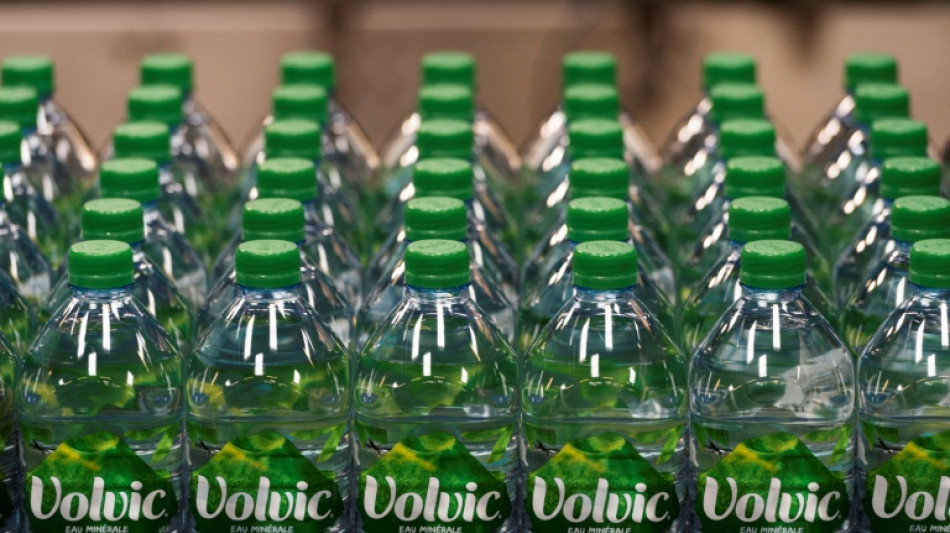
Volvic on front line of France's new water fears / Photo: Thierry ZOCCOLAN - AFP/File
The public fountains in Volvic, the home of one of the world's most famous mineral waters, have been turned off.
Just down the road from the bottling factory at the foot of the old volcanic hills of central France, streams once powerful enough to drive flour mills are drying up and villages are under a hosepipe ban.
Campaigners such as Sylvie de Larouziere, head of the water conservation group PREVA, point the finger at the Volvic plant. "It seems like it's always getting bigger," she complained.
A local aristocratic trout farmer is suing the company, owned by French multinational Danone, after a stream that fed his 17th-century fish ponds abruptly dried up.
The Puy de Dome region is sometimes called the "water tower" of France, with heavy and reliable rainfall meaning farmers downstream used to slosh around in their fields because the soil was so wet.
But those days are long gone. In early May with supplies "abnormally weak", authorities imposed a hosepipe ban and outlawed the filling of swimming pools in 31 nearby districts, hitting some 60,000 people.
Volvic's public fountains were switched off and villagers fear water cuts this summer.
"It was a shock," said Maria-Louisa Borges, a retired cleaner who has lived in Volvic for 50 years. "We're just coming out of winter."
The restrictions, affecting somewhere so famous for its abundant water, underline the worsening strains on supplies in France and the competing demands for an increasingly rare resource.
Two-thirds of the country's water tables are below normal, Environment Minister Christophe Bechu said last week as he voiced "very serious concerns".
But it also raises questions about the future of France's enormous mineral water industry, already decried by environmentalists for the hundreds of billions of plastic bottles it produces annually.
France is both the world's biggest exporter of bottled water and the home of its most famous brands from Volvic to Evian, Vittel to Perrier.
- 'Critical state' -
For decades, experts have been warning about the risk to global fresh water supplies posed by climate change, population growth, and over-consumption.
Problems have been gathering in France, though mostly beyond the public eye. But this winter, the country went a record 32 days without rainfall, from January 21 to February 21. Even villages in the foothills of the snow-topped Pyrenees mountains are having to be supplied by truck.
The dry winter followed punishing heat last summer with months of drought and high temperatures parching even the normally lush Alps and rendering mighty rivers like the Rhine unpassable for barges.
President Emmanuel Macron said it spelled "the end of abundance".
"Climate change is adding to an already degraded situation, with long droughts, heatwaves but also winter droughts," former French environment minister and a Green MP, Delphine Batho, told AFP. "That's leading to a critical state for drinking water."
In a sign of conflicts experts anticipate in future, activists opposed to farmers building rainwater-capture facilities in Batho's constituency in western France clashed violently with security forces in March.
Two protesters were left in a coma.
- Rain shortfall? -
No blows are being traded in Volvic, but fears are growing. Similar tensions are playing out in the eastern Vosges region, where Nestle-owned Vittel is accused of over-exploiting the water table.
Other disputes between water companies and locals have occurred as far afield as Mexico, California and Fiji.
"Sending water to the other side of the world while we die of thirst here? It bothers me," said Jose da Silva, a 69-year-old who worked for 30 years at the Volvic plant.
"They try to claim it's not the same source (as for the drinking water), but I'm not convinced," he told AFP.
The Volvic brand has been around since 1935, the water naturally filtered through a granite-lined volcanic basin in a process that takes five years, according to the company.
Pumping has rocketed from around 200,000 litres a year in 1950 to 1.7 billion litres in 2020, according to its own figures.
Yet Volvic is exempt from the latest water restrictions imposed on locals. The company, however, has pledged to respect a five-percent reduction of its extraction limit of 2.8 billion litres.
Given that it is currently withdrawing less than the limit, campaigners say the pledge makes no difference.
But the company insists it only uses 22 percent of the local water, with 50 percent taken by the public water system.
"Undertaken downstream from the drinking water source, the activities of Volvic do not have an impact on the availability in the drinking water system of the area," it said in a statement.
The local government prefect's office, which sets the annual quota for Volvic, also denied any link between the company and the water restrictions.
It blamed a shortfall in rain, saying it was 24 percent below average in 2022.
The water use restrictions were "preventative and aim to reduce consumption in order to avoid bigger supply tensions", it said.
- Legal fight -
But PREVA and another local group, Marsat, suspect the six deep wells used by Danone are drawing down the level of Volvic's aquifer.
Trout farmer Edouard de Feligonde has spent four years suing the French state for 32 million euros ($35 million) and taking Volvic to court to recover losses caused by his water source drying up.
He is confident an expert report ordered by a judge last year will validate his findings that show Danone is to blame.
"At the moment, authorities are trying to make us believe that the water shortages are linked to the general problem of drought. It's false," he told AFP.
He said many people are scared to speak out as Danone is by far the biggest local employer, with about 1,000 people on its payroll.
"I'm not the only one affected, but I'm the only one to have the means to fight back," he said.
T.Jamil--DT



