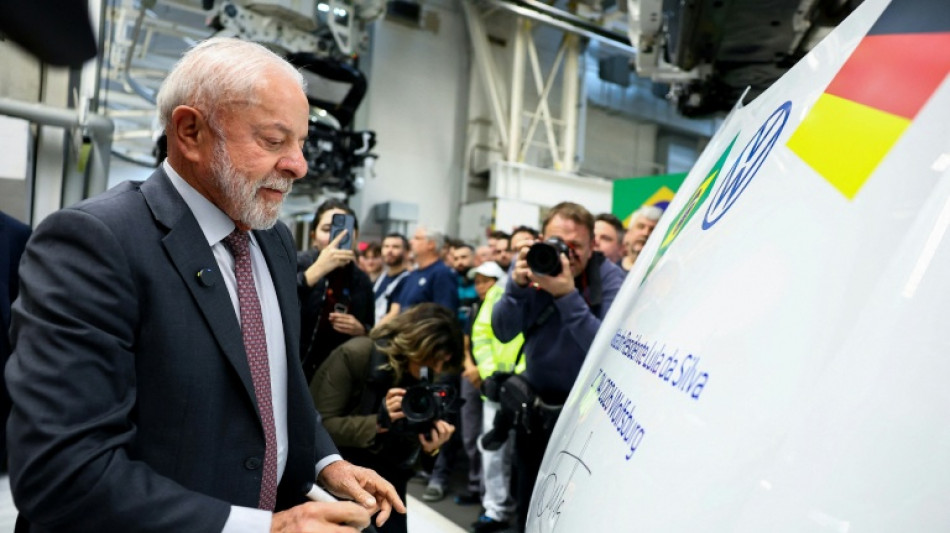
Concern stirs Lula camp as election bid loses momentum / Photo: Lisi Niesner - POOL/AFP
Four months ago, the stars seemed to be aligned for veteran left-winger Luiz Inacio Lula da Silva in his quest for an unprecedented fourth term as Brazilian president.
The 80-year-old was riding high in polls after staring down US President Donald Trump in a spat over the coup trial of former far-right president Jair Bolsonaro.
The economy was growing and unemployment was falling to record lows.
But a flurry of financial scandals and growing discontent over a cost-of-living crisis have eroded his lead over his right-wing rival, Flavio Bolsonaro, son of Jair Bolsonaro, now sitting in prison.
A survey by the polling firm Datafolha published on April 11 sent alarm bells ringing throughout the Lula camp.
For the first time it showed Bolsonaro edging out the incumbent in a presidential runoff, with the senator garnering 46 percent to 45 percent for Lula, although the pair remained locked in a statistical tie.
Worryingly for Lula, the Datafolha poll showed 51 percent of voters disapproving of his performance.
"It's a warning sign, obviously," said Jilmar Tatto, vice president of the Workers' Party, which former metalworker Lula co-founded in 1980.
The younger Bolsonaro is running as a more moderate version of his father, who is serving a 27-year sentence for plotting to cling onto power after losing elections to Lula in 2022.
Lula has launched a counteroffensive, highlighting improvements in health, education, and infrastructure since he succeeded Trump ally Bolsonaro.
The publicity effort is taking place on several fronts.
To allay concerns about his age, Lula has released videos of him lifting weights, using a treadmill and sprinting to meetings.
He has also issued a new call to arms in the face of Trump's intimidation of friend and foe alike.
"We cannot allow the world to bow down to the behavior of a president who believes that he can impose tariffs on products, punish countries, and wage war by email or Twitter," Lula said recently in Germany.
- 'Barely surviving' -
Defending Brazil's sovereignty gave Lula a poll bump last year, when the United States slapped tariffs on its longtime ally for putting Trump's friend Bolsonaro in prison.
But in the months since, the mood in Brazil has shifted.
Rising prices for essentials like food and energy have taken center stage, particularly among younger voters.
"The market is incredibly expensive. Buying clothes is very expensive too. It's very shocking because you're not really living, you're just barely surviving," Yohana Freitas Barbosa, a 27-year-old administrative assistant in the capital Brasilia, told AFP.
Mariano Machado, an analyst at the consulting firm Verisk Maplecroft, warned that "any gap between the macroeconomic situation and voters' everyday experience with the cost of living will influence the vote, and Lula knows it."
To curb rising fuel prices caused by the Middle East war, the government has temporarily reduced taxes on diesel to zero.
But Lula has failed to quell feverish speculation about his poll slump.
For the first time, newspaper columnists are pondering a hypothetical scenario in which he might withdraw from the election.
The ruling party has dismissed the idea and doubled down on its social agenda, which includes a proposal to cut the working week by four hours to 40 total.
"We are going to set the country's agenda and win the elections," Tatto said.
- Whiff of scandal -
A series of high-profile financial scandals have added to the president's woes.
Police and Congress are investigating a major alleged pension fraud scheme, from which one of Lula's sons is believed to have benefited.
Another probe is looking at the links between a businessman at the heart of a major banking scandal and high-ranking public officials.
While none of the investigations target the president, Brazilians' weariness with corruption "ends up tainting those in power," Edinho Silva, head of the Workers' Party, lamented.
For many on the right, Lula remains poisoned by the corruption scandals that marked his first two terms as leader between 2003 and 2010.
Lula himself spent 580 days in prison for corruption as part of the sprawling Lava Jato (Car Wash) probe, although his convictions were later annulled.
The lingering perception among some voters is "that the (Workers' Party) is more corrupt than the rest," Creomar de Souza, a politics professor at the Dom Cabral Foundation, told AFP.
A.Ansari--DT