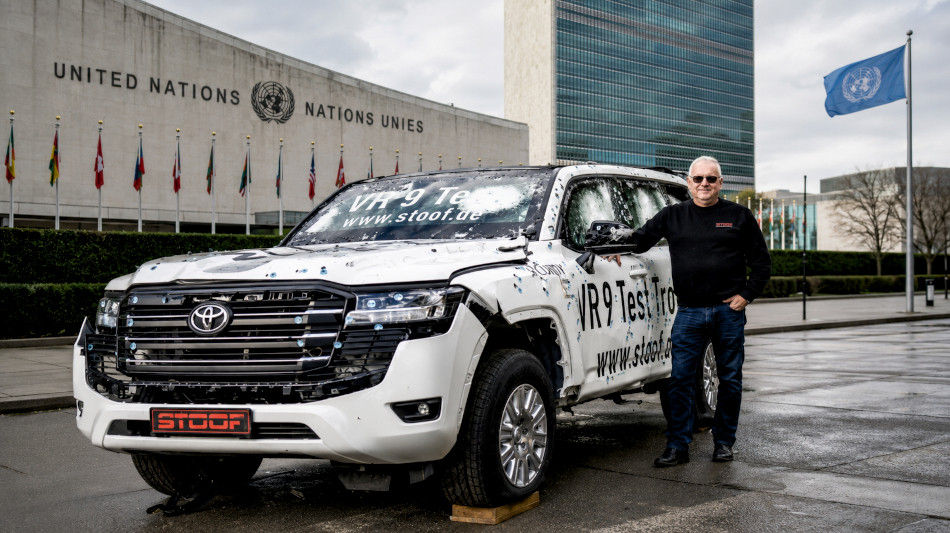
TROJAN: Special protection for a more perilous political era
The days when armoured official vehicles were seen primarily as a visible symbol of state power are over. In a security environment characterised by political radicalisation, terrorist threats, hybrid attacks, sabotage and the repercussions of international conflicts, specially armoured vehicles for high-risk individuals are increasingly becoming a practical component of professional security strategies. The Stoof Trojan, based on the Toyota Land Cruiser 300, is a prime example of this shift.
Its significance lies not merely in its heavy armour or imposing appearance. What is crucial is the combination of certified ballistic protection, comprehensively tested resistance to explosive effects, and the ability to remain manoeuvrable even under difficult road and off-road conditions. For politicians, diplomats, high-ranking officials and others with a specific risk profile, it is precisely this combination that can determine whether a vehicle can still be driven out of the danger zone following an attack.
The current threat situation highlights why such vehicles are no longer relevant solely for operations in distant crisis zones. In Germany, a total of 85,837 politically motivated offences were recorded in 2025. These included 4,156 violent offences. At the same time, the number of offences against public officials and elected representatives remained high at 5,797 cases. Across the European Union, 45 completed, failed or foiled terrorist attacks, as well as 486 arrests for terrorist offences, were reported during the same period.
These figures by no means imply that every Member of Parliament or local decision-maker requires a vehicle with VR9 protection. However, they do show that risk assessments today must be broader in scope than they were just a few years ago. Russia’s ongoing war of aggression against Ukraine, the conflicts in the Middle East, state-sponsored espionage and sabotage, and the rapid radicalisation of individual perpetrators online have broadened the spectrum of possible attacks. As a result, particularly high-profile individuals may become targets not only of classic assassination plots but also of spontaneous, highly unpredictable acts of violence.
VPAM VR9 / VR10 rating protects not only individual components but the entire vehicle
The scale of the relevant test guideline ranges from VR1 to VR10. VR9 is therefore the second-highest vehicle class and already imposes requirements that go far beyond protection against ordinary handguns or standard rifle ammunition.
The associated ballistic test programme includes hard-core ammunition in the calibre 7.62 × 51 millimetres with an impact velocity of around 820 metres per second. Such projectiles have a considerably higher penetration capability than conventional full-jacket ammunition. Nevertheless, the thickness of a single steel plate or glass pane says little about the actual safety of a vehicle.
The crucial difference lies in the testing of the complete vehicle. Classification in accordance with the Vehicle Directive requires that it is not merely individual armour materials that have been certified. Structural transitions, door pillars, hinges, welded seams, bonded joints, overlaps and the connections between protective glazing and the bodywork are also examined. It is precisely these areas that are considered particularly sensitive, because an attacker does not necessarily aim for the centre of an armour plate, but instead attempts to exploit existing weak points.
In the Trojan, high-strength steel components, aramid fabric and protective glazing several centimetres thick form a largely enclosed safety cell. The bodywork, chassis, suspension, wheels and braking system are adapted to the significantly higher vehicle weight. After all, the armour must not result in a situation where the vehicle survives an attack but can no longer be driven in a controlled manner due to overloaded brakes, damaged wheels or insufficient chassis reserves.
Three stars in the blast resistance test
The Trojan is of particular significance due to the additional testing carried out in accordance with the third edition of the guideline for blast-resistant vehicles. This assessment does not merely consider whether the armour remains externally intact following a detonation. The stresses on the occupants, potential shrapnel effects, deformation of the interior and the transfer of blast energy to the human body are also factored into the evaluation.
To this end, biofidelic test dummies are used, amongst other things; their mass distribution, movement behaviour and skeletal structure replicate the human body far more realistically than simple test specimens. This enables the testers to assess whether an occupant would be exposed to life-threatening accelerations or injury-causing stresses despite an externally intact safety cell. In the specified explosion tests, the Trojan achieved three out of a possible three stars in all categories tested. Three stars represent the highest rating for a successfully completed test variant. The side-impact explosion was carried out from a distance of two metres.
In addition, a test was carried out in accordance with the military standard STANAG 4569 at Level 2a. This scenario involves the explosive effect of six kilograms of TNT beneath a front wheel. For a civilian off-road vehicle, the combination of VR9 ballistic protection, the highest ERV star rating and an additional test against mine effects is exceptional. Although the international armoured vehicle industry offers other high-class vehicles, this specific combination is likely to have few direct equivalents in the civilian SUV segment.
The ability to escape after the initial attack is crucial
A modern special protection vehicle is not designed to allow for a prolonged firefight. Its most important task is to withstand the initial attack and to get the person at risk out of the immediate area of impact. Protection and mobility cannot therefore be considered in isolation from one another.
The Toyota Land Cruiser 300 provides a robust and off-road capable platform for this purpose. Following the conversion, the vehicle must be able to cope with a significantly greater mass without losing its driving stability and manoeuvrability. Specially tuned chassis components, reinforced wheels and a more powerful braking system are therefore part of the safety concept.
Run-flat tyre systems are designed to allow the vehicle to continue travelling even after a puncture. An armoured fuel tank, protected batteries, a secured central electrical system, a fire-extinguishing system and an internal communications system increase the likelihood that the vehicle will remain operational even after an attack. Depending on the operational profile, additional communications, tracking and warning systems can be integrated.
The unobtrusive exterior appearance is also a safety factor. A vehicle that is recognisable from a great distance as an exceptional armoured car can attract unnecessary attention. The Trojan retains key design elements of the Land Cruiser 300, whilst the actual protective structure remains largely concealed beneath the near-standard bodywork.
A VR9 may be necessary for politicians at particularly high risk
Whether a politician requires a vehicle of this protection class must not be decided solely on the basis of personal prestige or the political significance of an office. The decisive factors must be specific threats, the individual’s public profile, regularly used routes, the security situation at the location of deployment and the expected means of attack. For members of government, state guests, diplomats in crisis regions, high-ranking military and security officials, as well as judges or prosecutors involved in particularly dangerous legal proceedings, a VR9 vehicle may be objectively justified. The same applies to businesspeople whose work involves risks of kidnapping or attack, to witnesses at risk, and to staff of international and humanitarian organisations in unstable regions.
A vehicle such as the STOOF Trojan may also be necessary where there are no paved roads or where escape routes lead through rough terrain. Whilst a conventional armoured saloon offers a high level of comfort and protection on good roads, it can more quickly reach its limits in the event of damaged infrastructure, roadblocks or the need to manoeuvre off the road. The Trojan combines the protection of a heavy-duty security cell with the operational capabilities of a large off-road vehicle.
The purchase of an armoured vehicle must never be viewed as an isolated measure. Even the best armour loses much of its value if the driver is not specially trained, if alternative routes are unavailable, if communication systems fail, or if the maintenance of brakes, tyres and suspension is neglected. Regular driver training, coordinated escort vehicles, up-to-date route reconnaissance and an immediately available replacement vehicle are all part of a comprehensive protection concept.
Certification provides security, but not invulnerability
Even a vehicle tested to VR9 is not indestructible. Every certification specifies clearly defined test conditions. Attacks that significantly exceed these stress levels can overwhelm the protective effect. This makes it all the more important that clients understand what risk is covered by a particular protection class and where its limits lie.
This is precisely why independent testing carries greater weight than marketing terms such as ‘armoured’, ‘bulletproof’ or ‘maximum protection’. Robust certification makes technical performance comparable and compels manufacturers to demonstrate not only the performance of individual materials, but also the interaction of all safety-relevant components. The certified Trojan will remain part of the current special protection range in 2026. Its true strength lies not in superlatives, but in the documented combination of several high protection standards. VR9, the three-star ratings in the explosion tests, the additional mine scenario and the off-road capability of the Land Cruiser 300 result in a vehicle designed for exceptional threat scenarios.
At a time when elected officials and public representatives continue to face a high level of threats, hatred and violence, the procurement of such a special protection vehicle for a limited group of individuals may be a necessary investment in the state’s ability to act. After all, responsible personal protection does not mean waiting for an attack. It means minimising the consequences of a potential attack in advance, as far as is technically and organisationally possible.
STOOF International GmbH, based in Borkheide, is one of the market leaders in the field of specially protected vehicles for public authorities, security organisations, armed forces and international institutions. The company develops and manufactures highly specialised vehicle solutions with certified ballistic and blast protection for operations subject to demanding security requirements. As part of the MOSOLF Group’s Special Vehicles business unit, STOOF brings together comprehensive expertise in the field of protected mobility and specialist vehicle construction.
The company has been part of the MOSOLF Group since 2025. As a result, it benefits from the financial strength, Europe-wide network and extensive resources of one of the leading system service providers in the European automotive industry.
Further information can be found at: www.stoof-international.de and www.mosolf-special-vehicles.com
M.Motin