Tesla FSD secrecy puts Europe’s safety oversight under scrutiny
Europe’s argument over Tesla’s Full Self-Driving Supervised system has moved beyond the familiar contest between technological optimism and regulatory caution. It is now a dispute about evidence: how much the public should be allowed to know when a driver-assistance product is cleared for use on ordinary streets.
The Netherlands granted provisional approval in April after a review lasting more than eighteen months. Lithuania, Estonia, Denmark and Belgium have since recognised the Dutch decision, while an authorisation covering the entire European Union could be put to a vote later this year. Several larger markets remain unconvinced. The split is becoming more important because the Dutch assessment is serving not merely as a national judgement, but as the technical foundation for a potentially continent-wide change.
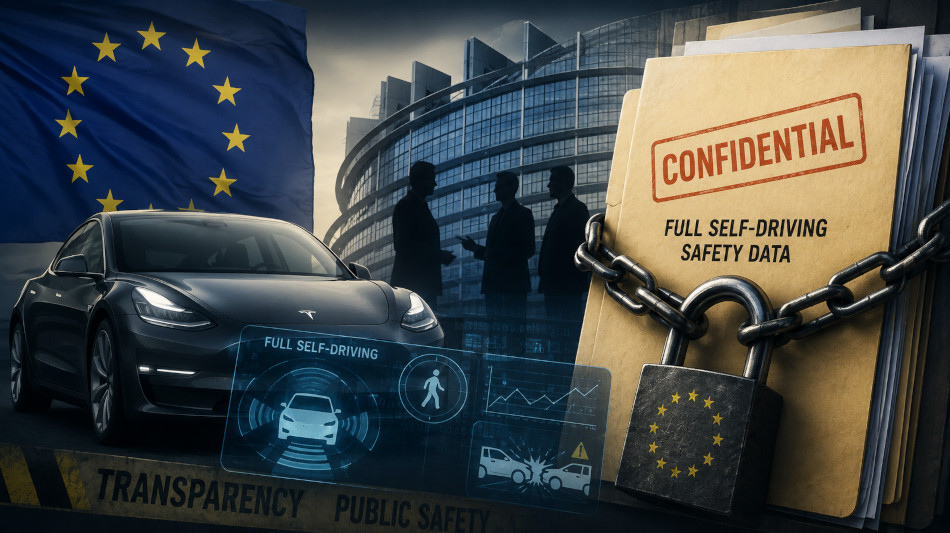
Nothing disclosed so far establishes that the system is unsafe. The more immediate problem is that neither drivers nor independent specialists can examine enough of the evidence to understand why regulators consider it safe.
A verdict the public cannot audit
The Dutch vehicle authority RDW describes a substantial assessment. It reports more than three thousand hours of testing, over one thousand test runs and the use of data covering 1.8 million kilometres driven in Europe. The work included test tracks, public roads, dense urban traffic, varied road layouts and severe weather. By mid-June, RDW said nearly forty thousand equipped Teslas had covered about twenty-four million kilometres in the Netherlands without a relevant incident.
Those figures deserve weight. They do not, however, reveal the intervention rate, the distribution of routes and weather, the definition of a relevant incident, the treatment of near misses or the benchmark used to decide that the system was at least as safe as competing assistance technology. RDW says it checked Tesla’s data collection and statistical analysis, carried out independent tests and continues to supervise the fleet. It has also increased post-approval reporting from an annual cycle to a monthly one.
That is more oversight than the public debate sometimes acknowledges. Yet the central weakness remains: the conclusion is public, while much of the method and most of the performance evidence are not.
A car that drives while the human remains liable
Full Self-Driving Supervised can steer, accelerate, brake, change lanes, negotiate junctions and follow a route through urban streets. Despite the breadth of those functions, it is not an autonomous driving system under European law. The driver remains responsible, must watch the road and must be prepared to intervene immediately. A cabin camera monitors attention, and persistent inattention can lead to warnings and temporary suspension of the feature.
This creates a demanding form of shared control. The more smoothly a car handles routine driving, the easier it becomes for the person behind the wheel to drift from active driver to passive monitor. Yet a difficult construction zone, an obscured sign, an unusual road layout or a sudden misjudgement can return responsibility to the human within seconds.
That supervision problem does not negate the potential safety benefits. Software does not become tired, intoxicated or distracted by a telephone, and it can react faster than a person in many circumstances. Finland’s transport authority has said the system has often been observed making safer decisions than a human driver. Finnish reviewers nevertheless continue to examine performance on steep and winding roads, restricted sight lines, overtaking situations and the driver’s ability to recover safely from an unexpected error.
One national approval with European consequences
The Dutch decision was issued through the European procedure for new technologies that do not fit existing harmonised rules. Article 39 permits a national approval authority to grant provisional clearance when a manufacturer demonstrates an equivalent level of safety, pending authorisation by the European Commission. Other member states may recognise that clearance within their own territory.
For Union-wide approval, the proposal needs a qualified majority representing at least 55 per cent of member states and 65 per cent of the European Union’s population. A vote could take place in October. Approval would matter far beyond one Tesla software release because an authorised exemption can lead to the underlying regulatory framework being adapted for comparable systems from other manufacturers.
Europe already permits certain hands-off assistance on motorways. Tesla is seeking much broader operation across city streets, rural roads and motorways while the driver remains legally in command. The decision will therefore help define how Europe treats a new class of vehicles that can perform most of the visible driving task without accepting legal responsibility for it.
Where trade secrets end and public evidence begins
Tesla is entitled to protect source code, neural-network design and commercially sensitive engineering. Regulators also need confidential access to technical material that companies could not reasonably be expected to publish.
The controversy concerns information of a different kind. Test design, collision definitions, intervention thresholds, road and weather exposure, comparison groups and aggregate failure rates can usually be disclosed without revealing how the software is built. Protecting intellectual property does not require concealing the entire safety case.
Correspondence released through public-records procedures indicates that confidentiality was a priority for Tesla during the Dutch review. In one exchange, the company sought assurance that a document would never be released before providing further material. RDW says it made its own disclosure decisions under rules protecting manufacturer-specific information and did not simply act at Tesla’s request. That may settle the formal question of who made the decision, but not whether the result serves the public interest. When a regulator allows a system to control a vehicle among pedestrians, cyclists and other motorists, the performance standard should be available in a redacted but technically meaningful form.
The concern is heightened by the debate over Tesla’s public safety statistics. The company has promoted collision rates suggesting that vehicles using Full Self-Driving Supervised perform several times better than conventional driving. Independent researchers have questioned whether those comparisons use matching crash thresholds, similar road environments and equivalent vehicle populations. Norwegian officials have also indicated that the material shared by the Dutch authority does not support a safety advantage as large as Tesla’s public presentation suggests.
RDW maintains that it did not rely on marketing claims. It says the approval rested on European vehicle data, independent testing and its own validation. That defence could be entirely justified. Without the analytical framework, outsiders cannot determine how strong it is.
A divided Europe approaches a decisive vote
France has said it will not support the current configuration, pointing to speeding and driver-monitoring concerns. Finland remains broadly positive about the technology’s potential but has not completed its assessment. Denmark authorised national use after reviewing the technical documentation, while also stating that European deliberations are covered by confidentiality rules.
Ongoing investigations in the United States add context, although they cannot deliver a verdict on the European system. American authorities continue to examine reported traffic-law violations and performance when camera visibility is degraded. The European software differs from the American version, and Europe applies a stricter pre-market approval process. Even so, those investigations make it reasonable to ask how known failure modes were reproduced, measured and controlled during European testing.
Tesla has a legitimate commercial interest in expanding the system. Advanced software is central to the company’s attempt to distinguish its cars in a market where electric models are multiplying and competition has intensified. Europe also has an interest in avoiding needless delay if the technology can reduce collisions. Innovation can save lives, and excessive caution carries costs of its own. But speed and secrecy are not inevitable partners.
The transparency standard Europe needs
A workable compromise would protect proprietary engineering while requiring publication of a structured safety case. That record should identify the approved software version, operational limits, test scenarios, exposure data, intervention and incident definitions, aggregate outcomes, comparison methodology and the conditions that would trigger corrective action or withdrawal. Serious incidents should be reported through a common European format, and significant over-the-air changes should prompt renewed assessment.
Such disclosure would not give competitors Tesla’s code. It would allow researchers, lawmakers and road users to understand what was tested, what failed and why the remaining risk was judged acceptable. Tesla may ultimately demonstrate that its supervised system reduces danger on European roads. The Dutch tests may be more rigorous than critics assume. The present secrecy makes both propositions harder to establish, not easier.
Europe is setting rules for an era in which software will perform more of the driving task while responsibility remains with the human occupant. A safety approval may be legally valid behind closed doors. For a technology operating in public space, it must also be publicly persuasive.
A.Lochmann