A decade post-Sandy, New York vulnerable as ever / Photo: STAN HONDA - AFP/File
Long before Superstorm Sandy devastated New York City and the surrounding region in 2012, scientist Klaus Jacob issued a prophetic report warning city leaders that such paralyzing flooding was imminent.
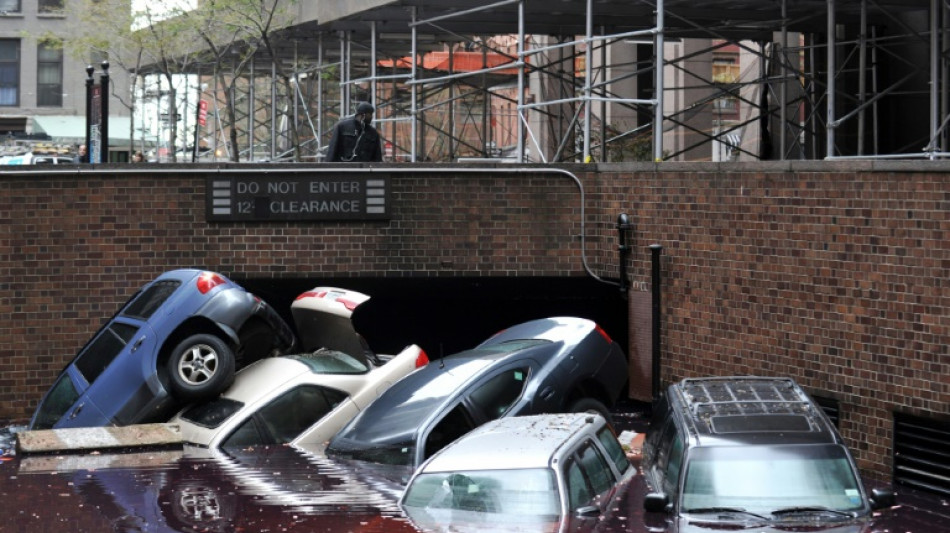
Then Sandy made landfall on October 29 of that year, leaving well over 100 people dead in the United States, including 43 New York City residents. It caused $19 billion in damages across the metropolis, triggering lengthy power outages, temporarily displacing thousands of people and damaging tens of thousands of residential units.
More than two feet of water flooded into Jacob's own home in a quaint Hudson River town in New York state, an irony he suffered because municipal zoning laws barred him from raising the building enough to avoid such inundation.
"A week after Sandy I got a letter in the mail: 'Now you can raise it,'" recounted Jacob, a geophysicist at Columbia University specializing in disaster risk management.
The experience speaks to the much larger challenges of short-sighted thinking as climate change warnings grow ever-more dire.
Ten years after Sandy left one of the world's cultural and economic powerhouses tragically swamped, Jacob says the city is far from prepared for the coming era of intense storms.
New York received billions of federal dollars and invested in rebuilding. A number of resiliency projects remain in the planning stages while a few, including one to reduce Manhattan's coastal flood risk, are underway.
Jacob said subway repairs that fixed thousands of holes would allow the vital transportation system to fare better in the wake of another Sandy-esque storm.
And the US Army Corps of Engineers recently detailed a $52 billion plan to erect a massive system of storm surge gates and seawalls.
But that will require years of bureaucracy to get approvals, and isn't slated to begin construction until 2030.
- Climate and housing -
An October report from New York's comptroller -- an elected official responsible for scrutinizing the budget -- criticized some city agencies for dawdling, with several projects stalled and billions in federal funding unused and still available.
Last fall's Hurricane Ida meanwhile highlighted the city's persistent frailties, including aging sewer infrastructure.
In a mere hour Ida poured more than three inches of rain onto Central Park -- nearly twice what the city's sewage system is capable of handling -- and, according to Jacob, "the subway system became the default sewer system."
Dozens of people in the region died. Several of the deceased lived in New York City basement apartments that flooded.
If Sandy hit tomorrow "we'd be way worse off," said Thaddeus Pawlowski, an urban designer focused on climate resiliency, who formerly worked at the NYC Office of Emergency Management.
"Our housing situation has gotten so much worse. Our neighborhoods are so much more unequal," Pawlowski told AFP.
New York is facing an acute housing crisis, but a fair proportion of the city's new residencies have been in coastal neighborhoods like Williamsburg and Long Island City. Municipal data mapped by local outlet The City shows some 2,000 new units were built square in the floodplain of Coney Island, a district Sandy pummeled.
The state has bought out some homeowners living in vulnerable neighborhoods, including in Staten Island's Ocean Breeze, where hundreds of homes were purchased and demolished.
"That's a good pilot program, but it's bread crumbs -- we need loaves," said Jacob. "Buying out is not enough. We need to have a place where they can move."
Jacob cited need for denser residential buildings, but emphasized new construction must eye climate risk rather than cater to the real estate industry.
"We don't have any long-term vision, such that short-term measures, like building housing, work together with that long-term vision," he told AFP.
"Without that vision being developed, I think we are just fiddling around forever on the edges."
- 'Massive mobilization' -
Climate experts and political leaders agree there's no silver bullet -- mitigating risk and shoring up resiliency demands sweeping planning and investment in conjunction with neighborhood-scale storm management, like shrub-filled bioswale ditches that filter runoff.
"We are not going to be able to say, 'we did one project and now we are safe forever,'" said Rohit Aggarwala, the city's chief climate officer. "That just is not the way it is going to work."
Pawlowski pointed to the Green New Deal -- a proposed congressional plan to reshape America's climate and economic policy -- as a way forward.
"We need a massive mobilization," he said.
Jacob did say that, unlike some of the United States' low-lying coastal cities like New Orleans, New York has "the luxury of high typography" that should inform building strategies.
Perhaps morbidly, he noted the city's cemeteries occupy its highest points: "We could swap the dead and the living."
Above all, Jacob urged against inertia, saying "either we are psychologically overwhelmed, or the water will overwhelm us."
"Which one do you prefer?"
F.Saeed--DT