Many thousands flee burning France holiday haven by road and sea / Photo: Maximilien LAMY - AFP
Famous as a summer getaway for the likes of actors Marion Cotillard and Jean Dujardin, the Cap Ferret peninsula in southwestern France has been emptied of its usual summer crowds by the wildfires, with more than 40,000 people moved by road and sea.
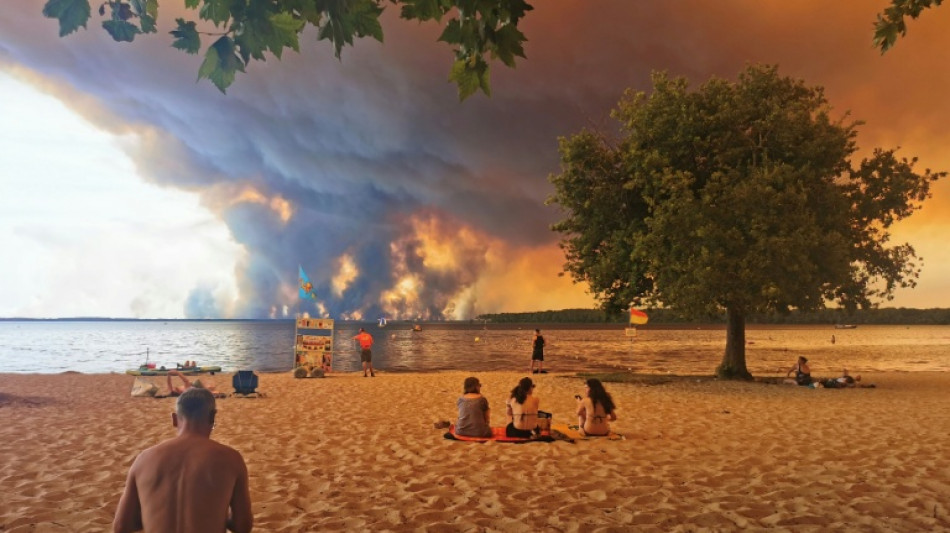
Thick smoke stretched across the skies above Lege-Cap-Ferret, where streets were deserted and metal shutters drawn, as wildfires drove residents and tourists away during the peak summer season.
"There's not a soul around," Cecile Maumy said at the ferry terminal. "It feels like the Covid period. It's unbelievable."
Le Spot campsite appeared abandoned, with only the sound of cicadas breaking the silence. Half-used bottles of syrup and opened bags of crisps remained on the tables, while the door of a caravan had been left ajar.
"It's a disaster, it's horrible," said Jean Goncalves, a T-shirt tied around his face.
The 54-year-old, who has lived in Lege-Cap-Ferret for 30 years, fled his home after watching his neighbour's wooden house catch fire.
Large smoke plumes from the fires could be seen from neighbouring towns along the Atlantic coast.
Holidaymakers in the seaside resort of Lacanau watched smoke blanket the sky from the safety of the beach, sheltered beneath umbrellas.
France has been battered by three heatwaves since May, part of increasingly frequent extreme weather episodes linked to climate change, causing thousands of excess deaths, drying up rivers and fuelling wildfires.
- 'XXL wildfire' -
The wildfire broke out on Wednesday in the village of Saumos close to the renowned Medoc vineyards.
Moving rapidly through dense pine forests, the blaze spread to the Cap-Ferret peninsula, long favoured by wealthy French families and known for its sand dunes and oyster shacks.
Many French A-listers, drawn to the understated charm of Cap-Ferret over the glitz of the French Riviera, spend their vacations there -- many have homes on the peninsula.
Residents have described scenes like a "war zone", while the regional prefect Sophie Brocas called the blaze an "XXL wildfire, unpredictable and voracious".
No fatalities have been reported, but dozens of homes have been destroyed, along with a campsite.
Faced with the advancing flames, officials ordered the evacuation of the entire peninsula and several nearby villages.
Officials said 44,000 people had been evacuated over the past two days.
Most people have left by car through the peninsula's single road, with traffic jams building up in the direction of Bordeaux.
Hundreds were also ferried out by boats as part of the evacuation plan, the first time it has been activated after it was put together following devastating fires in the region in 2022.
"Everything was handled smoothly," said David Lafforgue, a Cap-Ferret shopkeeper and local elected official. "Suitcases were ready, and people remained calm."
- 'Catastrophic' -
But he said he was worried about what comes next.
"Economically, it's catastrophic," he said. "We go from everything to nothing.
"July 20 to August 20 is the peak of our season. We don't know whether our seasonal workers will come back or whether our customers will return."
Some people were moved to Andernos, which itself had to be evacuated.
Maria Lalanne, a 90-year-old resident of Lege-Cap-Ferret with no family, was still in shock. She left her hearing aid and glasses behind at home.
"I have heart disease, blood pressure issues, eye problems. I don't know how long this will last. I don't know what has happened to my house," she said.
Evacuee Julie Boisvert had been staying in the village of Le Porge when her family was forced to leave.
She said she had begun to feel "surrounded" by the advancing flames.
"The gendarmes knocked on every door," said Boisvert, adding they left by car with their two children, aged five and two.
Firefighters were also battling another major fire near the town of Biscarrosse, southwest of Bordeaux.
"We have never experienced anything like this," said Gilles Clavreul, the prefect of Landes.
al-cas-lcr-jed-as/jxb
A.Padmanabhan--DT