Dubai Telegraph - Floating igloo leaves France for polar exploration mission

EUR -
AED 4.196947
AFN 75.425149
ALL 93.727408
AMD 417.699316
ANG 2.045914
AOA 1049.094839
ARS 1689.637308
AUD 1.630736
AWG 2.057048
AZN 1.943038
BAM 1.955294
BBD 2.301705
BDT 140.975048
BGN 1.962776
BHD 0.430996
BIF 3398.18089
BMD 1.142805
BND 1.475044
BOB 7.912588
BRL 5.836535
BSD 1.142805
BTN 110.168445
BWP 16.350059
BYN 3.303304
BYR 22398.968873
BZD 2.298446
CAD 1.603468
CDF 2582.738553
CHF 0.92346
CLF 0.027094
CLP 1066.202372
CNY 7.740501
CNH 7.736964
COP 3731.0511
CRC 518.475025
CUC 1.142805
CUP 30.28432
CVE 110.236499
CZK 24.188772
DJF 203.510945
DKK 7.47573
DOP 66.87388
DZD 152.115064
EGP 58.359256
ERN 17.142068
ETB 184.459937
FJD 2.537367
FKP 0.849573
GBP 0.848858
GEL 2.999846
GGP 0.849573
GHS 13.216814
GIP 0.849573
GMD 84.567635
GNF 10027.40747
GTQ 8.719898
GYD 239.102366
HKD 8.960559
HNL 30.605623
HRK 7.532108
HTG 149.344002
HUF 361.2708
IDR 20511.055782
ILS 3.481788
IMP 0.849573
INR 110.152243
IQD 1497.139124
IRR 1571356.234424
ISK 143.193543
JEP 0.849573
JMD 181.143166
JOD 0.810234
JPY 185.570313
KES 147.71913
KGS 99.938014
KHR 4616.887129
KMF 490.262808
KPW 1028.524159
KRW 1692.893695
KWD 0.354063
KYD 0.95237
KZT 537.690393
LAK 25813.777755
LBP 102341.031352
LKR 384.337358
LRD 206.85014
LSL 18.83656
LTL 3.374405
LVL 0.691271
LYD 7.322107
MAD 10.677799
MDL 20.108153
MGA 4901.818448
MKD 61.554238
MMK 2400.12125
MNT 4097.413511
MOP 9.229775
MRU 45.622003
MUR 53.860086
MVR 17.667962
MWK 1981.722319
MXN 19.984023
MYR 4.676587
MZN 73.03663
NAD 18.83656
NGN 1577.161707
NIO 42.053607
NOK 11.044154
NPR 176.269511
NZD 1.951899
OMR 0.439404
PAB 1.142825
PEN 3.87489
PGK 5.110612
PHP 70.489293
PKR 317.565853
PLN 4.332509
PYG 6925.330694
QAR 4.165823
RON 5.241018
RSD 117.371717
RUB 89.563812
RWF 1681.694638
SAR 4.291684
SBD 9.223989
SCR 15.395947
SDG 686.258817
SEK 11.044057
SGD 1.475046
SHP 0.853219
SLE 27.855847
SLL 23964.048077
SOS 653.142564
SRD 42.981992
STD 23653.746547
STN 24.493667
SVC 9.999415
SYP 126.316582
SZL 18.838459
THB 38.430807
TJS 10.565553
TMT 4.011244
TND 3.376257
TOP 2.751599
TRY 53.91975
TTD 7.75813
TWD 36.924696
TZS 3011.293326
UAH 51.098389
UGX 4233.905348
USD 1.142805
UYU 45.98811
UZS 13662.706692
VES 828.35021
VND 30050.04523
VUV 135.426657
WST 3.134387
XAF 655.798924
XAG 0.020133
XAU 0.000285
XCD 3.088487
XCG 2.059686
XDR 0.815404
XOF 655.78745
XPF 119.331742
YER 272.675482
ZAR 18.837098
ZMK 10286.619906
ZMW 20.82798
ZWL 367.982594
  • RBGPF

    0.0000

    67.35

    0%

  • CMSC

    -0.0700

    22.03

    -0.32%

  • RYCEF

    -0.7700

    17.9

    -4.3%

  • BCC

    -2.9500

    77.19

    -3.82%

  • VOD

    0.1200

    15.74

    +0.76%

  • RELX

    -0.3200

    33.7

    -0.95%

  • GSK

    -1.0100

    51.76

    -1.95%

  • NGG

    1.4800

    83.99

    +1.76%

  • RIO

    -0.5200

    90.15

    -0.58%

  • BCE

    -0.3000

    21.84

    -1.37%

  • JRI

    -0.0600

    12.94

    -0.46%

  • BTI

    -0.3200

    62.84

    -0.51%

  • AZN

    -0.3900

    168.9

    -0.23%

  • BP

    0.8200

    41.9

    +1.96%

  • CMSD

    -0.0500

    22.26

    -0.22%

Floating igloo leaves France for polar exploration mission
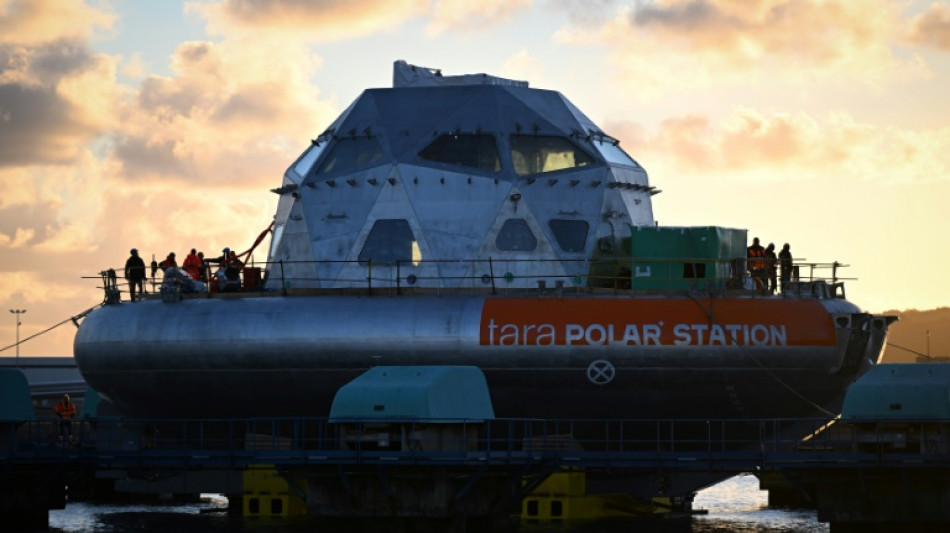
Floating igloo leaves France for polar exploration mission / Photo: LOU BENOIST - AFP/File

Floating igloo leaves France for polar exploration mission

A floating research station resembling a giant aluminium igloo on Sunday set out from France to begin a long-term mission in the Arctic that will see it drift with the polar ice in the most hostile of environments.

Text size:

The Tara Polar Station's specific shape enables it to withstand ice pressure and drift for months on end in a controlled fashion with the pack ice to explore biodiversity and the impact of climate change.

While the vessel was built in France, some 30 research centres from 12 countries -- including Germany, Canada, Spain, the US, Switzerland, and Japan -- are participating in the expedition.

"The Arctic is an ocean that has been little studied and is already changing significantly. It is undergoing a major transformation," said Romain Trouble, executive director of the Tara Ocean Foundation.

"You cannot understand the environment if you only spend two months a year there," he added.

The vessel sailed from France's western port of Lorient with French Minister for the Sea Catherine Chabaud in attendance and hundreds of people cheering on the quayside.

The floating laboratory -- shaped like an igloo perched on a large buoy -- is designed to withstand sea-ice pressure and endure temperatures as low as -52C.

Starting in mid-August, the station will travel eastward along the Russian coast, with an icebreaker clearing the way. Trapped in the pack ice by early September, the station is expected to drift at an average speed of 10 kilometres per day, eventually reaching the Fram Strait -- located between Greenland and Svalbard -- by the end of 2027.

Ten such expeditions are planned between 2026 and 2045, taking place every two years.

The vessel will carry 12 people during the winter, including six scientists, and 18 in the summer.

- 'Lose entire chapter of evolution' -

The international crew was carefully selected following medical and psychological aptitude tests and team-building.

"We weren't looking for adventurers who want to head to the North Pole alone. The idea is rather to have people who get along well to experience this confined human environment together," said Clementine Moulin, the expedition director.

Those staying through the winter will have to contend with five months of not just total darkness, claustrophobia and extreme cold, but also the presence of polar bears.

"Bears are a serious matter," said Eric Pelletier, a 58-year-old genomics researcher and crew member. "It's not a simple thing -- the bear is on its home turf and it's used to hunting and hides behind blocks of ice."

Every crew member has received firearms training to deal with potential attacks while a specially trained dog will accompany the crew to help spot approaching animals.

Using an opening in the hull and a wide array of onboard instruments, scientists will collect over 10,000 samples from the water, the atmosphere, and sea ice.

"There is biodiversity at the North Pole that is uniquely adapted to this environment. If the environment changes, that biodiversity might disappear," said Trouble.

"We could potentially lose an entire chapter of the evolution of life on this planet without even having had time to document it," he warned.

A.Krishnakumar--DT