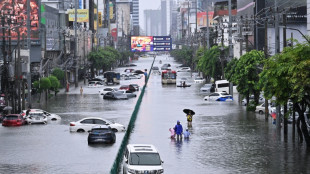
Scientists warn of record heat, threats to climate monitoring / Photo: Alberto PIZZOLI - AFP/File
Planetary heating is intensifying and key climate indicators are deteriorating, top scientists said Thursday, warning that funding decisions affecting Earth observation systems in the United States and other countries threaten efforts to track global warming.
More than 70 scientists -- including contributors to the UN's Intergovernmental Panel on Climate Change (IPCC) -- raised the alarm over record human-induced warming and surging marine heatwaves in an annual study published between major IPCC assessments.
"These indicators represent an essential monitoring of the vitals of a patient exhibiting ever increasingly troubling symptoms," said Peter Thorne, a co-author and physical geography professor at Ireland's Maynooth University.
"They all rest upon a suite of global observation capabilities which are, for the first time in my lifetime, systematically either actively degrading or at risk," said Thorne, who is also deputy chair of the Global Climate Observing System (GCOS), a UN-backed Earth monitoring program.
Global temperatures reached about 1.39C above preindustrial levels in 2025, with nearly all of that warming -- 1.37C -- driven by human activities, according to the study published in the journal Earth System Science Data.
Human-induced warming will reach 1.5C in around 2030, the scientists warned.
Nations agreed under the 2015 Paris climate accord to limit warming to well below 2C -- and preferably 1.5C -- to avoid the worst consequences of climate change.
But the report found the world is accumulating heat at a rapid pace, worsening "Earth's energy imbalance" — the rate at which energy enters and leaves the planet.
"Without human influence, it should be close to zero, but it has been growing since the 1970s and is now at a record high, doubling in recent decades," said the study's lead author, Piers Forster, a physical climate change professor at the University of Leeds in Britain.
The high rate of warming is due to a combination of greenhouse gas emissions reaching an all-time high and the reduction of aerosol pollution, which has weakened a cooling effect as these particles reflect sunlight.
CO2 emissions, however, remain the main driver of global warming and are at a record high.
While scientists said emissions are slowing, the "carbon budget" -- the amount of CO2 that can still be emitted to keep warming under 1.5C -- could be exhausted in around three years.
"Given that greenhouse gas emissions are still on the rise, keeping global warming below this (1.5C) threshold now seems unachievable," said Aurelien Ribes, climate scientist at the French meteorological service.
The sea rose by around 23 cm between 1901 and 2025 -- and it is rising at a faster pace at 3.84 mm per year, due to melting land-based ice and through thermal expansion as the ocean warms.
The number of marine heatwave days -- a new indicator added to this year's report -- has more than tripled since 1991, reaching 65 on average in 2025.
- Trump cuts -
Launched in 2023, the Indicators of Global Climate Change provides an annual update for policymakers on the state of the planet as climate change accelerates. The last IPCC assessment was finalised in 2023 and the next is due in 2028 or 2029.
The annual indicators report relies on around 40 global datasets which come from satellites and an array of land, sea and air instruments, including weather stations, ships, buoys and weather ballons.
But efforts to tackle climate change are increasingly overshadowed by wars in the Middle East and Ukraine, with governments facing a global energy crisis, budget constraints and a climate-sceptic President Donald Trump.
"Future monitoring of these indicators, such as ocean and satellite measurements of the Earth's energy imbalance, are threatened by geopolitical and public funding decisions," the report said.
It noted that funding for the UN's World Meteorological Organization has diminished while the GCOS "is also under threat".
Several satellite programs are at risk, including in the United States.
The authors pointed to the recent decision by the Trump administration to remove hundreds of deep-sea instruments.
Such instruments are "incredibly critical" to understand how oceans absorb heat and how that affects weather patterns and ocean circulation, said Samantha Burgess, strategic lead for climate at the European Centre for Medium–Range Weather Forecasts (ECMWF).
"We really need these in-situ observations to continue monitoring the climate," she said.
The scientists also cited a decrease in on-site measurements in Africa, the west Pacific and South America.
Burgess said the plane that carries the atmospheric observing system in the UK was recently defunded.
"So it's not just one nation, unfortunately," she said.
F.Saeed--DT