Dubai Telegraph - Half of mangrove ecosystems at risk: conservationists

EUR -
AED 4.318258
AFN 77.593968
ALL 97.486019
AMD 448.916829
ANG 2.104511
AOA 1078.088492
ARS 1688.840913
AUD 1.762318
AWG 2.119143
AZN 2.00125
BAM 1.962609
BBD 2.367393
BDT 143.637092
BGN 1.955442
BHD 0.443169
BIF 3487.033346
BMD 1.175669
BND 1.520362
BOB 8.122109
BRL 6.356607
BSD 1.175368
BTN 106.094165
BWP 16.591419
BYN 3.448635
BYR 23043.106402
BZD 2.363981
CAD 1.619083
CDF 2622.916619
CHF 0.932734
CLF 0.027444
CLP 1076.606917
CNY 8.305626
CNH 8.287729
COP 4489.878742
CRC 585.325665
CUC 1.175669
CUP 31.15522
CVE 111.337593
CZK 24.203482
DJF 208.940198
DKK 7.469435
DOP 75.356033
DZD 152.819298
EGP 55.847766
ERN 17.63503
ETB 182.523003
FJD 2.675234
FKP 0.881425
GBP 0.876008
GEL 3.162486
GGP 0.881425
GHS 13.531644
GIP 0.881425
GMD 85.823724
GNF 10217.736249
GTQ 9.002154
GYD 245.870897
HKD 9.149018
HNL 30.861043
HRK 7.535447
HTG 153.932722
HUF 382.546094
IDR 19579.997913
ILS 3.77392
IMP 0.881425
INR 105.986474
IQD 1540.125989
IRR 49525.043408
ISK 148.204953
JEP 0.881425
JMD 188.314914
JOD 0.833551
JPY 182.500812
KES 151.898082
KGS 102.812572
KHR 4714.431536
KMF 496.132055
KPW 1058.136113
KRW 1730.642829
KWD 0.360577
KYD 0.97949
KZT 612.028075
LAK 25488.497473
LBP 105339.915163
LKR 363.48794
LRD 208.122753
LSL 20.057327
LTL 3.471444
LVL 0.711151
LYD 6.389796
MAD 10.878441
MDL 20.017275
MGA 5284.631056
MKD 61.540744
MMK 2468.806923
MNT 4169.761073
MOP 9.420903
MRU 46.838187
MUR 54.209864
MVR 18.108568
MWK 2041.551435
MXN 21.216364
MYR 4.831706
MZN 75.137402
NAD 20.056804
NGN 1707.459503
NIO 43.217799
NOK 11.820414
NPR 169.750464
NZD 2.02034
OMR 0.452034
PAB 1.175368
PEN 3.953745
PGK 4.996004
PHP 69.249284
PKR 329.598889
PLN 4.224571
PYG 8032.799501
QAR 4.280723
RON 5.09123
RSD 117.403464
RUB 94.345003
RWF 1707.070944
SAR 4.411832
SBD 9.676449
SCR 17.703378
SDG 707.166687
SEK 10.857476
SGD 1.517841
SHP 0.882056
SLE 28.332542
SLL 24653.182491
SOS 671.893267
SRD 45.366114
STD 24333.9683
STN 25.100527
SVC 10.2849
SYP 12999.196213
SZL 20.057183
THB 37.186857
TJS 10.837104
TMT 4.126597
TND 3.449117
TOP 2.830728
TRY 50.086541
TTD 7.976605
TWD 36.67604
TZS 2884.782974
UAH 49.61457
UGX 4179.464075
USD 1.175669
UYU 46.281349
UZS 14119.781189
VES 302.859645
VND 30952.417541
VUV 144.011339
WST 3.268474
XAF 658.234986
XAG 0.018318
XAU 0.000274
XCD 3.177303
XCG 2.118331
XDR 0.819378
XOF 661.901517
XPF 119.331742
YER 280.426318
ZAR 19.823438
ZMK 10582.423162
ZMW 26.946254
ZWL 378.56484
  • RYCEF

    0.2300

    14.85

    +1.55%

  • CMSC

    0.1000

    23.4

    +0.43%

  • RBGPF

    3.1200

    81.17

    +3.84%

  • SCS

    0.0200

    16.14

    +0.12%

  • RIO

    0.6800

    76.92

    +0.88%

  • AZN

    -0.8300

    90.68

    -0.92%

  • GSK

    0.2600

    48.67

    +0.53%

  • BP

    -0.2800

    35.6

    -0.79%

  • BTI

    -0.3250

    58.435

    -0.56%

  • NGG

    0.2400

    74.88

    +0.32%

  • VOD

    0.0200

    12.58

    +0.16%

  • RELX

    0.1650

    40.245

    +0.41%

  • BCE

    0.2650

    23.455

    +1.13%

  • JRI

    0.0200

    13.74

    +0.15%

  • BCC

    -1.0900

    75.92

    -1.44%

  • CMSD

    -0.0310

    23.249

    -0.13%

Half of mangrove ecosystems at risk: conservationists
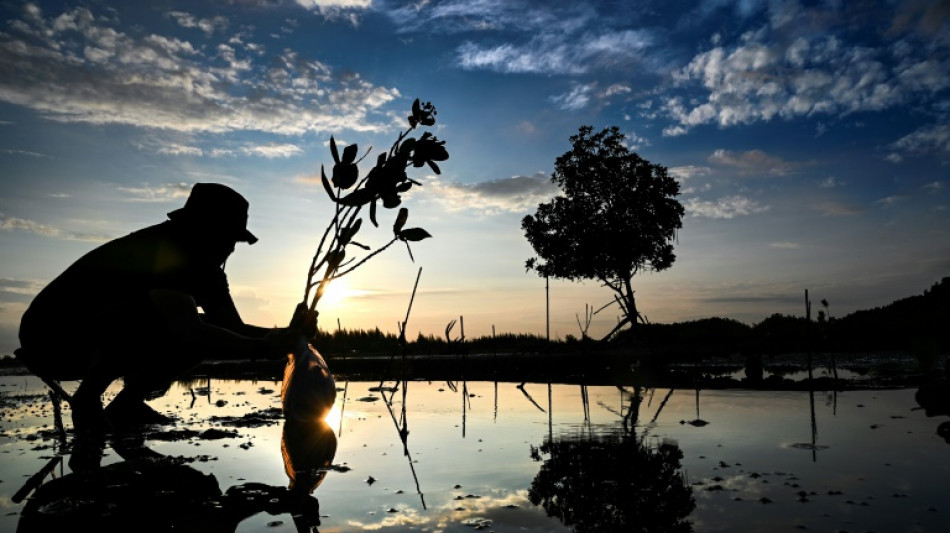
Half of mangrove ecosystems at risk: conservationists / Photo: CHAIDEER MAHYUDDIN - AFP/File

Half of mangrove ecosystems at risk: conservationists

Half of the world's mangrove ecosystems are at risk of collapse due to climate change, deforestation and pollution, according to a study published Wednesday.

Text size:

The International Union for Conservation of Nature (IUCN), known for its red list of threatened species, has for the first time taken stock of the world's mangroves, evaluating 36 different regions.

IUCN director general Grethel Aguilar said the assessment "highlights the urgent need for coordinated conservation of mangroves -- crucial habitats for millions in vulnerable communities worldwide".

Mangroves are trees or shrubs that grow mainly in seawater or brackish water along coastlines and tidal rivers, in equatorial climes.

Released on the International Day for Biodiversity, IUCN said its findings show that "50 percent of the mangrove ecosystems assessed are at risk of collapse" -- categorised as either vulnerable, endangered or critically endangered.

According to the assessment, 20 percent were at severe risk of collapse.

Mangroves are threatened by deforestation, development, pollution, and dam construction.

However, the risk is increasing due to sea-level rise and the greater frequency of severe storms associated with climate change.

Around 15 percent of the world's coasts are covered by mangroves, covering about 150,000 square kilometres.

- Disastrous disappearance -

Climate change threatens a third of mangrove ecosystems assessed, due to rising sea levels.

According to estimates, at the current rate, a quarter of the global area of mangroves is expected to be submerged in the next 50 years, IUCN said.

The northwest Atlantic Ocean, the northern Indian Ocean, the Red Sea, the South China Sea, and the Gulf of Aden coasts are expected to be particularly severely affected.

"Mangrove ecosystems are exceptional in their ability to provide essential services to people, including coastal disaster risk reduction, carbon storage and sequestration, and support for fisheries," said Angela Andrade, chair of the IUCN commission on ecosystem management.

"Their loss stands to be disastrous for nature and people across the globe."

The study said looking after mangroves was essential for mitigating the effects of climate change, with healthy ecosystems coping better with sea level rise and providing inland protection from the effects of severe storms.

Without significant improvement by 2050, climate change and rising sea levels will lead to the loss of 1.8 billion tonnes of carbon stored in mangroves.

Mangroves currently store nearly 11 billion tons of carbon -- almost three times the amount of carbon stored by tropical forests of the same size.

Maintaining good sediment circulation and allowing mangroves to expand inland will help them cope with sea level rise, IUCN said. It also called for the restoration of mangroves which have already disappeared.

"A very good study of mangrove change globally that was published in 2022 indicates about 5,000 square kilometres of mangrove were lost" between 1996 and 2020, IUCN's Marco Valderrabano told AFP.

D.Naveed--DT