Dubai Telegraph - Heatwave swells Asia's appetite for air-conditioning

EUR -
AED 4.181608
AFN 72.872269
ALL 93.945291
AMD 418.677729
ANG 2.038603
AOA 1044.691156
ARS 1686.593665
AUD 1.657548
AWG 2.04953
AZN 1.93526
BAM 1.95058
BBD 2.290809
BDT 140.184848
BGN 1.925284
BHD 0.428841
BIF 3383.755506
BMD 1.138628
BND 1.471224
BOB 7.87692
BRL 5.890078
BSD 1.137426
BTN 107.475909
BWP 15.457092
BYN 3.298615
BYR 22317.106713
BZD 2.287518
CAD 1.621241
CDF 2590.378831
CHF 0.922254
CLF 0.026681
CLP 1050.088484
CNY 7.735781
CNH 7.735855
COP 3922.288436
CRC 515.905781
CUC 1.138628
CUP 30.173639
CVE 109.970705
CZK 24.250949
DJF 202.542635
DKK 7.474488
DOP 67.637213
DZD 151.829381
EGP 56.100085
ERN 17.079418
ETB 183.370946
FJD 2.561628
FKP 0.859254
GBP 0.860786
GEL 3.005775
GGP 0.859254
GHS 12.864573
GIP 0.859254
GMD 83.690192
GNF 9971.402889
GTQ 8.677739
GYD 237.923288
HKD 8.92998
HNL 30.439807
HRK 7.532367
HTG 148.659558
HUF 354.826085
IDR 20382.577922
ILS 3.397216
IMP 0.859254
INR 107.728716
IQD 1490.00602
IRR 1566751.981124
ISK 144.002299
JEP 0.859254
JMD 179.09443
JOD 0.807288
JPY 184.844282
KES 147.395654
KGS 99.573103
KHR 4573.67994
KMF 491.887108
KPW 1024.765503
KRW 1762.6758
KWD 0.35269
KYD 0.947855
KZT 552.257242
LAK 25510.059856
LBP 101853.145041
LKR 382.44645
LRD 207.00512
LSL 18.687897
LTL 3.362072
LVL 0.688745
LYD 7.307252
MAD 10.658776
MDL 20.10367
MGA 4840.08984
MKD 61.633248
MMK 2390.534982
MNT 4078.632506
MOP 9.18837
MRU 45.393326
MUR 53.731804
MVR 17.602817
MWK 1972.339103
MXN 19.919141
MYR 4.636268
MZN 72.701031
NAD 18.687897
NGN 1571.68275
NIO 41.85835
NOK 11.337034
NPR 171.957291
NZD 2.01639
OMR 0.437804
PAB 1.137456
PEN 3.884205
PGK 4.993702
PHP 69.765434
PKR 316.276595
PLN 4.289484
PYG 6926.281938
QAR 4.146086
RON 5.243723
RSD 117.375482
RUB 87.682843
RWF 1669.673096
SAR 4.272653
SBD 9.18308
SCR 15.280534
SDG 683.749132
SEK 11.087696
SGD 1.474324
SHP 0.850101
SLE 28.255883
SLL 23876.461785
SOS 650.037585
SRD 42.692284
STD 23567.298515
STN 24.434931
SVC 9.952279
SYP 125.85493
SZL 18.683345
THB 37.900938
TJS 10.543837
TMT 3.996584
TND 3.369069
TOP 2.741543
TRY 53.127672
TTD 7.732104
TWD 36.273377
TZS 2992.88111
UAH 51.048038
UGX 4168.843668
USD 1.138628
UYU 45.767721
UZS 13708.254849
VES 708.503828
VND 29957.299878
VUV 136.581889
WST 3.166456
XAF 654.211995
XAG 0.019843
XAU 0.000286
XCD 3.077198
XCG 2.049896
XDR 0.81363
XOF 654.189074
XPF 119.331742
YER 271.673482
ZAR 18.74466
ZMK 10249.016856
ZMW 20.59235
ZWL 366.637717
  • RBGPF

    0.6100

    65.61

    +0.93%

  • CMSC

    0.1300

    22.06

    +0.59%

  • BCC

    -1.7600

    79.26

    -2.22%

  • NGG

    0.7500

    83.76

    +0.9%

  • BCE

    -0.6600

    22.26

    -2.96%

  • RYCEF

    0.2900

    18.68

    +1.55%

  • RELX

    -0.0500

    31.29

    -0.16%

  • RIO

    0.5500

    94.29

    +0.58%

  • CMSD

    0.1300

    21.9

    +0.59%

  • VOD

    -0.2000

    13.69

    -1.46%

  • JRI

    0.0700

    12.86

    +0.54%

  • AZN

    2.5400

    190.95

    +1.33%

  • BP

    0.2200

    37.35

    +0.59%

  • BTI

    -0.0200

    62.74

    -0.03%

  • GSK

    0.3100

    52.81

    +0.59%

Heatwave swells Asia's appetite for air-conditioning
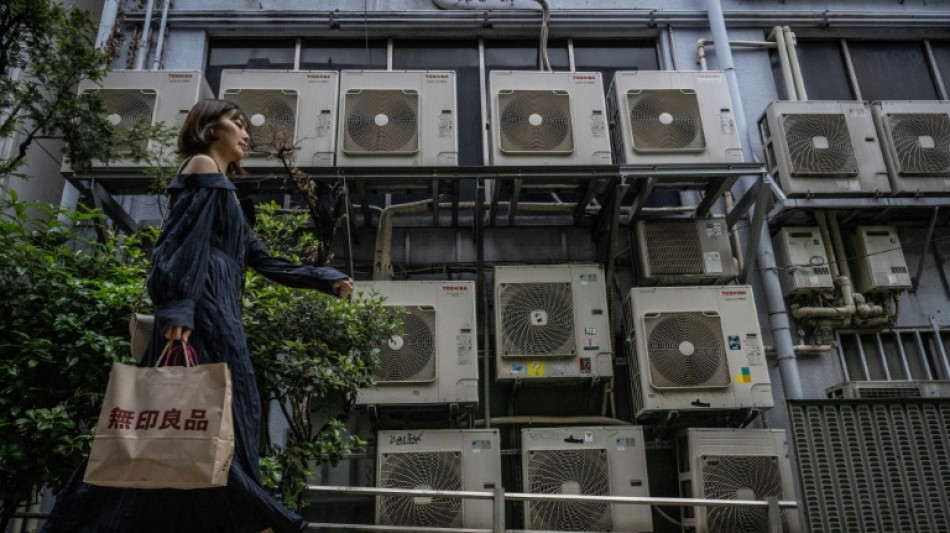
Heatwave swells Asia's appetite for air-conditioning / Photo: Yuichi YAMAZAKI - AFP

Heatwave swells Asia's appetite for air-conditioning

A record-breaking heatwave is broiling parts of Asia, helping drive surging demand for cooling options, including air-conditioning.

Text size:

AC exhaust units are a common feature of urban landscapes in many parts of Asia, clinging like limpets to towering apartment blocks in Hong Kong or tucked in a cross formation between the windows of a building in Cambodia.

They offer relief from temperatures that have toppled records in recent weeks, with many countries in the region hitting 40 degrees Celsius (104 Fahrenheit) or higher.

Scientists have long warned that human-induced climate change will produce more frequent, longer and more intense heatwaves.

Only 15 percent of homes in Southeast Asia have air-conditioning, according to a 2019 report by the International Energy Agency (IEA).

But that figure obscures vast variations: ranging from around 80 percent installation in Singapore and Malaysia, to less than 10 percent in Indonesia and Vietnam, the IEA said.

Forecasts suggest that higher temperatures and better wages could see the number of air-conditioning units in Southeast Asia jump from 40 million in 2017 to 300 million by 2040.

That would stretch local electricity capacity, which is already struggling under current conditions.

Myanmar is producing only about half the electricity it needs each day, with the junta blaming weak hydropower because of scant rains, low natural gas yields and attacks by its opponents on infrastructure.

Thailand has seen record power demand in recent weeks, as people retreat indoors to cooled homes or businesses.

Air-conditioning is already responsible for the emission of approximately one billion metric tons of carbon dioxide per year, according to the IEA, out of a total of 37 billion emitted worldwide.

Still, cooling options like air-conditioning are a key way to protect human health, especially for those who are most vulnerable to the effects of extreme heat: children, the elderly and those with certain disabilities.

With demand surging, dozens of countries last year signed up to the United Nations' Global Cooling Pledge, a commitment to improve the efficiency of air conditioners and reduce emissions from all forms of cooling.

Some countries have been trying to reduce the impact of cooling for years.

Since 2005, Japan has encouraged office workers to ditch ties and jackets so air conditioners can be kept at 28 degrees Celsius.

The annual "Cool Biz" programme took on new significance during power shortages in 2011 following the shutdown of nuclear plants after the Fukushima disaster.

X.Wong--DT