Dubai Telegraph - Japan to sell eels bred in captivity in 'world first'

EUR -
AED 4.202411
AFN 73.235002
ALL 93.9451
AMD 420.678057
ANG 2.048741
AOA 1049.890918
ARS 1708.312595
AUD 1.651213
AWG 2.062583
AZN 1.949836
BAM 1.955698
BBD 2.30538
BDT 141.132639
BGN 1.934858
BHD 0.431577
BIF 3404.622415
BMD 1.14429
BND 1.477123
BOB 7.926587
BRL 5.916437
BSD 1.14464
BTN 109.047312
BWP 15.438195
BYN 3.321027
BYR 22428.090154
BZD 2.30208
CAD 1.624836
CDF 2570.076459
CHF 0.916594
CLF 0.026912
CLP 1059.174754
CNY 7.768706
CNH 7.764588
COP 3848.999237
CRC 521.4728
CUC 1.14429
CUP 30.323693
CVE 110.259249
CZK 24.19568
DJF 203.829368
DKK 7.478628
DOP 67.806463
DZD 152.60404
EGP 56.395058
ERN 17.164355
ETB 183.546226
FJD 2.586612
FKP 0.856953
GBP 0.854554
GEL 3.015251
GGP 0.856953
GHS 13.003322
GIP 0.856953
GMD 82.965454
GNF 10038.476394
GTQ 8.735544
GYD 239.427511
HKD 8.976557
HNL 30.636402
HRK 7.538017
HTG 149.712191
HUF 353.483164
IDR 20590.817625
ILS 3.431327
IMP 0.856953
INR 108.954179
IQD 1499.42179
IRR 1574486.25789
ISK 144.089478
JEP 0.856953
JMD 181.200549
JOD 0.811347
JPY 184.648452
KES 148.00228
KGS 100.065561
KHR 4583.760912
KMF 493.189526
KPW 1029.861683
KRW 1749.36247
KWD 0.355062
KYD 0.95395
KZT 541.301766
LAK 25845.651894
LBP 102500.253599
LKR 383.390002
LRD 207.749164
LSL 18.566032
LTL 3.378792
LVL 0.69217
LYD 7.336617
MAD 10.704142
MDL 20.13395
MGA 4852.746881
MKD 61.631785
MMK 2402.876165
MNT 4099.016956
MOP 9.246518
MRU 45.681617
MUR 53.839292
MVR 17.691161
MWK 1984.896468
MXN 19.989726
MYR 4.65845
MZN 73.132026
NAD 18.566032
NGN 1567.769704
NIO 42.117803
NOK 11.261005
NPR 174.475899
NZD 2.003836
OMR 0.441357
PAB 1.14464
PEN 3.894897
PGK 5.028738
PHP 70.375043
PKR 318.231701
PLN 4.293435
PYG 6959.636986
QAR 4.184282
RON 5.227162
RSD 117.370878
RUB 88.095405
RWF 1675.712595
SAR 4.297696
SBD 9.22131
SCR 15.409196
SDG 687.15054
SEK 11.051625
SGD 1.477741
SHP 0.854328
SLE 27.863894
SLL 23995.199932
SOS 654.165879
SRD 42.986453
STD 23684.499186
STN 24.498722
SVC 10.015478
SYP 126.480809
SZL 18.563032
THB 38.133518
TJS 10.610547
TMT 4.016459
TND 3.378224
TOP 2.755177
TRY 53.515602
TTD 7.757595
TWD 36.546387
TZS 3005.843216
UAH 50.978341
UGX 4177.782087
USD 1.14429
UYU 46.037599
UZS 13712.284769
VES 731.090824
VND 30090.258096
VUV 136.092267
WST 3.173323
XAF 655.922787
XAG 0.018332
XAU 0.000274
XCD 3.092502
XCG 2.062892
XDR 0.815757
XOF 655.922787
XPF 119.331742
YER 271.254434
ZAR 18.573553
ZMK 10299.990075
ZMW 21.031903
ZWL 368.461014
  • CMSC

    0.0400

    21.99

    +0.18%

  • NGG

    2.6700

    82.85

    +3.22%

  • RIO

    1.0700

    94.42

    +1.13%

  • RBGPF

    2.5400

    68.15

    +3.73%

  • BTI

    1.2100

    61.77

    +1.96%

  • AZN

    11.2900

    195.15

    +5.79%

  • GSK

    2.3600

    53.66

    +4.4%

  • RYCEF

    0.5400

    19.68

    +2.74%

  • RELX

    0.5500

    31.93

    +1.72%

  • VOD

    0.1400

    13.15

    +1.06%

  • CMSD

    -0.0300

    22.15

    -0.14%

  • BCC

    0.4500

    75.93

    +0.59%

  • JRI

    0.0600

    13

    +0.46%

  • BP

    1.2500

    37.4

    +3.34%

  • BCE

    0.4000

    21.42

    +1.87%

Japan to sell eels bred in captivity in 'world first'
Japan to sell eels bred in captivity in 'world first' / Photo: Philip FONG - AFP/File

Japan to sell eels bred in captivity in 'world first'

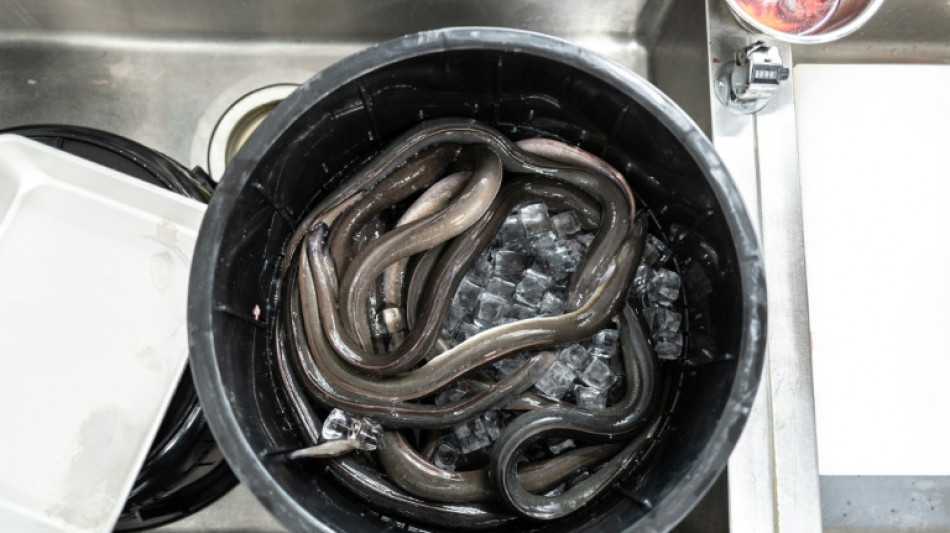
Eels bred in captivity will be sold in Japanese shops for the first time, in a move that could ease eventually pressure on the endangered fish, officials said Wednesday.

Text size:

Eel populations are falling worldwide, scientists say, largely due to factors linked to human activity such as the pollution of waterways, destruction of wetlands, hydroelectric dams, and fishing.

Eel is an enormously popular food in Japan and other parts of Asia.

The fish has proved stubbornly unwilling to reproduce in captivity without intervention, but Japanese researchers succeeded in breeding Japanese eels from eggs in a laboratory setting in 2010 at great expense.

Since then, they have been trying to reduce the "huge cost... so that the price could be accepted in the market," Yasutaka Okamoto, a fisheries agency official in charge of aquaculture promotion, told AFP.

"With countless small technological breakthroughs, the cost is now some 1,800 yen ($11) per one baby eel, down from more than a million yen at the initial stages, and down from some 40,000 yen in 2016," he said.

The price is still three to four times higher than a wild baby eel, "but we think it's time to test market reactions," he explained.

The project brought together government researchers, universities and the private sector.

Eel is eaten worldwide but is particularly popular in Japan, where it is called "unagi" and traditionally served grilled and covered in a sticky-sweet sauce.

"If the (Japanese) people didn't love eels so much, we wouldn't go to such lengths to research how to farm them," Okamoto said.

Grilled "kabayaki" using fully farmed eel will be sold from May 29 at a department store in Tokyo and several other outlets including online shops in Japan.

Yamada Suisan, the eel farming company selling the fish, said it was a world-first, and a "very significant step toward the future commercialisation of fully farmed eel."

Two kabayaki eels will be sold at around 9,000 yen ($57), a price that is broadly comparable to high-end produce.

Last year, a key global forum that regulates trade in threatened wildlife rejected an EU-led proposal to protect more species of eel.

The protections were fiercely opposed by top consumers of the fish, led by Japan.

The Japanese eel, along with the American variety, is listed as endangered by the International Union for Conservation of Nature.

The European eel is considered critically endangered.

W.Darwish--DT