'One Battle After Another' location manager explains THAT car chase / Photo: SANDY HUFFAKER - AFP
Most movie car chases involve screeching around city corners, weaving in and out of traffic and almost always smashing into a few police cars.
But for the dramatic pursuit that brings the Oscar-nominated "One Battle After Another" to its conclusion, director Paul Thomas Anderson wanted something a little bit different, his location manager Michael Glaser told AFP.
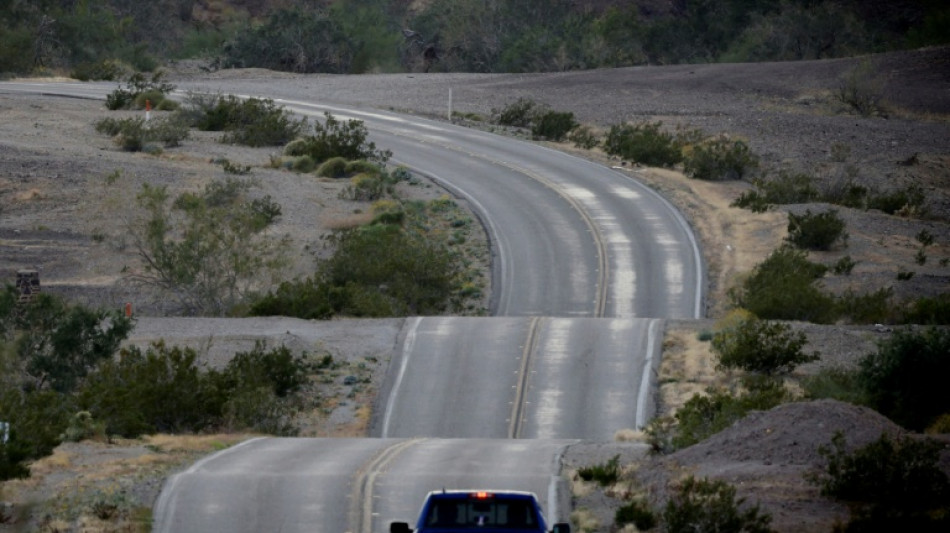
What the pair found was a desert highway that rolls up and down, like an asphalt serpent, with deadly blind peaks and treacherous hidden troughs.
The result is a high-octane cat and mouse hunt like no other in modern movie history.
"Things appear and then disappear and then appear again," Glaser said.
"It's the ebbs and flows of the road. You can't really see what's on the other side."
The so-called "River of Hills," in southern California captivated Anderson, whose low-to-the-ground camera angles give the audience the sweaty-palm feel of actually being aboard the roaring Ford Mustang, Dodge Charger, or modified purple Nissan Sentra in the scene.
- Pulling and pushing -
"One Battle After Another," which has been nominated for 13 Academy Awards, follows washed-up leftist revolutionary Bob Ferguson (Leonardo DiCaprio) as he is forced back into the game when his daughter (Chase Infiniti) goes missing.
Ferguson must battle through the mental fug of decades of pot-smoking to try to remember passwords and safe houses in his bid to best the deranged Colonel Lockjaw (Sean Penn), who has been hired by wealthy right-wing racists to hunt him down.
The film's final sequence sees Bob desperately searching for his daughter as she tries to outrun Lockjaw in the desert.
Glaser, who took AFP to the stretch of Highway 78 in Imperial County where part of the chase was filmed, said the road stands as a metaphor.
"It's the characters pulling and pushing each other through something," he said.
The crew also filmed on another stretch of road in Borrego Springs called "The Texas Dip," one of the around 200 locations Glaser offered for the movie.
"It was the kind of thing where we shot over multiple days," Andy Jurgensen, the Oscar-nominated editor of "One Battle After Another," told AFP.
"You just start shooting and just make sure you get all the shots from in front and behind of all the cars, and make sure that the distance kind of makes sense.
"And then it was just like: 'Okay, let's put it together'."
- 'Subconscious character' -
Location managers are among the first to join a project and among the last to leave, says Glaser.
The places they find are crucial to the look and feel of a movie.
In some cases, they take on a life of their own off-screen, like the steps of the Philadelphia Museum of Art from "Rocky," which have become a place of pilgrimage for generations of fans.
"I often think of locations as a subconscious character in the movie," said the 44-year-old Glaser.
They "create a mood, create a palette, create a feeling for characters, the places they inhabit."
"One Battle After Another" ran the gamut of California locations, from north to south.
"Starting in Eureka, where everything's green and lush, we step down to central California, where it's a little bit more like wineries, oak trees, not quite as green, not quite as lush.
"And then you're in the bleak starkness of desert as the characters wrap up their story."
Before he received the script, Glaser had already begun his search, based just on the bullet point notes that the movie's production designer gave him.
He describes the process of scouting for this movie as similar to the way a tree grows.
"Some branches would die off, and others would sprout up," he said.
This was particularly the case with the desert, whose desolation and desperation gave shape to the film's third act and the journey its characters were on.
"There's nobody out here to watch over you or help you or confine you. You're kind of on your own," Glaser said.
"One Battle After Another" arrives at the Academy Awards on March 15 as the favorite to win best picture, offering Anderson his best chance at Oscars glory for the first time in a career that has seen him garner 14 nominations spanning writing, directing and producing.
For Glaser, whose work doesn't fit neatly into any of the categories at Hollywood's biggest night, any recognition the film receives is shared.
"Everyone's DNA is in the film," he said. "We're not directing it. We're not in front of the camera. But, you know, there's a little piece of us."
A.El-Nayady--DT