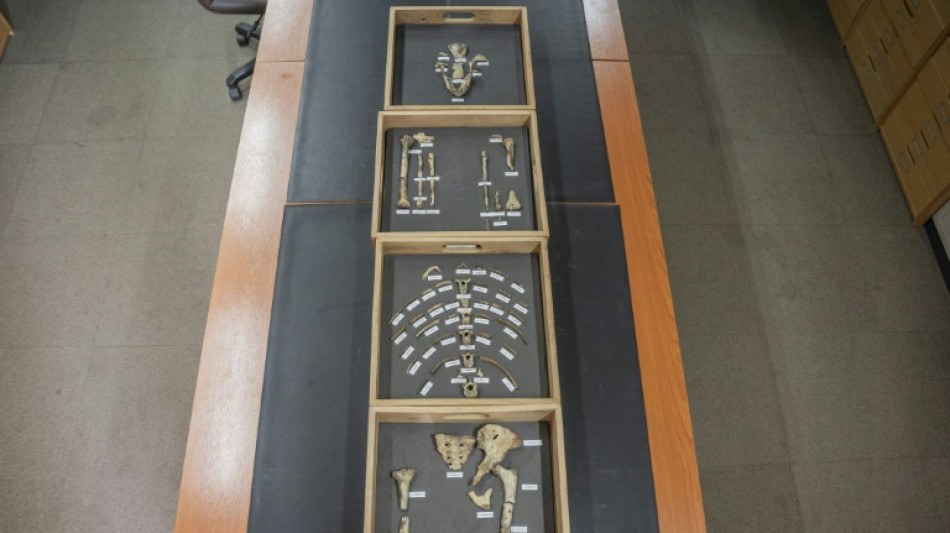
Human ancestor Lucy still has secrets 50 years after discovery / Photo: Amanuel Sileshi - AFP
She was, for a while, the oldest known member of the human family. Fifty years after the discovery of Lucy in Ethiopia, the remarkable remains continue to yield theories and questions.
In a non-descript room in the National Museum of Ethiopia, the 3.18-million-year-old bones are delicately removed from a safe and placed on a long table.
They consist of fossilised dental remains, skull fragments, parts of the pelvis and femur that make up the world's most famous Australopithecus afarensis, Lucy.
The hominid was discovered on November 24, 1974, in the Afar region of northeast Ethiopia by a team of scientists led by Maurice Taieb, Yves Coppens, Donald Johanson, Jon Kalb, and Raymonde Bonnefille.
The 52 bone fragments, amounting to some 40 percent of Lucy's skeleton, was, at the time, the most complete ever found, and revolutionised the understanding of our ancestors.
The skeleton was initially called A.L-288-1, in reference to Afar and its geolocation.
But the researchers nicknamed it Lucy after The Beatles' song "Lucy in the Sky with Diamonds", which they listened to after celebrating their discovery.
Lucy walked on two legs and is thought to have died aged between 11 and 13 -- considered an adult for this species. She was 1.10 metres tall (3.6 feet) and weighed 29 kg (64 pounds).
For Sahleselasie Melaku, the 31-year-old head of the palaeontology department, Lucy's discovery represented an emergence from a "dark age" in our understanding of human ancestors.
"The impact of the discovery was very big in the discipline and even the whole world," he told AFP.
Lucy showed that members of the human family existed beyond three million years ago, and she also provided a template for fitting together later bone discoveries.
The amount of information that can be gleaned from the bones has allowed some highly detailed theories about Lucy's life.
A slightly deformed vertebra, for instance, "means she probably had back problems", said Melaku.
- 'Exceptional' -
Jean-Renaud Boisserie, a paleonthologist specialised in Ethiopia and the research director at the French National Centre for Scientific Research said it was an "exceptional" breakthrough for the discipline.
"We basically knew very little about the period of three million years ago, and we had nothing as complete," he said.
Lucy was often described as "the grandmother of humanity", but more recent discoveries suggest she may have been more like an aunt or a cousin, experts say.
Skeletal finds in places like Ethiopia, South Africa and Kenya have complicated the picture and led to much debate about when different species of hominid emerged and which should be classified as part of the human or chimpanzee families.
The discovery of "Toumai" in Chad in 2001 -- a skull dated to six or seven million years old -- suggested the human family may go much further back than previously thought.
Meanwhile, Lucy has yet to reveal all her secrets.
A study published in 2016 argued she spent a third of her time in trees, where she nested, and had highly developed upper limbs.
Another study that year in the American journal Plos One theorised that she died after falling from a tree.
A 2022 study in Nature, focused on Lucy's pelvis, concluded that newborn members of Australopithecus had a very immature brain, like human newborns today, and required parental support to survive.
"There are a lot of unanswered questions," said Melaku with a smile. "Especially, we don't know much more about the early livelihoods of these early human ancestors."
The museum receives frequent requests to study it, but the iconic skeleton no longer leaves Ethiopia.
Wider scientific progress and advanced equipment are opening up new avenues for research.
"The studies that can be carried out on her, on her peers, pose the scientific questions of tomorrow," said Boisserie.
"Material as exceptional as this plays a driving role in the evolution of research."
F.Chaudhary--DT