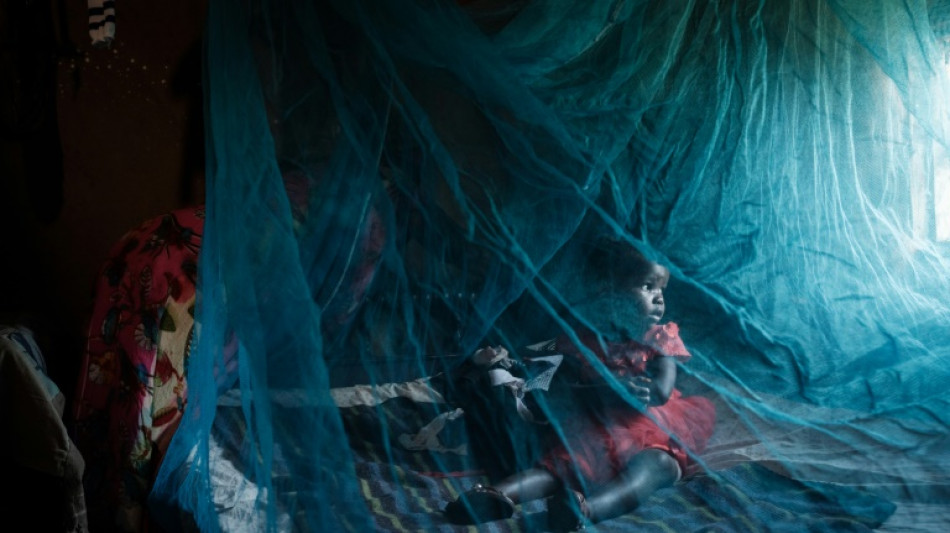
Urban mosquito sparks malaria surge in East Africa / Photo: YASUYOSHI CHIBA - AFP/File
The spread of a mosquito in East Africa that thrives in urban areas and is immune to insecticide is fuelling a surge in malaria that could reverse decades of progress against the disease, experts say.
Africa accounted for about 95 percent of the 249 million malaria cases and 608,000 deaths worldwide in 2022, according to the most recent data from the World Health Organization (WHO), which said children under five accounted for 80 percent of deaths in the region.
But the emergence of an invasive species of mosquito on the continent could massively increase those numbers.
Anopheles stephensi is native to parts of South Asia and the Middle East but was spotted for the first time in the tiny Horn of Africa state of Djibouti in 2012.
Djibouti had all but eradicated malaria only to see it make a slow but steady return over the following years, hitting more than 70,000 cases in 2020.
Then stephensi arrived in neighbouring Ethiopia and WHO says it is key to an "unprecedented surge", from 4.1 million malaria cases and 527 deaths last year to 7.3 million cases and 1,157 deaths between January 1 and October 20, 2024.
Unlike other species which are seasonal and prefer rural areas, stephensi thrives year-round in urban settings, breeding in man-made water storage tanks, roof gutters or even air conditioning units.
It appears to be highly resistant to insecticides, and bites earlier in the evening than other carriers. That means bed nets -- up to now the prime weapon against malaria -- may be much less effective.
"The invasion and spread of Anopheles stephensi has the potential to change the malaria landscape in Africa and reverse decades of progress we've made towards malaria control," Meera Venkatesan, malaria division chief for USAID, told AFP.
- 'More research is needed' -
The fear is that stephensi will infest dense cities like Mombasa on Kenya's Indian Ocean coast and Sudan's capital Khartoum, with one 2020 study warning it could eventually reach 126 million city-dwellers across Africa.
Only last month, Egypt was declared malaria-free by WHO after a century-long battle against the disease -- a status that could be threatened by stephensi's arrival.
Much remains unknown, however.
Stephensi was confirmed as present in Kenya in late 2022, but has so far stayed in hotter, dryer areas without reaching the high-altitude capital, Nairobi.
"We don't yet fully understand the biology and behaviour of this mosquito," Charles Mbogo, president of the Pan-African Mosquito Control Association, told AFP.
"Possibly it is climate-driven and requires high temperatures, but much more research is needed."
He called for increased funding for capturing and testing mosquitos, and for educating the public on prevention measures such as covering water receptacles.
- Multiplying threats -
The spread of stephensi could dovetail with other worrying trends, including increased evidence of drug resistant malaria recorded in Uganda, Rwanda, Tanzania and Eritrea.
"The arrival of resistance is imminent," said Dorothy Achu, WHO's head of tropical and vector-borne diseases in Africa.
WHO is working with countries to diversify treatment programmes to delay resistance, she said.
A new malaria variant is also evading tests used to diagnose the disease.
"The increased transmission that stephensi is driving could potentially help accelerate the spread of other threats, such as drug resistance or another mutation in the parasite that leads it to be less detectable by our most widely-used diagnostics," said Venkatesan at USAID.
Another added challenge is the lack of coordination between African governments.
Achu said WHO is working on "a more continental approach".
But Mbogo in Kenya said "more political will" was needed.
"We share information as scientists with colleagues in neighbouring countries," he said"But we need to reach the higher level. We need cross-border collaborations, data-sharing."
H.Yousef--DT