Dubai Telegraph - Thirsty birds struggle to survive in scorching Indian heat

EUR -
AED 4.26534
AFN 76.075909
ALL 92.132815
AMD 421.558637
ANG 2.078702
AOA 1066.189644
ARS 1755.810511
AUD 1.610107
AWG 2.090568
AZN 1.973246
BAM 1.956064
BBD 2.339225
BDT 142.741084
BGN 1.970205
BHD 0.438165
BIF 3476.383546
BMD 1.161427
BND 1.470605
BOB 14.48914
BRL 5.937445
BSD 1.161472
BTN 109.790217
BWP 15.592169
BYN 3.576197
BYR 22763.960344
BZD 2.335845
CAD 1.603407
CDF 2648.052457
CHF 0.942496
CLF 0.02739
CLP 1081.10223
CNY 7.794687
CNH 7.791819
COP 3639.097803
CRC 527.077852
CUC 1.161427
CUP 30.777804
CVE 110.281289
CZK 24.186012
DJF 206.819658
DKK 7.474616
DOP 68.739561
DZD 154.727591
EGP 59.171898
ERN 17.421398
ETB 188.341119
FJD 2.550435
FKP 0.85777
GBP 0.857372
GEL 3.025518
GGP 0.85777
GHS 13.245956
GIP 0.85777
GMD 85.945507
GNF 10208.507844
GTQ 8.866233
GYD 242.984844
HKD 9.107042
HNL 31.166335
HRK 7.534991
HTG 151.851122
HUF 363.966112
IDR 20441.107247
ILS 3.499053
IMP 0.85777
INR 110.090055
IQD 1521.511634
IRR 1596496.933194
ISK 140.393377
JEP 0.85777
JMD 184.444861
JOD 0.823424
JPY 179.16921
KES 150.311904
KGS 101.566672
KHR 4703.654253
KMF 492.444835
KPW 1045.284234
KRW 1558.280208
KWD 0.358962
KYD 0.967835
KZT 527.307886
LAK 26026.844287
LBP 104005.262064
LKR 381.873116
LRD 203.248271
LSL 18.643993
LTL 3.42939
LVL 0.702535
LYD 7.352991
MAD 10.943575
MDL 20.063791
MGA 4985.736417
MKD 61.53909
MMK 2438.405594
MNT 4178.306917
MOP 9.380405
MRU 46.783507
MUR 54.424014
MVR 17.955977
MWK 2013.897462
MXN 19.695589
MYR 4.717246
MZN 74.20988
NAD 18.643993
NGN 1534.882623
NIO 42.735944
NOK 10.746552
NPR 175.662434
NZD 1.988012
OMR 0.446571
PAB 1.161372
PEN 3.895942
PGK 5.16074
PHP 72.603072
PKR 322.030393
PLN 4.317197
PYG 6873.95613
QAR 4.233425
RON 5.249413
RSD 117.365657
RUB 100.316015
RWF 1708.737676
SAR 4.361793
SBD 9.292007
SCR 16.038126
SDG 698.590446
SEK 11.151338
SGD 1.470093
SHP 0.860461
SLE 28.628959
SLL 24354.533103
SOS 663.79233
SRD 43.837466
STD 24039.184636
STN 24.503619
SVC 10.162457
SYP 15100.86787
SZL 18.626591
THB 38.221969
TJS 10.743187
TMT 4.064993
TND 3.387557
TOP 2.796436
TRY 56.282583
TTD 7.868162
TWD 36.588403
TZS 3073.750044
UAH 51.690335
UGX 4395.611406
USD 1.161427
UYU 46.756504
UZS 13727.909478
VES 936.547772
VND 30170.377441
VUV 137.066096
WST 3.156858
XAF 656.048253
XAG 0.017548
XAU 0.000264
XCD 3.138814
XCG 2.093209
XDR 0.821189
XOF 656.053902
XPF 119.331742
YER 275.258201
ZAR 18.615694
ZMK 10454.238146
ZMW 22.386307
ZWL 373.978875
  • RBGPF

    0.0000

    70

    0%

  • GSK

    -1.3000

    48.59

    -2.68%

  • NGG

    -0.1400

    77.98

    -0.18%

  • BCC

    -1.7500

    77.46

    -2.26%

  • CMSC

    0.0350

    20.845

    +0.17%

  • RIO

    2.0200

    105.29

    +1.92%

  • BCE

    -0.1350

    23.535

    -0.57%

  • RELX

    -0.8200

    34.69

    -2.36%

  • BTI

    -0.1550

    55.195

    -0.28%

  • CMSD

    -0.0260

    20.664

    -0.13%

  • JRI

    0.0600

    12.2

    +0.49%

  • AZN

    -1.6500

    161.05

    -1.02%

  • VOD

    0.3750

    17.275

    +2.17%

  • BP

    1.0700

    44.88

    +2.38%

  • RYCEF

    0.0000

    20.12

    0%

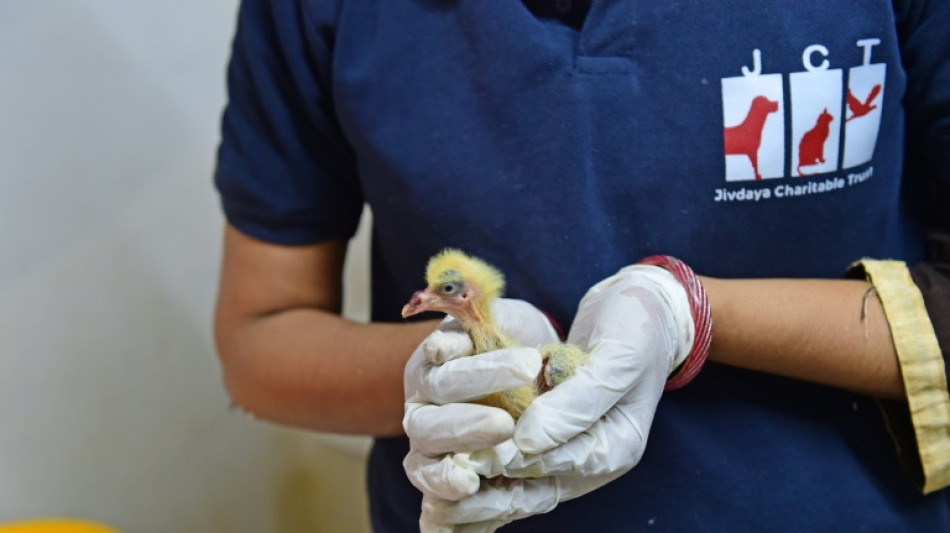
Thirsty birds struggle to survive in scorching Indian heat
Thirsty birds struggle to survive in scorching Indian heat / Photo: SAM PANTHAKY - AFP

Thirsty birds struggle to survive in scorching Indian heat

A volunteer scoops up a fledgling kite lying nearly immobile on a scorching Indian sidewalk as the relentless sun beats down on its feathers -- one of countless birds struggling to endure an unbearable heatwave.

Text size:

An early start to summer has brought record temperatures and made life a misery for human and animal alike, with experts warning that climate change is making such conditions more intense and more frequent.

One animal hospital in the western city of Ahmedabad has treated around 2,000 birds over the past month, many weak and severely dehydrated, with some suffering from broken wings after falling from trees.

"We receive daily at least 50 to 60 dehydrated birds," Gira Shah, co-founder of the Jivdaya Charitable Trust that manages the hospital, told AFP, adding that temperatures have soared up to 46 degrees Celsius (115 degrees Fahrenheit).

The bird hospital is one of the biggest of its kind in India and was established by members of the Jain faith -- an ancient Indian religion that preaches non-violence and love for all creatures, great and small.

The hellish heat has coincided with the end of the breeding season for some bird species, resulting in large numbers of chicks and fledglings being treated in the facility.

A regular stream of volunteer rescuers and members of the public bring the birds in cardboard boxes or baskets every day, where they are logged, weighed, tagged and examined by a veterinarian.

The birds are treated, but around one in four do not survive due to the severity of their dehydration or from the resulting complications.

Those that recover are kept in an aviary until they are ready to be released back into the wild.

Others that have been too severely disabled by their injuries are sent to zoos or educational institutions.

- 'Pretty dire' -

Veterinarian Nidhi Sharma had already treated a parakeet and a babbler chick before the fledgling kite rescued from the road was brought to her for examination.

"It's severely dehydrated," the 29-year-old said as she injected it with replenishing fluids.

The rescuers believe the kite, weakened by the heat, fell to the ground from its nest in a tree nearly 15 metres (50 feet) above.

Hospital curator Sherwin Everett has worked at Jivdaya -- "compassionate life" in the local Gujarati language -- since 2010.

He says this year's heatwave has been among the worst for local birds he has ever seen.

Heatwaves have killed more than 6,500 people in India since 2010, but Shah and Everett are also calling on the public to also be considerate of the welfare of any wildlife they come across.

"We are expecting until July to have multiple heatwaves and the temperature will get worse," Everett said.

"Right now we have received quite a lot of birds that have been dehydrated," he added. "But the upcoming months seem to be pretty dire for us as well."

C.Akbar--DT