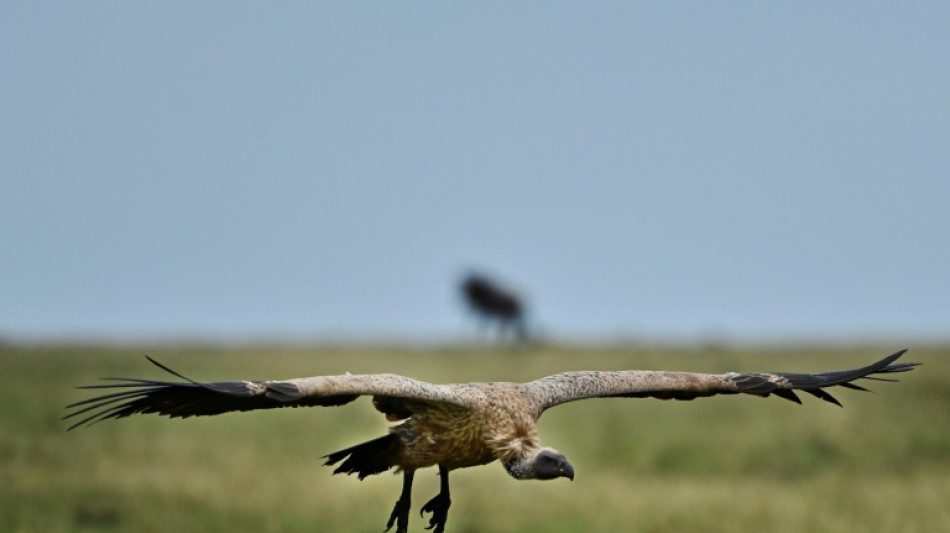
Africa's large birds of prey facing 'extinction crisis': study / Photo: Tony Karumba - AFP/File
The flamboyantly plumed Secretary Bird and the serpent-catching Snake Eagle are among dozens of Africa's large birds of prey facing a human-driven "extinction crisis" researchers said on Thursday.
Previous research has shown that rapid human and agricultural expansion has had a particularly dire impact on vultures in Africa, due to habitat change and poisoning.
But the new study by researchers at the University of St Andrews and The Peregrine Fund found that other large birds of prey -- or raptors -- that do not depend on scavenging and are less vulnerable to poisoning had also suffered similarly severe depletions.
Scientists said these large birds of prey in decline face a "double jeopardy" -- increasingly dependent on protected areas, they also have a more restricted habitat.
Unless Africa's conservation network is extended and other human threats are eased, "large raptor species are unlikely to persist over much of the continent's unprotected land by the latter half of this century", said lead author Philip Shaw, honorary research fellow at the University of St Andrews.
The study, published in Nature Ecology and Evolution, measured changes in population abundance for 42 raptor species in Niger, Burkina Faso, Mali, northern Cameroon, Kenya and Botswana during two periods, 1969 to 1995 and 2000 to 2020.
Of the birds studied, 37 species had witnessed declines, with 29 plummeting by at least 30 percent over three generational periods.
The authors concluded that as a group, Africa's diurnal raptors -- those active during the day like eagles -- "are facing an extinction crisis, with more than two-thirds of the species examined potentially qualifying as globally threatened".
- Human impact –
Larger birds are particularly at risk because they need a wider habitat and breed more slowly than smaller birds, rendering their populations less resilient.
Human threats include shooting, trapping, poisoning, electrocutions or collisions with energy infrastructure, with birds killed for food or belief-based reasons.
The animals they prey on are also targeted.
Species declines were most pronounced in West and Central Africa, where protected areas are particularly underfunded.
High regional levels of poverty and corruption have been linked to adverse conservation outcomes for numerous charismatic mammal species, according to the study.
To protect the birds, the researchers point to two solutions.
The first is to expand protected areas in Africa in line with one the goals set at the Convention of Biological Diversity (COP 15) in 2022 -- to effectively conserve and manage at least 30 percent of the world's surface by 2030.
Currently, protected areas account for just 14 percent of Africa's land and inland waters, Shaw said.
The second is to manage existing protected areas more effectively, Shaw added.
Researchers stress that effective conservation of large birds of prey is in human societies' best interests.
Vultures, for example, by scavenging carcasses can limit the transmission of zoonotic diseases to human populations, Shaw said.
The loss of big predators also has a profound effect on ecosystems.
Without them, prey populations can become unregulated and damage crops.
"In Africa, losing the largest and most uniquely adapted avian predators will most likely have the biggest impact on ecosystem function," Shaw said.
S.Saleem--DT