Dubai Telegraph - RNA recovered from extinct animal in world first

EUR -
AED 4.271898
AFN 72.686926
ALL 96.41106
AMD 438.965478
ANG 2.081879
AOA 1066.477167
ARS 1624.84862
AUD 1.648521
AWG 2.093412
AZN 1.975323
BAM 1.965257
BBD 2.338886
BDT 142.484456
BGN 1.987938
BHD 0.440343
BIF 3448.315063
BMD 1.163007
BND 1.485705
BOB 8.02479
BRL 6.112435
BSD 1.161288
BTN 108.535709
BWP 15.868021
BYN 3.457691
BYR 22794.932625
BZD 2.335408
CAD 1.592447
CDF 2643.514377
CHF 0.912012
CLF 0.026742
CLP 1054.23043
CNY 8.002071
CNH 8.000236
COP 4315.662249
CRC 541.594688
CUC 1.163007
CUP 30.819679
CVE 110.798676
CZK 24.416746
DJF 206.785339
DKK 7.471632
DOP 68.911327
DZD 153.897714
EGP 60.75582
ERN 17.445101
ETB 181.307537
FJD 2.569901
FKP 0.871698
GBP 0.864053
GEL 3.157563
GGP 0.871698
GHS 12.703862
GIP 0.871698
GMD 85.479249
GNF 10178.984582
GTQ 8.894805
GYD 242.955448
HKD 9.11082
HNL 30.736916
HRK 7.533491
HTG 152.098679
HUF 386.875395
IDR 19635.04324
ILS 3.610613
IMP 0.871698
INR 108.017038
IQD 1521.321092
IRR 1530080.77726
ISK 143.584908
JEP 0.871698
JMD 182.911804
JOD 0.824605
JPY 184.057503
KES 150.784095
KGS 101.704716
KHR 4653.172524
KMF 496.604216
KPW 1046.710712
KRW 1722.366999
KWD 0.356311
KYD 0.967774
KZT 559.742002
LAK 24959.934934
LBP 103998.309215
LKR 364.649133
LRD 212.515434
LSL 19.690959
LTL 3.434056
LVL 0.703491
LYD 7.433742
MAD 10.8541
MDL 20.311093
MGA 4833.071305
MKD 61.648611
MMK 2441.677383
MNT 4148.387235
MOP 9.369732
MRU 46.355083
MUR 54.161537
MVR 17.980256
MWK 2013.227719
MXN 20.578362
MYR 4.581663
MZN 74.29751
NAD 19.690959
NGN 1598.61056
NIO 42.735658
NOK 11.314369
NPR 173.642681
NZD 1.97742
OMR 0.447162
PAB 1.161233
PEN 4.039841
PGK 5.014021
PHP 69.125688
PKR 324.166696
PLN 4.251168
PYG 7588.5512
QAR 4.246499
RON 5.095251
RSD 117.462099
RUB 95.414029
RWF 1697.814229
SAR 4.365916
SBD 9.364135
SCR 17.796475
SDG 698.96646
SEK 10.791691
SGD 1.480676
SHP 0.872556
SLE 28.580955
SLL 24387.682982
SOS 663.673841
SRD 43.422605
STD 24071.891967
STN 24.61794
SVC 10.160459
SYP 128.586735
SZL 19.683299
THB 37.397661
TJS 11.095514
TMT 4.082154
TND 3.422269
TOP 2.800241
TRY 51.536204
TTD 7.883736
TWD 36.988287
TZS 3018.002423
UAH 50.987774
UGX 4384.003009
USD 1.163007
UYU 47.317913
UZS 14158.255868
VES 528.80828
VND 30634.761239
VUV 138.660755
WST 3.172441
XAF 659.109011
XAG 0.01652
XAU 0.00026
XCD 3.143084
XCG 2.092781
XDR 0.821175
XOF 659.114706
XPF 119.331742
YER 277.502332
ZAR 19.392553
ZMK 10468.458238
ZMW 22.499663
ZWL 374.487704
  • RBGPF

    -13.5000

    69

    -19.57%

  • CMSC

    0.1120

    22.762

    +0.49%

  • BCC

    3.7500

    72.05

    +5.2%

  • RYCEF

    1.1500

    16.45

    +6.99%

  • NGG

    0.1500

    82.14

    +0.18%

  • BCE

    -0.0300

    25.76

    -0.12%

  • RIO

    2.5900

    85.74

    +3.02%

  • RELX

    -0.4300

    32.93

    -1.31%

  • GSK

    0.2900

    52.13

    +0.56%

  • CMSD

    0.1316

    22.79

    +0.58%

  • JRI

    -0.0050

    11.765

    -0.04%

  • BTI

    0.1500

    57.52

    +0.26%

  • AZN

    0.9100

    184.51

    +0.49%

  • VOD

    0.1300

    14.46

    +0.9%

  • BP

    -1.5900

    43.19

    -3.68%

RNA recovered from extinct animal in world first
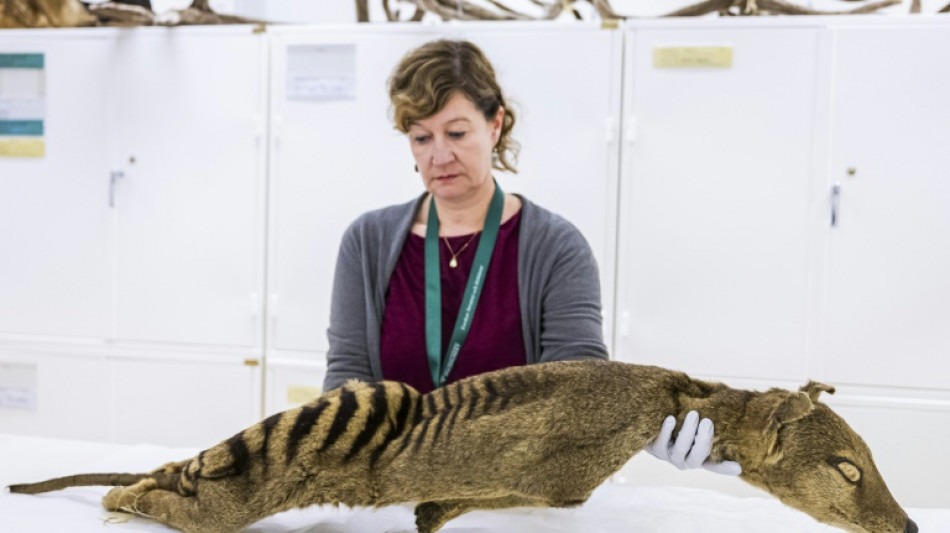
RNA recovered from extinct animal in world first / Photo: Jonathan NACKSTRAND - AFP

RNA recovered from extinct animal in world first

Scientists have for the first time recovered RNA from an extinct species, the Tasmanian tiger, raising hope for the resurrection of animals once thought lost forever, Stockholm University researchers told AFP.

Text size:

"RNA has never been extracted and sequenced from an extinct species before," said Love Dalen, a Stockholm University professor of evolutionary genomics who co-led the project.

"The ability to recover RNA from extinct species constitutes a small step (toward) maybe being able to resurrect extinct species in the future," he said.

Dalen and his team were able to sequence RNA molecules from a 130-year-old Tasmanian tiger specimen preserved at room temperature in Sweden's Museum of Natural History.

With this they were able to reconstruct skin and skeletal muscle RNA.

RNA is a molecule that is used to convey information from the genome to the rest of the cell about what it should do.

"If you're going to resurrect an extinct animal, then you need to know where the genes are and what they do, and in what tissues they are regulated," Dalen said, explaining the need for knowledge about both DNA and RNA.

The last known living Tasmanian tiger or thylacine, a carnivorous marsupial, died in captivity in 1936 at the Beaumaris Zoo in Tasmania.

After European colonisation of Australia, the animal was declared a pest and in 1888 a bounty was offered for each full-grown animal killed.

Scientists have focused their de-extinction efforts on the Tasmanian tiger as its natural habitat in Tasmania is largely preserved.

- 'Exciting idea' -

Daniela Kalthoff, in charge of the mammal collection at the Museum of Natural History, said the idea of possibly resurrecting the Tasmanian tiger was an "exciting idea".

"This is a fantastic animal and I would love to see it live again," she said, demonstrating the black-and-brown striped skin the researchers used in their study.

Their findings also have implications for studying pandemic RNA viruses.

"Many of the pandemics that have happened in the past have been caused by RNA viruses, most recently the coronavirus but also ... the Spanish flu," Dalen explained.

"We could actually go and look for these viruses in wild animal remains stored in dry museum collections. That might actually help us understand the nature of pandemics and where pandemics come from," he said.

The study opens the door to using museum collections in this new way.

"There are millions and millions of dried skins and dried tissue from insects, mammals and birds and so on in museum collections around the world, and one could actually now go and recover RNA from all these specimens," Dalen said.

U.Siddiqui--DT