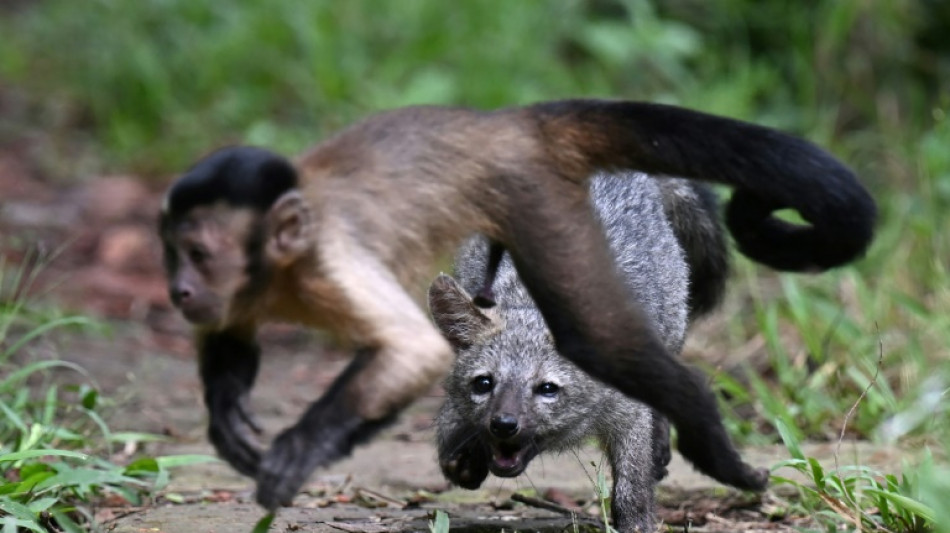
Repentant ranchers rescuing Colombian wildlife / Photo: Raul ARBOLEDA - AFP
Two newborn pumas and a convalescing porcupine share a room in the home of the Zapata family, which has renounced livestock farming to focus on stewardship of the Colombian Amazon and its animals uprooted by deforestation.
Just over a decade ago, the Zapatas decided to change their ways, and instead of cutting back trees for pasture, plant new ones.
They sold their cows and let the jungle claim back most of their land in San Jose de Guaviare in southern Colombia.
Today, the family of three work to rehabilitate animals affected in a variety of cruel ways by humanity's encroachment on nature.
They sacrificed part of their home and backyard, where for the moment they house 60 creatures, ranging from monkeys, birds and armadillos to a spotted wild cat known as an ocelot.
"This farm was dedicated to cattle raising: 56 hectares of which only about 12 (hectares) were... forest," said Dora Sanchez, who runs the ranch-turned-reserve with husband Hector Zapata, 57, and daughter Samantha, 23.
"Little by little, my family understood that (conservation) is a good thing," the 48-year-old told AFP on the former ranch now called the Nupana reserve.
"We must preserve and protect the forest, because it is the source of life... We are one hundred percent convinced that it is the jungle" that is the future, she added.
- 'Positive effect' -
Like many others in this rural department of Guaviare, the Zapatas were attracted by the dream of making a new life in a "land without men for men without land."
When Sanchez and Zapata moved there in 1997, most of the locals were raising cattle or planting coca -- the raw ingredient of cocaine, of which Colombia is the world's main producer.
Both cattle and cocaine are jungle killers and Guaviare lost some 25,000 hectares of forest just in 2021, according to authorities.
The family raised cattle for 15 years before deciding this was no longer for them. By 2012, the last cows left the farm.
"I began to do some experiments, to set up agroforestry systems and we began to see the positive effect," said Sanchez, an agroforestry engineer by training.
"The forest began to change, the fauna began to return. We improved the water conditions and the soil began to improve."
Today, the reserve has 40 hectares of jungle, said Sanchez, and tourists visit its eco trail. Some "adopt" an animal and make monthly contributions for its upkeep.
Baby animals are cared for in the family house.
Roaming free on the property, a small grey fox and a capuchin monkey that lost a leg chase each other around playfully -- among the animals too domesticated or weak to return to the wild.
Other, more potentially dangerous creatures, must live out their days in enclosures "because they do not have the necessary skills, they cannot survive, they do not recognize that a predator can attack them," said Samantha Zapata, an agronomy student.
Some of the animals at the reserve had been confiscated from people who kept them as pets or tried to sell them.
Others were found injured or abandoned in the ever-shrinking Amazon.
The Zapatas keep the wild animals separately in cages, giving them medicine and food to get them back on their feet and hopefully back to the wild.
"There are many challenges, because each animal has its own characteristics and behavior," said Hector Zapata, adding they had learnt a lot through practical experience.
"Taking care of them, guiding them step by step to a... release, I think is one of the most difficult challenges we have."
- Learn to hunt -
Samantha bottle feeds the baby pumas with mixed emotions.
"They are very beautiful and we would normally never have been able to see them so close, but it is sad because (people) killed their mother," she said.
The cubs were rescued by the CDA environmental agency and brought to the ranch after a citizen reported them abandoned in the jungle, their eyes closed and with their umbilical cords still attached.
Locals told the CDA some farmers had been killing wild cats in the area to protect their sheep.
"At the age of four, five months we will begin to give them meat... and live prey so that they can learn to hunt and can develop naturally," said Samantha Zapata.
Hopefully, "they will not be condemned to living in a cage."
A.El-Sewedy--DT